

The European standard “EN 12350 Testing of fresh concrete” consists of the following subsections published under the same title:
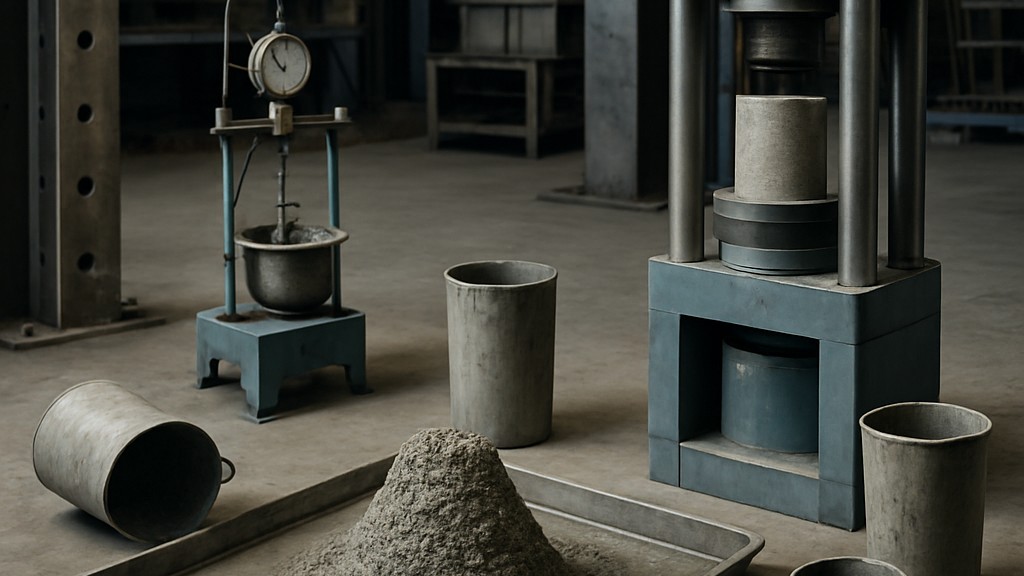
Depending on the intended use of the sample, a decision must be made whether to collect a point sample or a composite sample. A sample of at least 1,5 times the amount estimated to be required for the tests is taken. If the consistency retention properties of concrete need to be measured, the amount of concrete to be sampled should be at least 1,5 times the amount estimated for the tests and sufficient to fill the closed container, leaving a 25 mm to 50 mm gap at the lid.
In principle, fresh concrete is compacted into a cone. When the cone is pulled upward, the distance the concrete slumps provides a measure of its consistency.
In principle, fresh concrete is compacted into a slump cone. The cone is lifted from the concrete, and a transparent disc is carefully lowered onto the concrete by swinging it over the concrete and held in contact with it. The concrete slump is recorded. A vibrating table is activated, and the time it takes for the bottom surface of the transparent disc to fully contact the mortar (Vebe time) is measured.
In principle, fresh concrete is carefully placed into a compaction container using a trowel, avoiding any compaction. Once the compaction container is full, the top surface is aligned with the top surface of the compaction container. The concrete is compacted by vibration, and the distance from the surface of the compacted concrete to the top edge of the compaction container is used to determine its compressibility.
In principle, this test is intended to determine the consistency of fresh concrete by measuring the spread of concrete on a flat slab subjected to shaking.
In principle, fresh concrete is compacted into a rigid, waterproof container of known volume and mass and then weighed.
There are two testing methods, each using devices that utilize the Boyle-Mariotte law. For reference, the two methods are called the water column method and the pressure gauge method, and the devices are called the water column meter and the pressure gauge. If concrete is being tested at different points, the same procedure should be followed regardless of the method used to fill and compact the concrete in the air test vessel.
In the water column method, water is introduced into a closed air test vessel to a predetermined height above a known volume of compacted concrete sample, and a predetermined air pressure is applied to the water. The decrease in air volume in the concrete sample is measured by observing the water level, and the water column is calibrated in terms of the percentage of air in the concrete sample.
In the pressure measurement method, a known volume of air at a known pressure is combined with an unknown volume of air from the concrete sample in a closed air test vessel. The pressure measuring device dial is calibrated in terms of the percentage of air for the resulting pressure.
In principle, slump flow and t500 time are used to evaluate the fluidity and flow rate of self-compacting concrete in the absence of obstructions. The slump test is based on the slump test described in EN 12350-2. The result is an indicator of the filling ability of self-compacting concrete. t500 time is a measure of the flow rate and an indicator of the relative viscosity of self-compacting concrete. Fresh concrete is poured into a cone as used in the EN 12350-2 slump test. When the cone is pulled upward, the time from the start of the upward movement of the cone until the concrete flows to a diameter of 500 mm is measured, which is the t500 time. The largest diameter of the flow spread of the concrete and the diameter of the spread at right angles to it are then measured, and the average is the slump flow. The t500 time measurement can be omitted if not desired.
The V-funnel test is principally used to evaluate the viscosity and filling ability of self-compacting concrete. A V-shaped funnel is filled with fresh concrete, and the time it takes for the concrete to flow through the funnel is measured and recorded as the V-funnel flow time.
The L-box test is primarily used to evaluate the ability of self-compacting concrete to flow through narrow openings, including gaps between reinforcement bars and other obstructions, without segregation or clogging. There are two variations: the two-bar test and the three-bar test. The three-bar test simulates more compact reinforcement. A measured amount of fresh concrete is allowed to flow horizontally through the gaps between vertical, smooth reinforcement bars. As shown in the figure, the concrete heights at the end of the vertical section and the end of the horizontal section are measured, and the ratio is determined. This ratio provides a measure of the passing or clogging behavior of self-compacting concrete.
The sieve segregation resistance test is primarily used to evaluate the resistance of self-compacting concrete to segregation. After sampling, the fresh concrete is allowed to stand for 15 minutes, and any water leakage is noted. A specified portion of the sample is poured onto a 5 mm square sieve. After 2 minutes, the weight of the material passing through the sieve is recorded. The segregation rate is calculated as the ratio of the sample to the material passing through the sieve.
The J-ring test is principally used to evaluate the ability of self-compacting concrete to flow through narrow openings, including gaps between reinforcing bars and other obstructions, without segregation or clogging. Narrow and wide bar spacing tests are described. Narrow bar spacing simulates more closely packed reinforcement.
The J-ring test is an alternative to the L-box test in EN 12350-10, although the results are not directly comparable. The method follows the procedure detailed in EN 12350-8, except that a J-ring, consisting of a ring of evenly spaced vertical straight bars, is placed over the slump cone before it is filled with concrete. Additionally, if specified, the time it takes for the concrete to reach a diameter of 500 mm t500J should be measured.
Our organization, which has been supporting businesses across all sectors for years through a wide range of testing, measurement, analysis, and evaluation activities, has a strong team of employees who closely follow global developments in science and technology and are constantly improving themselves. In this context, we also provide testing services in accordance with the EN 12350 "Testing of Fresh Concrete" standard.
To get an appointment, to get more detailed information or to request an evaluation, you can ask us to fill in our form and reach you.

