ISO 17892 Geotechnical Investigation and Testing - Laboratory Testing of Soil
The “ISO 17892 Geotechnical investigation and testing - Laboratory testing of soil ” standard, published by the International Organization for Standardization (ISO) , consists of the following sub-sections published under the same title:
- ISO 17892-1 Part 1: Determination of water content describes a method for determining the water content of soils. This standard is applicable to the laboratory determination of the water (moisture) content of a soil test sample by oven drying in the context of geotechnical investigations. Water content is essential as a guide to the classification of natural soils and as a control criterion in recompacted soils and is measured in samples used in most field and laboratory tests. The oven-drying method is the definitive procedure used in ordinary laboratory practice. The practical procedure for determining the water content of a soil is to determine the mass loss during drying of the test sample to a constant mass in a controlled drying oven at a specified temperature. The mass loss is assumed to be due to free water and is referenced to the remaining dry mass of the solid particles. This standard meets the requirements for determining the water content of soils for geotechnical investigations and testing in accordance with EN 1997-1 and EN 1997-2.
- The standard “ISO 17892-2 Part 2: Determination of bulk density” describes three methods for determining the bulk density of soils:
- Linear measurement method: This method is suitable for determining the bulk density of a regularly shaped soil sample, including samples prepared for other tests. The samples used are rectangular prisms or cylinders of circular cross-section.
- Liquid immersion method: This method involves determining the bulk density of a natural or compacted soil sample by measuring its mass in air and its apparent mass when suspended in a liquid. This method can be used when appropriately sized pieces of material are available.
- Liquid displacement method: This method involves determining the bulk density of a soil sample by measuring its mass in air and the mass of liquid displaced by immersion. This method can be used when appropriately sized pieces of material are available.
This standard is applicable to the laboratory determination of bulk density of soil within the scope of geotechnical investigations.
If the liquid immersion method or liquid displacement method is used and there is a possibility of liquid penetration into the sample (e.g., water), the sample should be covered before testing to prevent liquid penetration. The bulk density of a soil is useful in determining in-situ overburden stress as a function of depth. If necessary, the dry density of a sample can be calculated from the bulk density and water content, if known.
This standard meets the requirements for determining the bulk density of soils for geotechnical investigation and testing in accordance with EN 1997-1 and EN 1997-2 standards.
- ISO 17892-3 Part 3: Determination of particle density describes methods for determining the particle density of soils. This standard is applicable to the laboratory determination of soil particle density for geotechnical investigations and describes two methods: the liquid displacement pycnometer method and the gas displacement pycnometer method. The liquid pycnometer method described in this standard is applicable to soil types with particle sizes below approximately 4 mm or to soils crushed to meet this requirement. Larger pycnometers are used for coarser materials. The particle size of soils suitable for gas pycnometer testing is limited by the sample container dimensions of the particular gas pycnometer used. This standard meets the requirements for determining the particle density of soils for geotechnical investigations and testing in accordance with EN 1997-1 and EN 1997-2. The presence of dissolved salts in the pore water may affect the results of these tests. Techniques for compensating for dissolved salts are available but are beyond the scope of this standard.
- ISO 17892-4 Part 4: Determination of Particle Size Distribution describes a method for determining the particle size distribution of soils. This standard is applicable to the laboratory determination of the particle size distribution of a soil test sample for geotechnical investigations by sieving, sedimentation, or a combination of both. Particle size distribution is one of the most important physical properties of soil. Soil classification is primarily based on particle size distribution. Many geotechnical and geohydrological soil properties are related to particle size distribution. Particle size distribution provides a soil description based on the division of particle sizes into discrete classes. The size of each class can be determined by sieving or sedimentation. Coarse soils are usually tested by sieving, but fine and mixed soils are often tested by a combination of sieving and sedimentation, depending on the soil composition. The sieving method described is applicable to all uncemented soils with particle sizes smaller than 125 mm. Two sedimentation methods are described: the hydrometer method and the pipette method. This standard meets the requirements for particle size distribution testing in accordance with EN 1997-2.
- The standard "ISO 17892-5 Part 5: Incremental Load Oedometer Test" describes methods for determining the compressibility of soils by incremental loading in an oedometer. This standard is applicable to the laboratory determination of soil compression and deformation properties within the context of geotechnical investigations. The oedometer test is performed on a cylindrical test specimen laterally confined by a rigid ring. The specimen is subjected to discrete increments of vertical axial loading or unloading and is allowed to discharge axially from the top and bottom surfaces. Tests can be performed on intact, remolded, recompacted, or reconstituted specimens. Stress paths and drainage conditions in foundations are typically three-dimensional, and variations in the calculated values of both magnitude and slump ratio can occur. The small size of the specimen often does not adequately represent the texture characteristics found in natural soils. Consolidation test analyses are often based on the assumption that the soil is saturated. In unsaturated soils, some of the derived parameters may not be suitable. This standard meets the requirements for determining the compressibility properties of soils within the oedometer for geotechnical investigation and testing in accordance with EN 1997-1 and EN 1997-2 standards.
- ISO 17892-6 Part 6: Falling cone test describes a method for testing the undrained strength index of both intact and reformed samples of fine-grained soils using the falling cone method. This standard is applicable to the laboratory estimation of the undrained shear strength of a soil test specimen in geotechnical investigations. In the falling cone test, a cone is allowed to fall with its tip toward a soil sample, and the penetration of the cone into the soil is measured. The penetration values are used to estimate the undrained shear strength.
The drop cone test produces complex shear in the test specimen and is not representative of either vertical triaxial compression or horizontal shear testing. However, this index test can be correlated with some estimates of undrained shear strength determined by other laboratory test methods. Because the test is performed on a small laboratory sample, the results may not agree with laboratory tests performed on larger samples. In addition, the test sample may not fully represent the soil in its natural state in the field; for example, the test sample may not have in situ cracks spaced greater than the sample size. Therefore, the test can be considered an estimate of undrained shear strength rather than a true measurement. The ratio of the reconstituted shear strength to the intact shear strength can be used to estimate the susceptibility of a soil sample. The measurement of shear strength over time can be used to evaluate the thixotropic strength recovery of a reconstituted soil sample. This document meets the requirements for strength index testing of soils for geotechnical investigation and testing in accordance with EN 1997-1 and EN 1997-2.
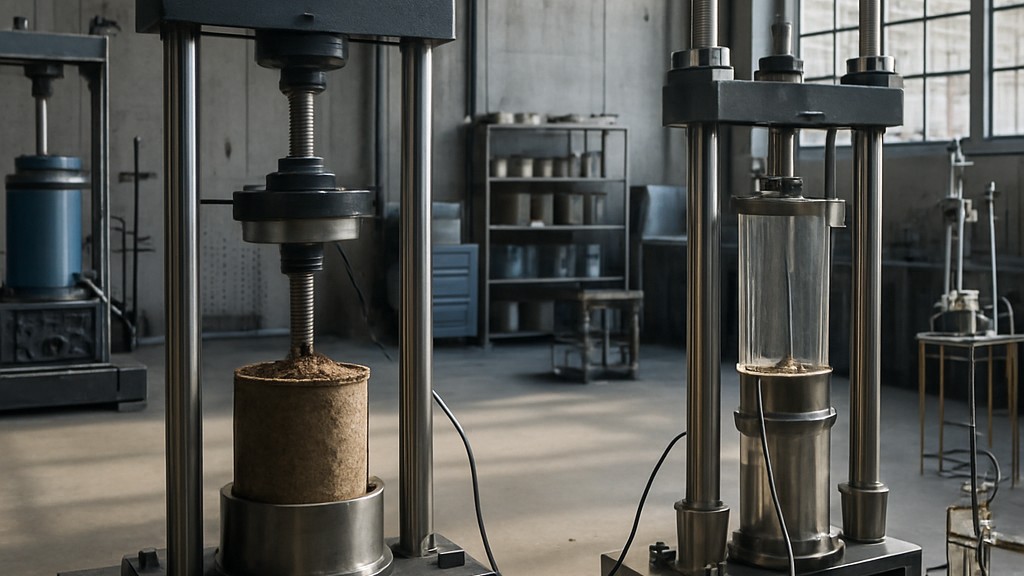
- ISO 17892-7 Part 7: Unconfined Compression Testing describes a method for unconfined compression testing. This standard is applicable to the determination of the unconfined compressive strength of a homogeneous soil sample that has been undisturbed, recompacted, remoulded, or reconstituted under compressive loading in the context of geotechnical investigations. This test method is useful for estimating the undrained shear strength of soil. It should be noted that drainage is not impeded during this test. Therefore, the estimated value for undrained shear strength is only valid for low-permeability soils that behave insufficiently drained during the test. This standard meets the requirements for unconfined pressure tests for geotechnical investigations and testing in accordance with EN 1997-1 and EN 1997-2.
- ISO 17892-8 Part 8: Unconsolidated, undrained triaxial compression tests describes a method for unconsolidated, undrained triaxial compression tests. This standard is applicable to the laboratory determination of undrained triaxial shear strength under compressive loading in the context of geotechnical investigations. A cylindrical specimen, which may include intact, recompacted, remoulded, or reconstituted soil, is subjected to isotropic tension under undrained conditions and then sheared under undrained conditions. The test allows the determination of shear strength and stress-strain relationships in terms of total stresses. Non-standard procedures, such as tests in which pore pressure is measured or tests with filter drainage, are not covered by this standard. This standard meets the requirements for unconsolidated, undrained triaxial compression tests for geotechnical investigations and testing in accordance with EN 1997-1 and EN 1997-2.
- The standard "ISO 17892-9 Part 9: Consolidated triaxial compression tests on water-saturated soils" describes a method for consolidated triaxial compression tests on water-saturated soils. This standard is applicable to the laboratory determination of triaxial shear strength under compressive loading in the context of geotechnical investigations. A cylindrical specimen, which may consist of intact, recompacted, remolded, or reconstituted soil, is subjected to isotropic or anisotropic stress under drained conditions and then sheared under undrained or drained conditions. The test allows the determination of shear strength, stress-strain relationships, and effective stress paths. All stresses and strains are expressed as positive numerical values in compression.
This standard provides one test for a single specimen. A minimum of three related test sets are required to determine shear strength parameters from these tests. Procedures for evaluating the results are included in the standard appendix (Annex B), and, where necessary, shear strength parameters are included in the report.
The following special procedures are not fully covered in this procedure:
- Tests with lubricated tips
- Multi-stage tests
- Zero lateral stress consolidation tests
- Tests with local measurement of stress or local measurement of pore pressure
- Tests without rubber membranes
- Extension tests
- Shear tests with cell pressure changes
However, these specific tests may refer to the general procedures described in this standard. This standard specifies the requirements for consolidated triaxial compression tests for geotechnical investigation and testing in accordance with EN 1997-1 and EN 1997-2.
- ISO 17892-10 Part 10: Direct shear tests describes two laboratory test methods for determining the effective shear strength of soils under consolidated, drained conditions using a shear box or ring shear device. This standard is applicable to the laboratory determination of effective shear strength parameters for soils under direct shear in the context of geotechnical investigations. The tests in this standard are for undisturbed, remolded, recompacted, or reconstituted soils. The procedure describes the requirements for determining the shear strength of a specimen under a single vertical (normal) stress.
Typically, three or more similar samples of a soil are prepared for shearing under three or more different vertical pressures to enable shear strength parameters to be determined in accordance with Annex B. Specific procedures for sample preparation and testing, such as tests involving progressive loading and pre-shearing or interfaces between soils and other materials, are not covered in the procedures of this standard. This standard meets the requirements for determining the drained shear strength of soils under direct shear for geotechnical investigation and testing in accordance with EN 1997-1 and EN 1997-2.
- The standard "ISO 17892-11 Part 11: Permeability tests" describes methods for the laboratory determination of water flow properties in soil. This standard is applicable to the laboratory determination of soil permeability coefficients within the scope of geotechnical investigations. This standard fulfills the requirements for the laboratory determination of soil permeability coefficients for geotechnical investigations and testing in accordance with EN 1997-1 and EN 1997-2.
- ISO 17892-12 Part 12: Determination of liquid and plastic limits describes methods for determining the liquid and plastic limits of a soil. These include two Atterberg limits for soils. The liquid limit is the water content at which a soil transitions from a liquid to a plastic state. This standard describes the determination of the liquid limit of a natural soil sample or a soil sample from which material greater than approximately 0,4 mm has been removed. This standard describes two methods: the falling cone method and the Casagrande method. The falling cone method in this standard should not be confused with the method described in ISO 17892-6. The plastic limit of a soil is the water content at which the soil ceases to be plastic upon further drying. The determination of the plastic limit is normally done in conjunction with the determination of the liquid limit. It is recognized that test results are subject to operator judgment and that some variability in results will occur.
- The standard "ISO 17892-13 Part 13: Swelling testing of soils, hard soils and soft rocks - Single sample cycle procedure" describes methods for determining the swelling properties of soft rocks or hard soils in an oedometric cell, i.e., limited lateral deformation under axial loading. This standard is applicable to the laboratory determination of swelling pressure and stress within the context of geotechnical investigations. The results of the swelling tests are used for the design of rock and soil supports and linings for excavations and tunneling in swollen rock to prevent major unplanned failures due to swelling. The swelling test is performed on an intact cylindrical specimen. The specimen is first loaded to the in-situ stress state in the dry state, unloaded, and reloaded to the expected design stress. The specimen is immersed under constant stress conditions and then unloaded.
Our organization, which has been supporting businesses across all sectors for years with a wide range of testing, measurement, analysis, and evaluation activities, has a strong team of employees who closely follow global developments in science and technology and are constantly improving themselves. In this context, we also provide testing services in accordance with the "ISO 17892 Geotechnical Research and Testing - Soil Laboratory Testing" standard.



