

The European standard "EN 789 Timber structures - Test methods - Determination of mechanical properties of wood-based panels" describes test methods for determining some mechanical properties of commercial wood-based panel products for use in load-bearing timber structures. These specifications are designed to calculate characteristic values for use in deriving material design values.
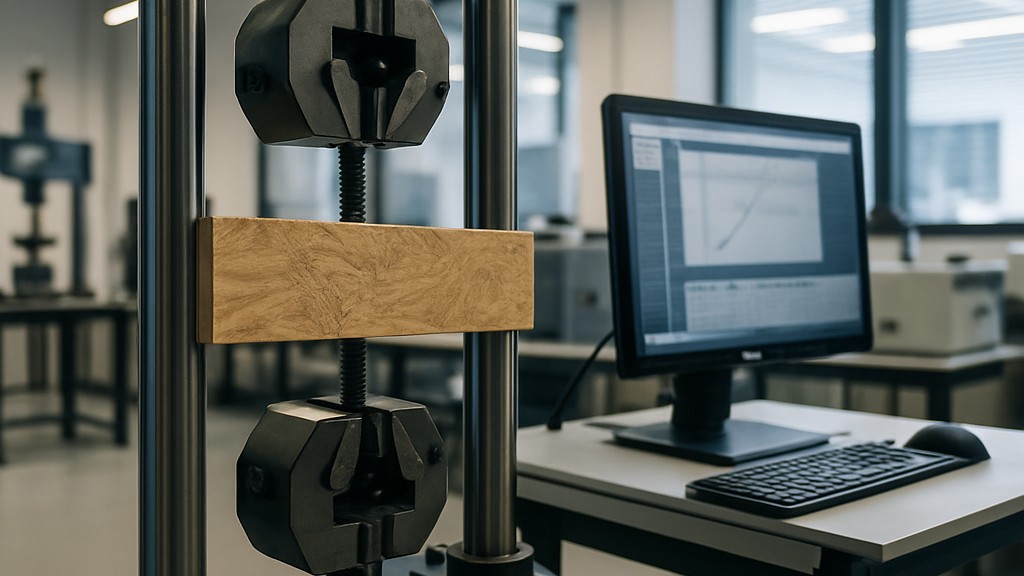
As defined in the EN 13986 standard for wood-based panels, it is necessary to determine the characteristic values of mechanical properties for each type and quality of load-bearing panel product that will enable it to be used for structural purposes. This standard describes in detail the tests required to determine these characteristic values. Unless there is reason to suspect a significant change in the product's properties, the tests need only be performed once for each product.
Characteristic values for panels of certain types and qualities are given in the EN 12369 standard and these can be used for panels conforming to this standard without additional testing.
This standard is not intended for use in quality control tests where smaller test pieces than specified here are sufficient. Due to limited experience, the test method for compression perpendicular to the plane of the panel (bearing) is included in Annex D.
In the world of sustainable construction, timber structures stand out for their renewability, carbon sequestration potential, and aesthetic appeal. However, the wood-based panels such as plywood, oriented strand board, and particle board that form the backbone of these environmentally friendly structures must withstand rigorous mechanical demands to ensure safety and longevity. The EN 789 standard provides a method for assessing the strength and stiffness of these materials under load-bearing conditions. With the growing emphasis on green building regulations across the EU, the EN 789 standard remains a cornerstone for engineers and manufacturers seeking to certify panels for structural use.
The resurgence of wood in modern architecture, from modular housing to high-rise hybrid structures, has increased the need for reliable materials. Wood-based panels, made from compressed wood fibers, strands, or veneers, offer versatility for floors, walls, roofs, and framing. However, their performance varies depending on factors such as moisture content, density, and manufacturing processes. Without standardized testing, inconsistencies can lead to structural failures, compromising safety and increasing costs.
Prior to the EN 789 standard, the various existing tests and national methods made implementation challenging. This standard harmonizes all of these in a single protocol. It is aligned with the EU Construction Products Directive (CPR) and contributes to the standards that declare performance characteristics for CE marking.
The EN 789 standard contains precise and repeatable methods for evaluating fundamental mechanical properties, such as flexural strength and modulus of elasticity, shear strength, and compressive and tensile strength. Representative samples are taken from production batches, subjected to equilibrium humidity (typically 65 percent relative humidity at 20 degrees Celsius), and tested using universal testing machines. The results account for variability, and characteristic values are calculated according to the EN 1058 standard (e.g., 5th percentile for strength, adjusted for size effects).
The test methods defined in this standard are:
These methods emphasize accuracy: dimensions are measured to within 0,1 mm, loads are calibrated to plus/minus 1 percent, and density/humidity is verified according to EN 322. A recent update addresses real-world warping risks by improving edge warping for thin panels.
Ultimately, the EN 789 standard is not just a testing protocol; it's the reliability engine powering the rebirth of wood. By measuring the unwavering durability of wood-based panels, it builds confidence in safe, sustainable, and innovatively constructed structures.
Our organization, which has been serving for many years and meticulously following global developments in science and technology, employs a skilled team and extensive infrastructure to conduct testing, measurement, and analysis in a wide range of areas for businesses across all sectors. In this context, we also provide testing services in accordance with the EN 789 Timber structures - Test methods - Determination of mechanical properties of wood-based panels standard.
To get an appointment, to get more detailed information or to request an evaluation, you can ask us to fill in our form and reach you.

