

The standard “EN ISO 8497 Thermal insulation - Determination of steady-state heat transfer properties of thermal insulation for circular pipes”, which is based on a European standard and published by the International Organization for Standardization (ISO), specifies the device performance requirements but does not define the device design. This standard is generally applicable to circular pipes operating at temperatures above ambient temperature. The sample type, temperatures and test conditions to which this standard applies are specified in detail in the standard.
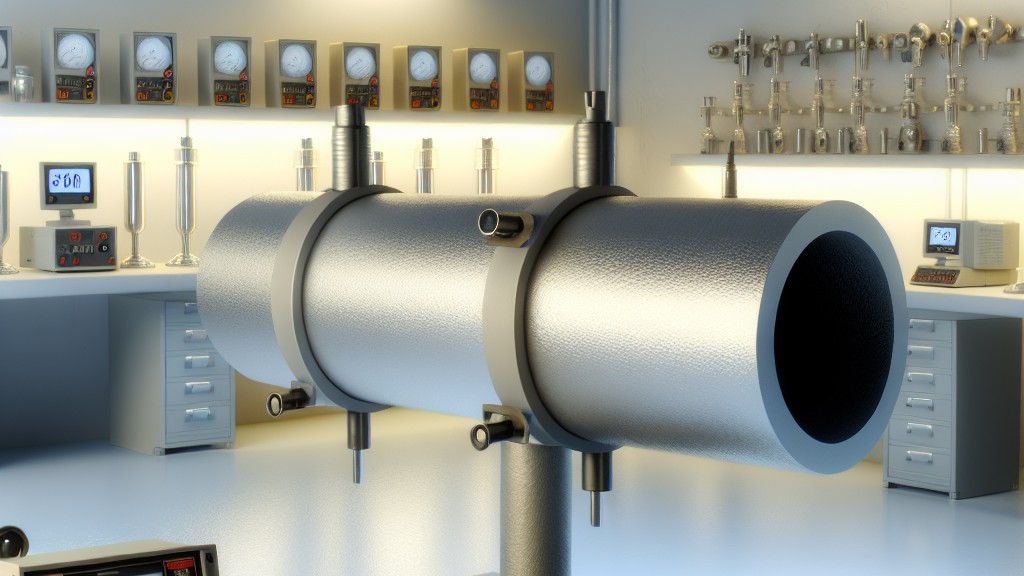
The geometry of pipe insulation requires special terms that do not apply to flat specimens. The concept of linear is used to specify properties based on unit length (in the direction of the pipe axis) of a given insulation dimension. These linear properties are useful because the total heat loss can be calculated knowing the pipe length and the applicable temperature. The concept of linear does not specify the heat flow in the axial direction. In this standard, the direction of heat flow is predominantly radial.
For the purposes of this standard, the definitions and symbols given are based on the definitions and symbols given in ISO 7345, with the exception of linear thermal transfer. In addition,
Test specimens may be rigid, semirigid or flexible (blanket type) or loosely packed as appropriate. They may be homogeneous or non-homogeneous, isotropic or anisotropic, contain slots, joints or metallic elements, and may include jackets or other coatings. Specimens shall be uniform in size and shape throughout their length (except for intentional irregularities occurring well within the dimensioned test section) and shall be designed for use in tubes of the same size as the test apparatus in place. Specimens shall generally have a circular outer shape concentric with the bore; other outer shapes are permissible but only thermal transfer can be determined.
The tube may be operated at temperatures up to the maximum service temperature of the sample or the materials used in the construction of the instrument. The lower limit of the tube temperature is determined by the constraint that it is sufficiently greater than the temperature of the external surface of the sample to provide the required measurement accuracy. Normally, the instrument is operated in still air maintained at an ambient temperature of 15°C to 35°C, but this can be extended to other temperatures, other gases and other velocities. The external sample surface temperature may also be controlled by the use of a heated or cooled outer sheath or blanket or by the use of an additional layer of insulation. If a cool outer sheath or jacket is used, operation at lower temperatures is possible provided the tube is maintained at a higher temperature.
The test tube shall have a circular cross-section. The test tube shall normally have a horizontal orientation. Other orientations may be used, but special considerations must be given because of possible convection effects both in and around the test tube and the sample.
Two distinctly different types of pipe devices are considered in this standard: the shielded end and the calibrated or calculated end types, which differ in the treatment of axial heat transfer at the ends or in the test section, with samples containing elements with high axial conductivity such as metallic jackets being tested only in the shielded end type device.
Linear thermal transfer can be calculated for all samples and is the most useful property in measuring pipe insulation performance. Knowing its value and the average temperatures of the pipe and surrounding ambient air, the heat loss for a given length of insulated pipe can be calculated directly, provided that the conditions of use are comparable to the test conditions.
Thermal conductivity is often used in properties. In theory, it can only be calculated for homogeneous specimens of concentric circular shape that fit tightly into the test tube without an air gap. In practice, it is often necessary to deviate from ideal conditions if the resulting errors are judged to be acceptable. Thermal conductivity is useful in deriving linear transfer or other properties for insulation dimensions other than those of normal measurement. Other properties may be used when appropriately specified.
Our organization, which has been trying to support businesses from every sector with its testing, measurement, analysis and evaluation studies carried out in a wide range for years, has a strong staff that closely follows the developments in the world in the field of science and technology and constantly improves itself. In this context, testing services in accordance with the standard "EN ISO 8497 Thermal insulation - Determination of steady-state heat transfer properties of thermal insulation for circular pipes" are also provided to businesses.
To get an appointment, to get more detailed information or to request an evaluation, you can ask us to fill in our form and reach you.

