

A European standard, “EN 318 Wood-based panels - Determination of dimensional changes associated with changes in relative humidity”, describes a method for determining dimensional changes in wood-based panels due to changes in relative humidity in the air.
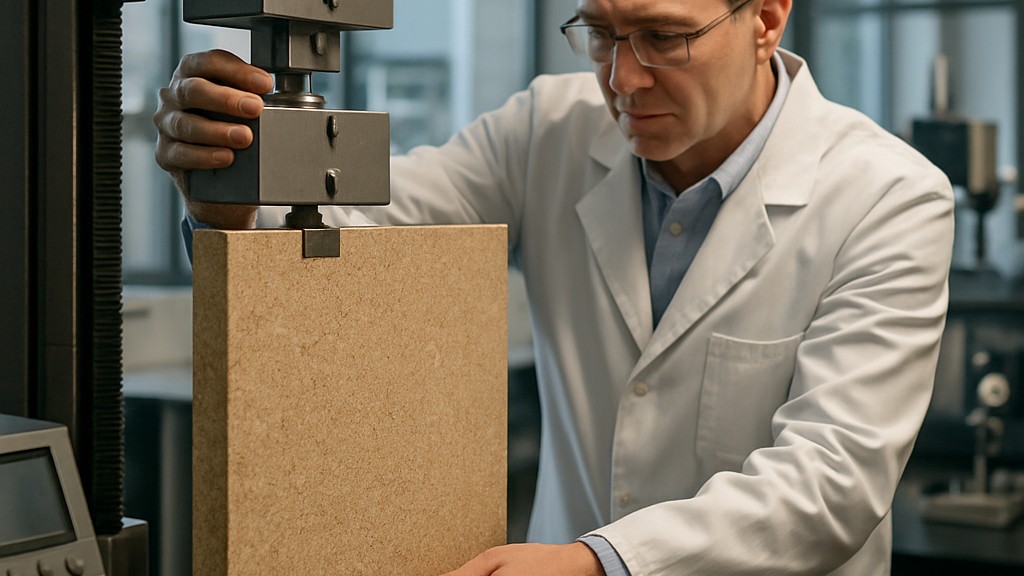
Because changes in relative humidity fundamentally affect the moisture content of a panel and lead to changes in its dimensions, test pieces are measured after exposure to different relative humidity levels. The equilibrium moisture content of panel products depends on the moisture change history. For any given relative humidity, higher equilibrium moisture contents are achieved during desorption than during adsorption, resulting in a hysteresis effect (the dependence of a system's state on its history). To obtain true dimensional change, measurements are made between 65 and 85 percent relative humidity during adsorption and between 65 and 30 percent relative humidity during desorption.
The standard test piece dimensions are 300 mm plus or minus 2 mm and a thickness of 50 mm plus or minus 2 mm, although longer test pieces can also be used. Two sets of four test pieces are cut from each panel in each panel direction, resulting in a total of 16 test pieces per panel. Standard EN 326-1 applies to the general conditions for sampling test pieces.
To ensure that measurements are taken in the same location each time, test pieces should be prepared with appropriate markings. Marks are placed on the centerline of the test piece, 50 mm from the ends and at its midpoint. Ink markings on the surface of the test piece are considered sufficient. Other marking types may be used if proven accurate.
A suitable reference system consists of glass plates at least 1 mm thick glued to the ends of the test piece. An alternative reference system consists of metal buttons spaced approximately 25 mm from each end, 250 mm apart. The buttons can be mechanically fixed or glued to the surface of the test piece. The adhesive must not be water-based or hygroscopic. Other reference systems may be used if proven to provide accurate results.
Two sets of test pieces are processed separately and each is conditioned in three steps. The test pieces are conditioned to a constant mass in each step listed in the table. Length, thickness, and mass are then measured.
Constant mass is considered to have been achieved when the results of two consecutive weighings carried out at 24-hour intervals do not differ by more than 0,1 percent from the mass of the test piece. The climate should be measured and recorded at least once an hour during the conditioning of the test pieces.
After the conditioning periods, the following parameters should be measured on the test pieces:
All measurements must be carried out in the conditioning atmosphere or within 5 minutes of removing the test pieces from the conditioning chamber.
After the test, the test pieces must be dried according to the EN 322 standard and then weighed.
In the world of construction and woodworking, precision is paramount. Materials must withstand environmental fluctuations without compromising structural integrity or aesthetic appeal. This is where EN 318, which plays a crucial role in ensuring the reliability of wood-based panels, comes into play. This standard provides a standardized method for measuring how panels such as plywood, particleboard, and fiberboard respond to humidity changes. This standard helps manufacturers, engineers, and builders select materials that perform consistently under real-world conditions.
The EN 318 standard remains a cornerstone for the timber industry. It continues to influence global building codes by emphasizing sustainability, as wood products are increasingly preferred for their environmentally friendly profile.
Wood is hygroscopic, meaning it absorbs and releases moisture from the air. Relative humidity, the ratio of the amount of water vapor in the air to the maximum amount it can hold, can vary significantly in homes, offices, or outdoor structures. A sudden drop in relative humidity can cause paneling to shrink and cause cracks or gaps in flooring or cabinets. Conversely, high humidity can cause swelling, warping floors, or jamming of doors.
The EN 318 standard addresses these issues by measuring dimensional changes, specifically linear expansion or contraction along the length and width of panels. This data is vital for:
Without such testing, wood products may underperform, leading to costly repairs or safety risks in load-bearing applications.
In short, the EN 318 standard measures the impact of moisture on wood-based panels, laying the foundation for safer and more durable building environments. Whether for a contractor supplying materials or a laminate flooring installer, understanding this standard enables informed choices. As demand for renewable materials grows, this standard, combining woodworking with modern engineering, will continue to be indispensable.
Our organization, with its competent and experienced team, has been understanding the needs of its customers for years, providing them with the advanced testing services they need, and assisting them in the establishment, implementation, and improvement of management systems. In this context, we also provide testing services in accordance with the EN 318 Wood-based panels - Determination of dimensional changes associated with changes in relative humidity standard.
To get an appointment, to get more detailed information or to request an evaluation, you can ask us to fill in our form and reach you.

