

The European standard "EN 310 Wood-based panels - Determination of modulus of elasticity in bending and flexural strength" describes a method for determining the apparent modulus of elasticity in straight bending and flexural strength of wood-based panels with a nominal thickness of 3 mm or greater. Structural design values should be determined according to "EN 789 Timber structures - Test methods - Determination of mechanical properties of wood-based panels."
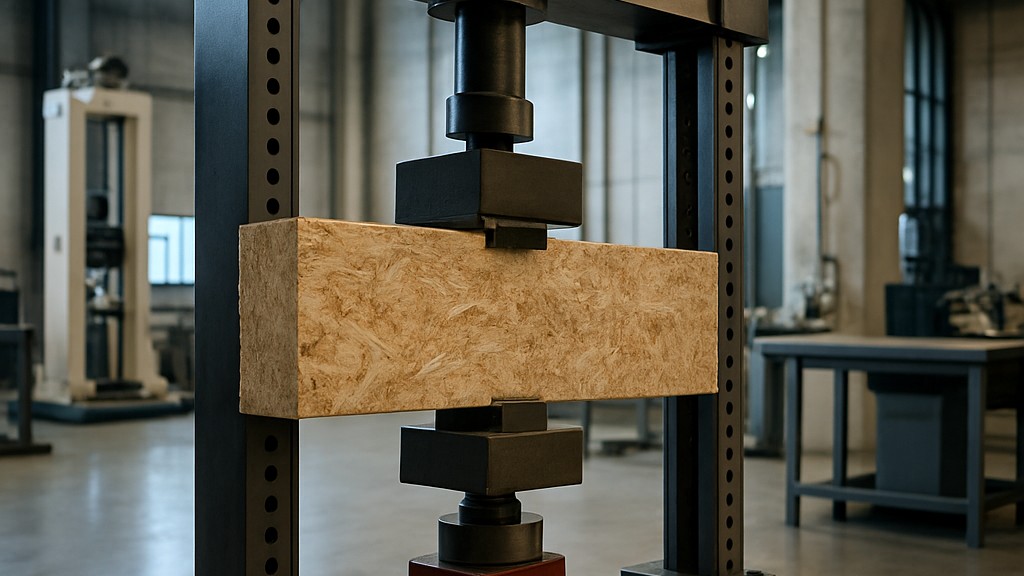
In principle, the modulus of elasticity and flexural strength in bending are determined by applying a load to the center of a test piece supported at two points. The modulus of elasticity is calculated using the slope of the linear region of the load-deflection curve. The calculated value is the apparent modulus, not the test modulus, because the test method involves shear as well as bending. The flexural strength of each test piece is determined by determining the ratio of the bending moment at maximum load to the full-section moment.
Sampling and cutting of test pieces must be carried out in accordance with EN 326-1. A series of both transverse and longitudinal test pieces is required. The test pieces must be rectangular and have a width of 50 mm plus/minus 1 mm.
In the case of extruded panels, cellular panels, or panels of similar construction with cavities parallel to the length of the test piece, the width of the test piece should be at least the width of a single core element (e.g., two pipe diameters plus two web thicknesses) and the test pieces should have a symmetrical cross-sectional area as shown in the figure given in the standard.
For test pieces with gaps perpendicular to the length, the loading head should be placed directly on a web. The length should be 20 times the nominal thickness plus 50 mm, with a maximum length of 1050 m and a minimum length of 150 mm.
If the test piece deflection is large but fracture does not occur, the distance between supports for testing flexural strength should be reduced. The test report should include the distance between supports where the fracture tests were performed. If this procedure is necessary, a new set of test pieces should be used.
Plywood test pieces should be free from visible strength-reducing features.
Test pieces shall be conditioned to constant mass in an atmosphere having a relative density of 65 percent plus or minus 5 percent and a temperature of 20 degrees Celsius plus or minus 2 degrees Celsius. Constant mass is considered to have been achieved when the results of two successive weighings, carried out 24 hours apart, do not differ from the weight of the test piece by more than 0,1 percent.
While testing, the edge and thickness of each test piece are measured at the following points according to the EN 325 standard:
The distance between the centres of the supports is adjusted to within 1 mm of 20 times the nominal panel thickness, but not less than 100 mm and not more than 1000 mm. The distance between the centres of the supports is measured to the nearest 0,5 mm. The test piece is placed flat on the supports with the longitudinal axis perpendicular to the axes of the supports, with the centre point under load. The load shall be applied at a constant crosshead speed throughout the test. The loading rate shall be adjusted so that the maximum load is reached within 60 seconds plus/minus 30 seconds. The deflection at the centre of the test piece (immediately below the loadhead) is measured to the nearest 0,1 mm, and this value is plotted against the corresponding measured loads to the nearest 1 percent of the measured value. If the deflection is determined by incremental readings, at least six pairs of reading instruments shall be used. The maximum load shall be recorded to the nearest 1 percent of the measured value.
Tests are performed on two groups of test pieces along the board's two orientations, longitudinal and transverse. In each group, half of the test pieces are tested with the top face up and half with the bottom face up.
In short, the EN 310 standard covers the testing method for the flexural properties of wood-based panel products such as plywood, particleboard, oriented strand board, and medium-density fiberboard (MDF). These mechanical properties are critical for evaluating the performance of materials in structural or load-bearing applications.
The primary objective of this standard is to establish a uniform test method to evaluate:
These values are key indicators of a material's mechanical behavior and structural performance. The modulus of elasticity is calculated from the slope of the load-deflection curve in the linear elastic region. Flexural strength is derived from the maximum load at fracture.
The EN 310 standard is used by:
This standard is particularly important in the context of engineering, construction, and product quality for wood-based panels. This standard is considered important for the following reasons:
Consequently, the EN 310 standard plays a key role in the mechanical testing and standardization of wood-based panels. By measuring modulus of elasticity and flexural strength, it provides critical data that supports structural integrity, product development, and compliance across a wide range of industries. It ensures that materials used in construction and manufacturing are both safe and fit for purpose.
Our organization, which has been supporting businesses across all sectors for years through a wide range of testing, measurement, analysis, and evaluation activities, boasts a strong team of employees who closely follow global developments in science and technology and are constantly improving themselves. In this context, we also provide testing services in accordance with the EN 310 Wood-based panels - Determination of modulus of elasticity and flexural strength in bending standard.
To get an appointment, to get more detailed information or to request an evaluation, you can ask us to fill in our form and reach you.

