

A European standard “EN 15817 Polymer-modified bituminous thick coatings for waterproofing - Water resistance” describes a procedure for determining the water resistance of polymer-modified bituminous thick coatings for waterproofing purposes.
For the purposes of this standard, the terms and definitions given in the EN 15814 standard apply.
Polymer-modified bitumen coatings are widely used for waterproofing in construction due to their excellent flexibility, crack-bridging ability, and resistance to moisture and chemicals. This material is commonly used in:
Polymer modified bitumen thick coatings are used for the following reasons:
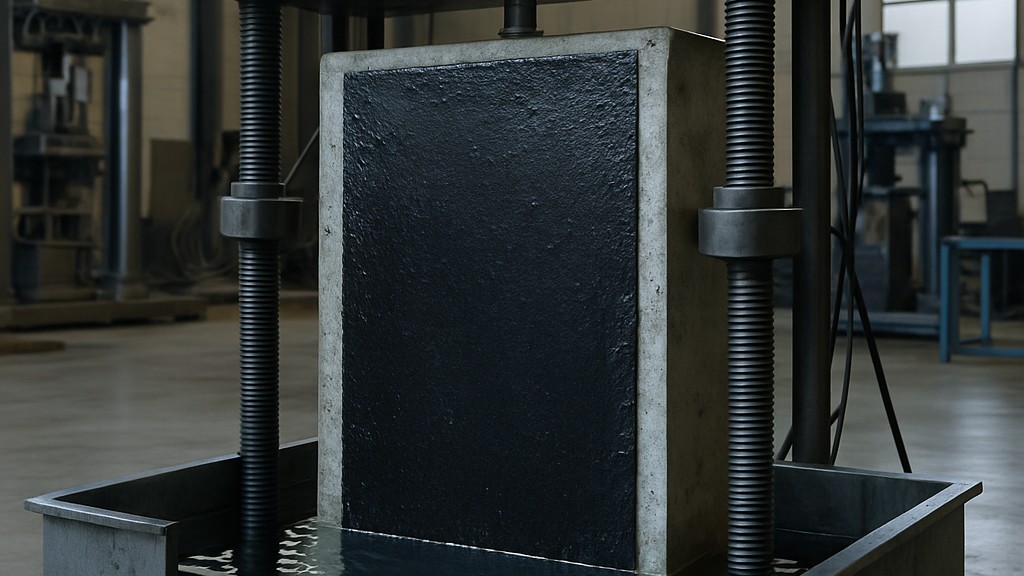
After preparing a flexible layer of polymer-modified bitumen emulsion, the sample is stored in room-temperature water for 28 days. At the end of this period, a visual assessment is performed.
A glass beaker containing 2,5 liters of tap water is used for the tests. The sample dimensions must be at least 90 mm × 250 mm. The sample is placed so that two-thirds of it is submerged and one-third is not. The sample is suspended in the center of the beaker, surrounded by water on all sides. A magnetic stirrer is also used in the tests.
The polymer bitumen emulsion component must be conditioned for 28 days in accordance with ISO 554 under normal climatic conditions of 23°C (plus/minus 2°C) and 50% (plus/minus 5%) relative humidity. The wet coating should be leveled using a frame or foil gauge at room temperature, as specified by the manufacturer, to achieve the specified dry layer thickness of 4 mm (plus/minus 0,4 mm). The sample size depends on the size of the container. If necessary, filler material should be added.
After storage in a normal climate, the sample should be kept in a container of water for 28 days. During this period, the water should be constantly stirred gently using a magnetic stirrer.
After 28 days, a visual assessment should be made to see if there is any change in the material, whether the reinforcement is peeling or whether the water color has changed.
The purpose of the EN 15817 standard is to determine the adhesion strength of polymer-modified bitumen coatings applied to mineral substrates (e.g., concrete, masonry). These coatings are widely used in construction for waterproofing basements, foundations, and underground structures.
The EN 15817 standard is important for many reasons, particularly in the context of waterproofing and building materials. The main reasons for its importance are:
Consequently, the EN 15817 standard is in high demand because it ensures the reliable, safe, and effective adhesion of bituminous waterproofing systems to building surfaces. It enhances the reliability, performance verification, and confidence in building materials needed to protect structures against moisture and water damage.
Our organization, which has been supporting businesses across all sectors for years through a wide range of testing, measurement, analysis, and evaluation activities, has a strong team of employees who closely follow global developments in science and technology and are constantly improving themselves. In this context, we also provide testing services in accordance with the EN 15817 standard for polymer-modified bituminous thick coatings for waterproofing - Water resistance.
To get an appointment, to get more detailed information or to request an evaluation, you can ask us to fill in our form and reach you.

