

A European standard, “EN 15812 Polymer-modified bituminous thick coatings for waterproofing - Determination of crack-bridging ability” describes two methods for determining the crack-bridging properties of polymer-modified bituminous thick coatings for waterproofing: Method A and Method B. Both test methods are equally applicable.
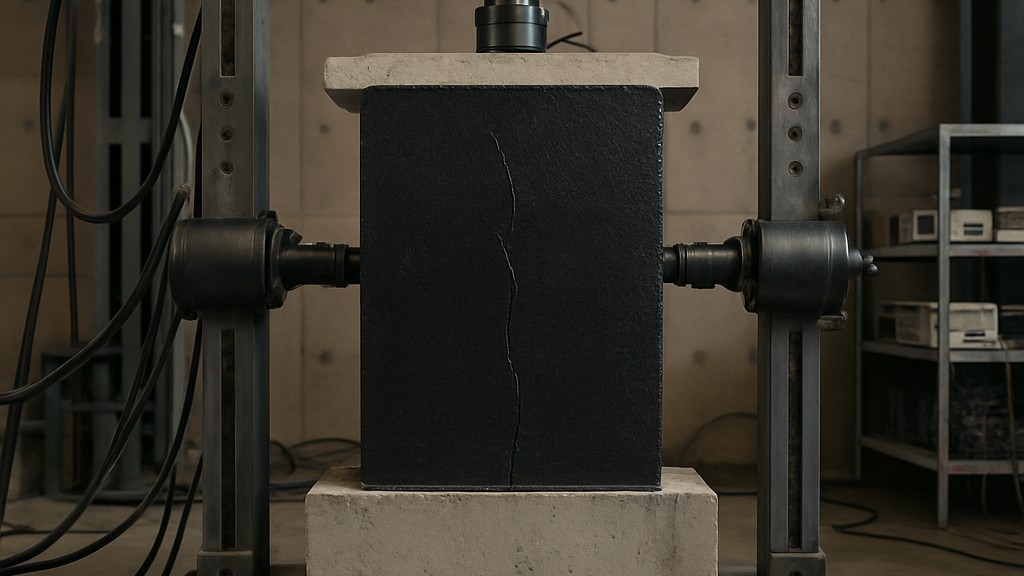
For the purposes of this standard, the terms and definitions given in EN 15814 apply. Crack-bridging ability refers to the ability of a product to bridge a crack under specified conditions without damage.
In principle, after the substrate is coated, a distinct crack is created in the substrate at a nominal crack point. The applied bitumen coating is stretched over this crack. Mechanical tension is applied to the bitumen coating. The crack width is continuously widened at the specified rate. The measurement is completed when damage to the bitumen coating occurs or when the required crack width is reached. The required crack width is held constant for 24 hours. At the end of this period, a visual assessment is performed. Crack-bridging properties are determined at a specific temperature.
According to this standard, two different test methods can be applied:
The testing device used in these tests must ensure that crack movement is within specified limits and that crack slippage (horizontal and vertical movement) is prevented during measurement. It must be equipped with a device to maintain the temperature at which crack bridging properties are to be determined (normally 4°C). The tolerance for the test temperature should be plus/minus 1°C.
Sample preparation should be carried out in accordance with the manufacturer's instructions. Preparation is generally carried out at room temperature. At least two test samples are used in each test.
When using Method A, the test piece is a reinforced concrete slab measuring 300 mm x 200 mm x 40 mm. Concrete slabs are manufactured and stored in accordance with EN 1766, with a maximum aggregate size of 8 mm. The surface of the concrete slab must be free of substances that could affect adhesion. After curing in accordance with EN 1766, the concrete slabs must be stored for at least 7 days at a normal climate of 23 degrees Celsius plus/minus 2 degrees Celsius and a relative humidity of 50 percent plus/minus 5 percent, in accordance with ISO 554, before coating.
Concrete slabs should be coated according to the manufacturer's instructions, with a 150 mm wide strip along the entire length of the slab. A 25 mm wide strip is left uncovered along the longitudinal edges of the slab surface to detect cracks during crack bridging tests. Test pieces are cured and stored in a climate consistent with the manufacturer's instructions (normally 23°C plus/minus 2°C and 50% plus/minus 5% relative humidity). The wet layer thickness should be adjusted to achieve the desired dry layer thickness after drying, with a 10% tolerance. The dry layer thickness should be the lowest possible, but not less than 3 mm. To achieve the specified dry layer thickness, the wet layer should be leveled using a frame or jig of appropriate height.
The test specimens are then conditioned for 28 days at a normal climate of 23 degrees Celsius plus/minus 2 degrees Celsius and a relative humidity of 50 percent plus/minus 2 percent. The test specimens are then conditioned for 12 hours at 4 degrees Celsius plus/minus 1 K before testing.
The rupture bridge is tested in a travel- or deformation-controlled bending tensile machine at 4°C plus/minus 1°C, according to the load regulation specified in EN 1062-7. Testing can then be initiated at a rate of 0,1 mm/min, as required, until the required crack width is reached. The 2 mm crack width should be checked using measuring devices or sensors fixed on both sides of the sheet.
When using Method B, the test piece is a concrete slab measuring 150 mm x 150 mm x 40 mm. Concrete slabs are manufactured according to EN 1766 using a test concrete with the following properties:
The surface of the concrete slabs must be free of substances that could affect adhesion. According to the EN 1766 standard, after storage, concrete slabs must be stored at a normal climate of 23°C (plus/minus 2°C) and a relative humidity of 50% (plus/minus 2%) for at least seven days before coating.
Concrete slabs are applied to a 120 mm x 120 mm area. The wet layer thickness should be applied in such a way that the desired dry layer thickness is achieved after drying, with a tolerance of 10 percent. The dry layer thickness should be the minimum possible, but at least 3 mm. To achieve the specified dry layer thickness, the wet layer should be leveled using a frame or straightedge of appropriate height.
The test specimens are then conditioned for 28 days at 23 degrees Celsius (plus/minus 2 degrees Fahrenheit) and a relative humidity of 50 percent (plus/minus 5 percent). The test specimens are then conditioned for 12 hours at 4 degrees Celsius (plus/minus 1 degree Fahrenheit) before testing.
Both stainless steel pieces are removed from the concrete to be cleaned and placed back into the pipes. They are secured outside the slab, for example with a piece of rubber, to keep them in place.
Our organization, which has been supporting businesses across all sectors for years through a wide range of testing, measurement, analysis, and evaluation activities, boasts a strong team of employees who closely follow global developments in science and technology and are constantly improving themselves. In this context, we also provide testing services in accordance with the EN 15812 standard for polymer-modified bituminous thick coatings for waterproofing - Determination of crack-bridging ability.
To get an appointment, to get more detailed information or to request an evaluation, you can ask us to fill in our form and reach you.

