

The French standard "NF P01-013 Railing tests" describes methods and criteria for testing the mechanical resistance of railings and handrails in buildings. This standard complements NF P01-012, which focuses on the size and safety requirements of railings. Together, these standards ensure that railings provide adequate fall protection in a variety of environments, including private residences, public buildings, and public establishments.
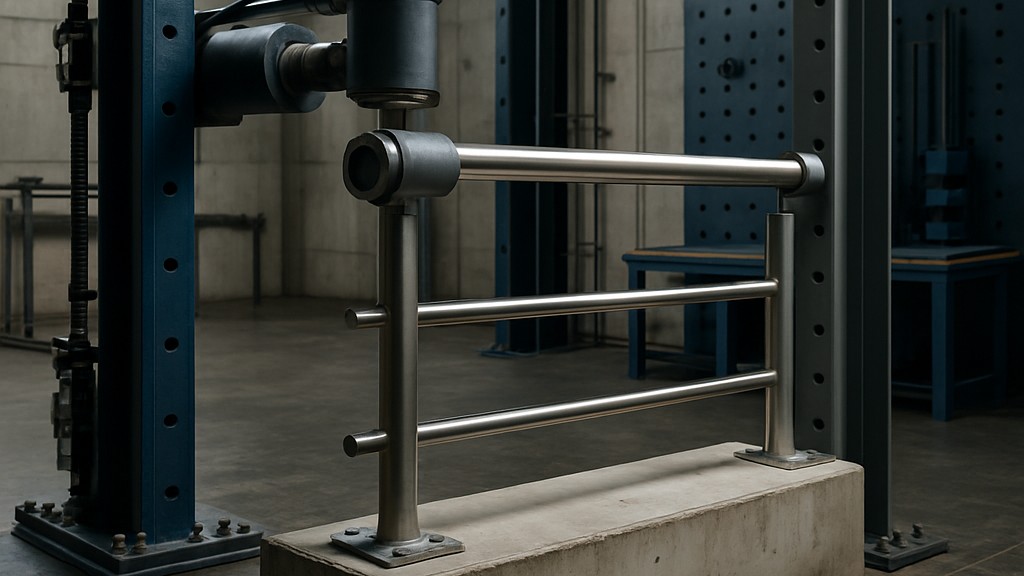
Current standards include valid analyses and statistics for the safety forces defined in the NF P01-012 standard, as the acceptable deformations for these tests are NF P01-013.
The purpose of this standard is to define the static and dynamic tests that guardrails must undergo to verify their ability to withstand forces, such as impact or pressure, that may occur during a fall. It ensures that guardrails are robust enough to prevent accidents.
These standards apply to the following types of guardrails:
This standard does not cover guardrails for industrial purposes (in accordance with standard NF E85-101) or guardrails used in civil engineering structures.
This standard specifies minimum resistance levels measured in decanewtons per metre (daN/m) that vary depending on location:
For stairs in stadiums or at the ends of stands, the requirement may be reduced to 100 daN/m
The test methods performed under this standard are:
The standard also defines acceptable deformation limits for each test to ensure structural integrity.
In terms of materials and fasteners,
Meanwhile, while NF P01-012 addresses dimensions (e.g., a minimum height of 1 meter, spacing between bars, and a solid 45 cm safety zone at the base to prevent children from climbing or crossing), NF P01-013 focuses on ensuring the railing can withstand physical stresses. Both standards are critical to ensuring that railings are safe, durable, and comply with French building regulations.
Compliance with NF P01-013 is mandatory for guardrails on buildings where the risk of falling exceeds 1 metre or has a slope of 45 degrees or more. For heights less than 1 metre, the installation of a guardrail is recommended but not mandatory, although NF P01-013 still provides guidance on resistance.
Manufacturers and installers certified under this standard ensure their products meet these standards to ensure safety and regulatory compliance.
The NF P01-013 standard is important because it defines the safety requirements for railings and barriers in buildings, particularly for preventing falls from heights for children. This standard is considered important for the following reasons:
Typical applications of this standard include:
Our organization, which has been supporting businesses across all sectors for years through a wide range of testing, measurement, analysis, and evaluation activities, has a strong team of employees who closely follow global developments in science and technology and are constantly improving themselves. In this context, we also provide testing services to businesses in accordance with the "NF P01-013 Railing Testing" standard.
To get an appointment, to get more detailed information or to request an evaluation, you can ask us to fill in our form and reach you.

