

The standard "JIS A 5001 Crushed stone for road construction" developed by the Japanese Industrial Standards Organization (JIS) describes the requirements for crushed stone for roads used to pave roads, roadbeds, surface and base layers of bituminous pavements and similar areas. The standards specified in this standard are as follows:
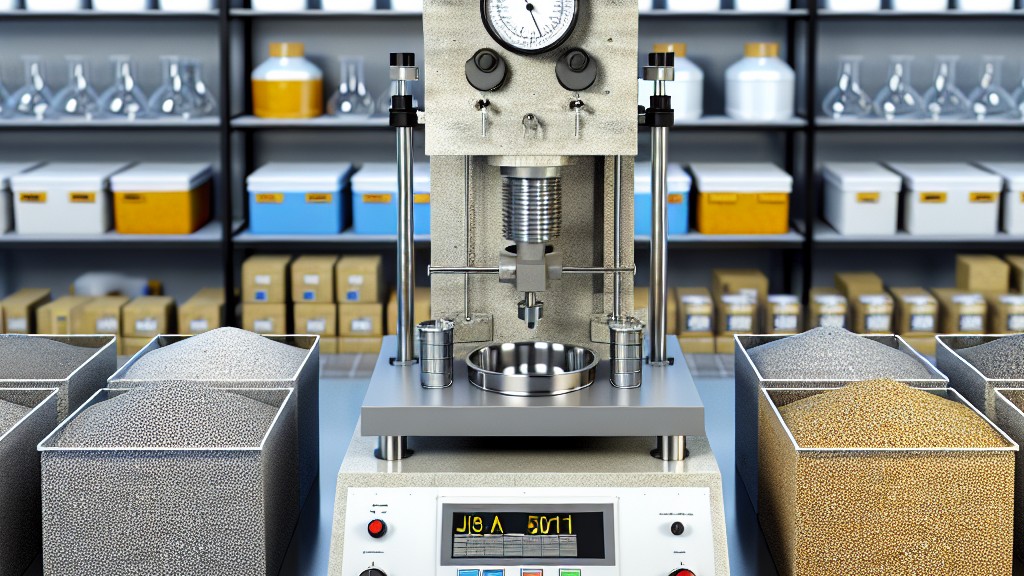
The types and names of crushed stone included in the scope of this standard are shown in the table provided in the standard. Grain-adjusted crushed stone is used in grain-adjusting construction methods and is made by adding other materials to single-grained crushed stone and crusher work to obtain the specified grain size and moisture content. It is mixed using a device that can adjust the water ratio.
Crushed stone should be clean, hard, durable, and should not contain harmful amounts of dirt, mud, thin or long stone fragments, organic impurities, etc. In terms of physical properties, crushed stone should be tested in accordance with this standard, and the grain size should be in accordance with the table.
The nominal dimensions of the screens for porous screens specified in JIS Z 8801 are 106 mm, 75 mm, 63 mm, 53 mm, 37,5 mm, 31,5 mm, 26,5 mm, 19 mm, 13,2 mm, 4,75 mm, 2,36 mm, 1,18 mm, 600 μm, 425 μm, 300 μm, 150 μm and 75 μm. The absolute dry specific gravity, water absorption and abrasion loss shall be in accordance with the table. The plasticity index of the screened stone and graded crushed stone shall be NP. The moisture content and the modified CBR2 of the modified CBR grain-adjusted crushed stone shall be determined to obtain the required density during compaction.
The rough stones used must be cleaned of top soil and other impurities. In addition, the raw stones to be processed must be hard, durable, have a flat shape when broken, and there must be no risk of cracks between the crystals. The size of the raw stone must be at least three times the maximum grain size of the crushed stone. Crushed stone must be stored in a way that large and small particles are not separated and no foreign matter is mixed.
The sample should be taken to be representative of the whole and then divided rationally.
The grain size test shall be carried out in accordance with the method specified in the JIS A 1102 standard. However, tests on the amount of sieving and size-adjusted crushed stone passing through a sieve with a nominal size of 0,074 mm shall be carried out in accordance with the JIS A 1103 standard. The sample for the sieving test is the sieve residue after the washing test, and its mass after drying is 500 g for sieving and 15.000 g for grain-adjusted crushed stone.
The bone dry specific gravity and water absorption test shall be carried out in accordance with the method specified in the JIS A 1110 standard. However, the sample shall pass through a sieve with a nominal size of 13 mm and be retained on a sieve with a nominal size of 5 mm, and the total mass shall be approximately 2000 g.
The abrasion loss test shall be carried out in accordance with the method specified in the JIS A 1121 standard. However, the sample shall pass through a sieve of nominal size 13 mm and be retained on a sieve of nominal size 5 mm, and shall have a total mass of 5 g plus/minus 000 g. The number of balls to be used for the test shall be eight, and their total mass shall be 10 plus/minus 3,330 g. The rotation speed of the testing machine shall be 25-30 revolutions per minute, and the rotation speed shall be 33 revolutions per minute.
The plasticity index is determined in accordance with the method specified in the JIS A 1205 standard.
In the inspection method, the batch size is determined in accordance with the JIS Z 9001 standard or by mutual agreement between the relevant parties. Samples are taken using the reasonable sampling inspection method and tests are carried out in accordance with this standard.
In short, this standard divides recycled aggregates into categories based on quality and intended use. For example,
This standard includes properties such as particle size distribution, water absorption, density and impurity content. It also includes performance criteria for the use of recycled aggregates in new concrete mixes.
Our organization, which has been trying to support businesses from every sector with its testing, measurement, analysis and evaluation studies carried out in a wide range for years, has a strong staff that closely follows the developments in the world in the field of science and technology and constantly improves itself. In this context, testing services in accordance with the "JIS A 5001 Crushed stone used in road construction" standard are also provided to businesses.
To get an appointment, to get more detailed information or to request an evaluation, you can ask us to fill in our form and reach you.

