

The European standard “ EN 12667 Thermal performance of construction materials and products - Determination of thermal resistance by shielded hot plate and heat flow meter methods - Products with high and medium thermal resistance ” describes the principles and test methods for determining the thermal resistance of test specimens with a thermal resistance of at least 0,5 m2·K/W using shielded hot plate or heat flow meter methods.
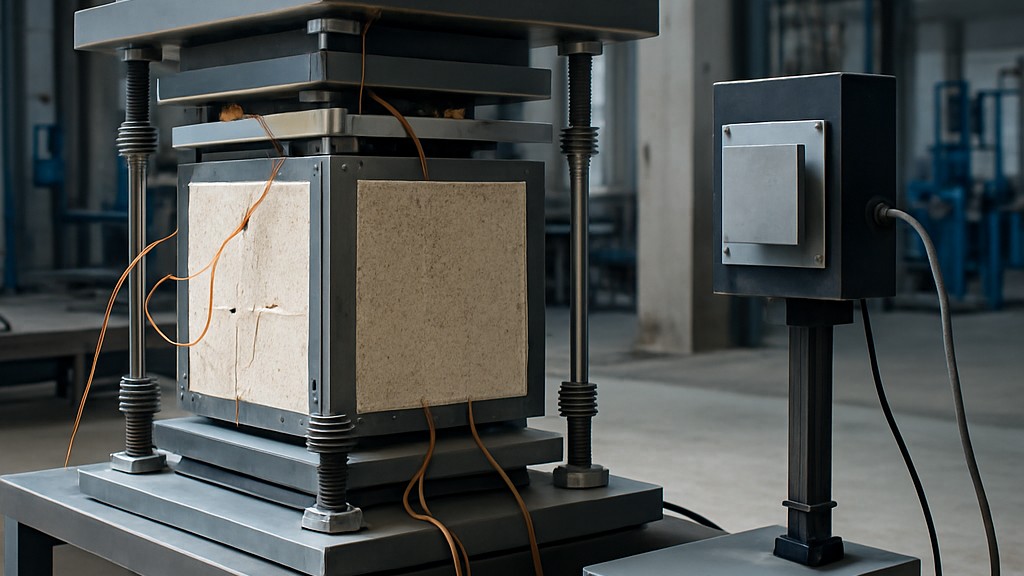
This limit is due to the influence of contact thermal resistances. The upper limit for measurable thermal resistance depends on a number of factors described in this standard, but a single figure cannot be assigned. It is generally applicable to any average test temperature, but the equipment design in this annex is primarily designed for operation between a minimum cooling unit temperature of minus 100 degrees Celsius and a maximum heating unit temperature of plus 100 degrees Celsius (Annex D).
Limits on the average test temperature are imposed only by the materials used in device construction and ancillary equipment. They provide additional limits for equipment performance and test conditions.
It does not provide general equipment design procedures, equipment failure analysis, equipment performance control, or evaluation of equipment accuracy. It provides sample equipment designs that comply with the requirements specified in this standard.
This standard does not provide general guidance and background information (e.g., procedures requiring multiple measurements, such as the heat transfer property to be reported, product-dependent sample preparation, those to evaluate the effect of sample inhomogeneity, those to test samples whose thickness exceeds the capacity of the instrument, and those to evaluate the relevance of the thickness effect).
Because of these limitations, this standard should be used in conjunction with the product standard associated with the product to be tested. While primarily designed for building materials, this standard can also be used for samples made from any material that meets the specified requirements. This standard does not cover measurements on moist products with any thermal resistance or on thick products with high or medium thermal resistance.
In this standard, the principles are determined as follows:
Testing is divided into two parts: sample processing and actual measurements. Certain decisions regarding measurable heat transfer properties, sample processing, and test conditions must be made at the beginning of the test. Instructions regarding these decisions should be sought solely in this standard or in the relevant product standard applicable to the sample to be tested.
A test procedure is the complete set of operations performed on a prepared sample as specified in this standard to determine the desired heat transfer property. These may be further divided into conditioning and the remaining operations for running a test with a shielded hot plate or heat flow meter.
After determining the mass of the samples, they must be conditioned to a constant mass according to relevant product standards. Conditioning involves drying, for example, in a ventilated oven, or drying and then equilibrating with laboratory air. The sample itself can be enclosed in a vapor-tight envelope to prevent moisture transfer to or from the sample during testing. The relative mass loss is calculated from the mass determined before and after drying. To reduce test time, samples can be conditioned to the average test temperature immediately before being placed in the instrument.
The thermal performance of building materials and products is crucial because it directly impacts a building's energy efficiency, indoor comfort, and environmental impact. It is considered important in the following respects:
Our organization, which has been supporting businesses across all sectors for years through a wide range of testing, measurement, analysis, and evaluation activities, boasts a strong team of employees who closely follow global developments in science and technology and are constantly improving themselves. In this context, we also provide testing services in accordance with the standard "EN 12667 Thermal performance of building materials and products - Determination of thermal resistance using protected hot plate and heat flow meter methods - Products with high and medium thermal resistance."
To get an appointment, to get more detailed information or to request an evaluation, you can ask us to fill in our form and reach you.

