

The International Organization for Standardization (ISO) standard "ISO 15148 Hygrothermal performance of building materials and products - Determination of the coefficient of water absorption by partial immersion" describes a method for determining the short-term coefficient of liquid water absorption by partial immersion without a temperature gradient. This standard is intended to evaluate the rate of water absorption by insulation and other materials normally protected by capillary action from continuous or heavy rain during storage or construction on site. This method is suitable for plasters or coatings that are normally tested in conjunction with the substrate on which they are installed.
It is not intended to evaluate the water absorption of materials used under water or in general contact with saturated ground, in which case the full immersion test is more appropriate.
For the purposes of this standard, the following definitions apply in addition to the terms and definitions given in ISO 9346:
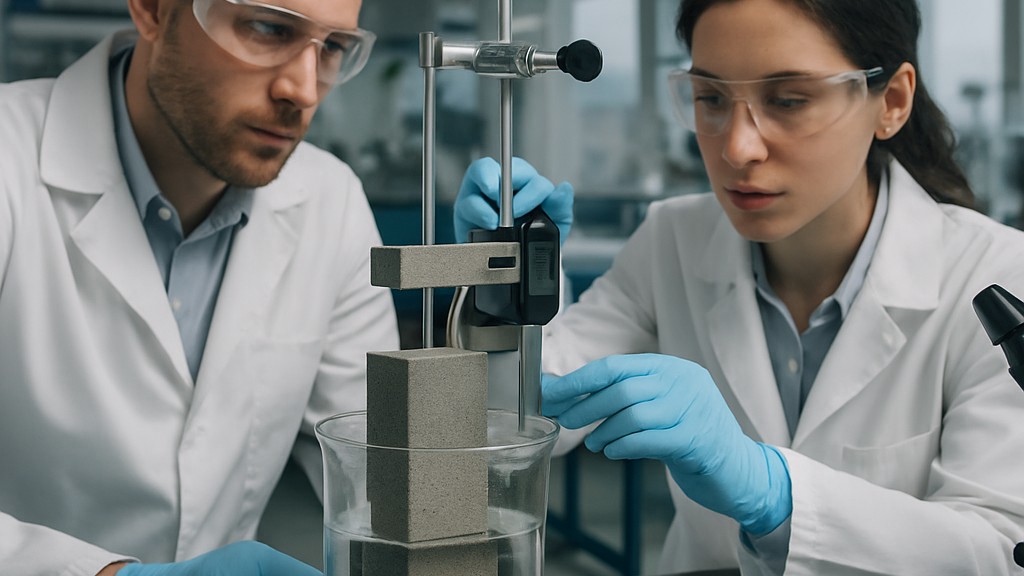
Water absorption by partial immersion is generally determined by measuring the change in mass of a test sample with its lower surface in contact with water for at least 24 hours. Any water adhering to the surface and not absorbed by the product is completely removed, for example, by wiping it with a sponge, before weighing the sample.
The equipment used in the tests must include:
Test specimens must be representative of the material or product and must have a constant cross-section and uniform shape to ensure uniform water flow. Surfaces must be free of surface irregularities.
Each test specimen should have a water contact area of at least 50 cm² . However, for materials containing macroscopic particles such as aggregates, the edge or the smallest diameter of the surface of a square specimen should be at least ten times the largest particle size. Larger specimens, preferably those with a surface area of at least 100 cm² , are recommended as they will provide greater accuracy.
Whenever possible, the sample thickness should be the full thickness of the product. When samples are cut from products, they should be representative of the material being evaluated and thick enough to allow for damage-free handling. For materials containing macroscopic particles, such as aggregates, the thickness should preferably be at least ten times, but at least five times.
At least three samples must be tested. If the water contact area of individual samples is less than 100 cm², at least six samples with a total area of at least 300 cm² must be tested.
Test specimens are cut to be representative of the entire material and exclude product edges. For materials known to be isotropic, test specimen sets are prepared in all potential directions of use.
Test samples should be prepared using methods that do not alter the original structure of the product, preserving all surfaces, coatings, or coverings. For products bonded to a substrate normally in use, such as veneer, thin plaster, or stucco, samples should be formed from the combined product and a standard substrate. The total thickness is the sum of the coating and the substrate.
The edges of solid samples should be sealed with a water- and vapor-impermeable sealant that will not react chemically with the sample or penetrate significantly into the pores of the product. It is particularly important to seal the edges of surface-coated samples to prevent bypass of the coating.
When sealing is not possible with very low-density fibrous or loose filler materials, they can be placed in a tube fitted tightly onto a wire mesh placed at the mouth of the tube. The open area of the wire mesh should be as wide as possible to fully support the sample throughout the test. In this case, the surface area of the sample should be at least 100 cm² to minimize edge effects.
The surface in contact with water must be flat to allow for the normal surface roughness of the material.
Test samples should be stored under test conditions until the mass of each sample stabilizes within 0,1 percent of its total mass when measured over 24 hours. Further details on appropriate conditioning techniques are given in ISO 12570.
In the world of construction and building science, the performance of materials under various environmental conditions is of paramount importance. A critical consideration is how building materials interact with moisture, specifically their ability to absorb water, which can lead to problems such as mold growth, structural deterioration, and reduced thermal efficiency. This is where ISO 15148 comes in. By providing a precise method for measuring this behavior, this standard provides engineers, researchers, and manufacturers with a reliable tool to evaluate short-term water absorption and ensure safer and more durable structures.
Water absorption in building materials is a key factor in hygrothermal performance, encompassing both heat and moisture transfer. Excessive absorption can compromise a building's exterior.
Our organization, with its competent and experienced team, has been understanding the needs of its customers for years, providing them with advanced testing services, and assisting them in establishing, implementing, and improving management systems. In this context, we also provide testing services in accordance with the ISO 15148 Hygrothermal Performance of Building Materials and Products - Determination of Water Absorption Coefficient by Partial Immersion standard.
To get an appointment, to get more detailed information or to request an evaluation, you can ask us to fill in our form and reach you.

