

The standard "AATCC TM 022 Water Repellency Test Method - Spray Test," published by the American Association of Textile Chemists and Colorists (AATCC), describes a test method applicable to all types of textile fabrics, whether or not a water-repellent finish has been applied. This method measures the resistance of fabrics to wetting with water. It is particularly suitable for measuring the water-repellent effectiveness of finishes applied to fabrics.
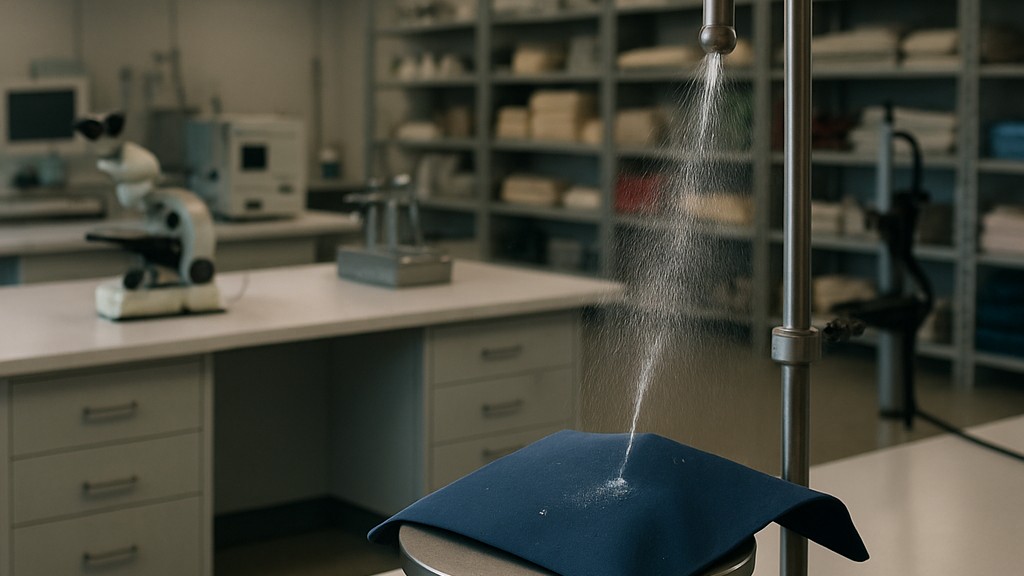
The results obtained with this test method depend on the resistance to wetting or water repellency of the fibers, yarns and finishes on the fabric and the structure of the fabric.
In principle, water sprayed onto the taut surface of a test specimen under controlled conditions produces a wetted pattern whose size depends on the relative repellency of the fabric. Evaluation is accomplished by comparing the wetted pattern with images on a standard chart.
For the purposes of this standard, water repellency refers to the ability of a fiber, yarn, or fabric to resist wetting. In textiles, the face is the side of a fabric intended to be the external, visible surface of a finished product.
The portability and simplicity of the instrument, along with the brevity and simplicity of the testing procedure, make this test method particularly suitable for surface screening operations. However, it is not intended to be used to estimate the potential rain penetration resistance of fabrics, as it does not measure water penetration through the fabric. The AATCC TM 035 Water Resistance Test Method - Rain should be used to test rain penetration.
Three 180,0 mm x 180,0 mm test specimens are required for testing and should be conditioned at 65 percent plus/minus 2 percent relative humidity and 21 degrees Celsius plus/minus 1 degree Celsius for at least 4 hours prior to testing. Whenever possible, each specimen should contain different longitudinal and transverse yarn groups.
To calibrate the instrument, 250 mL of distilled water at 27°C (plus/minus 1°C) is poured into the funnel and the time required for the funnel to empty is measured. The spray time should be between 25 and 30 seconds; otherwise, the nozzle should be checked to see if the holes are widened or clogged. The test sample is securely clamped to the 152,4 mm diameter frame, ensuring that the fabric sample's face is exposed to the water spray. The sample surface should be smooth and free of wrinkles.
The hoop is placed on the tester's stand, with the fabric facing up, so that the center of the spray pattern coincides with the center of the hoop. For gabardine, pique, or similar ribbed fabrics, the hoop is placed on the stand so that the fabric is oriented in the direction it will be used in the final product. Pour 250 mL of distilled water at 27°C plus/minus 1°C into the tester's funnel and allow it to spray onto the test sample for 25–30 seconds. Avoid touching the funnel with the graduated cylinder while pouring the distilled water. The movement of the funnel changes the position of the spray on the sample. The hoop is held by the bottom edge and, with the opposite edge facing the fabric, is struck once sharply against a hard object. The hoop is then rotated 180 degrees and the previously held spot is struck again. These steps are repeated for all three samples.
The AATCC TM 020 standard provides a simple, reliable, and widely used method for evaluating the water repellency of fabrics, particularly for outdoor, protective, or performance apparel. This standard is considered important for the following reasons:
As a result, the AATCC TM 020 standard is important to ensure the functional performance, customer satisfaction and production quality of water repellent fabrics.
Our organization, which has been supporting businesses across all sectors for years through a wide range of testing, measurement, analysis, and evaluation activities, has a strong team of employees who closely follow global developments in science and technology and are constantly improving themselves. In this context, we also provide testing services in accordance with the "AATCC TM 022 Water Repellency Test Method - Spray Test" standard.
To get an appointment, to get more detailed information or to request an evaluation, you can ask us to fill in our form and reach you.

