EN ISO 13934 Textiles - Tensile Properties of Fabrics
The standard "EN ISO 13934 Textile - Tensile properties of fabrics", which is based on a European standard and later published by the International Organization for Standardization (ISO), consists of the following subsections published under the same title:
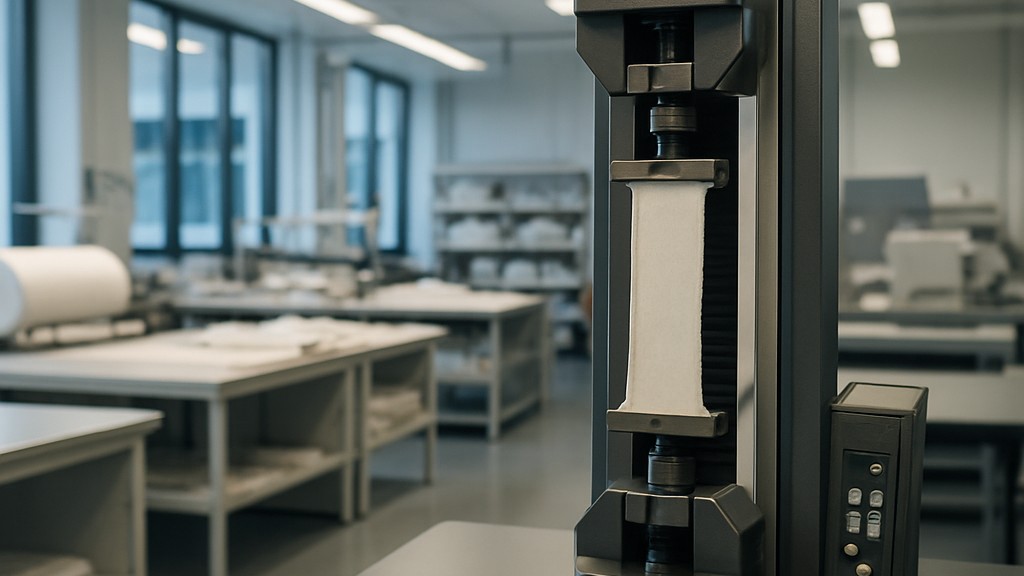
- The standard "EN ISO 13934-1 Part 1: Determination of maximum force and elongation at maximum force using the strip method" describes a procedure for determining the maximum force and elongation at maximum force of textile fabrics using the strip method. The second part of this standard describes a method known as the grip method.
This method is primarily applicable to woven textile fabrics, including those that exhibit stretch properties achieved through the presence of an elastomeric fiber or a mechanical or chemical treatment. This standard is also applicable to fabrics produced by other techniques. However, it is not normally applicable to geotextiles, nonwovens, coated fabrics, textile-glass woven fabrics, or fabrics made from carbon fibers or polyolefin tape yarns.
This method involves determining the maximum force and elongation at maximum force of test specimens in equilibrium with a standard atmosphere for testing, and of test specimens in the wet state. This method is limited to the use of constant-extension-rate testing machines.
For the purposes of this standard, the following terms and definitions apply:
- Constant-extension-rate testing machine refers to a tensile testing machine with one clamp fixed and the other clamp moving at a constant speed throughout the test, ensuring that the entire testing system is virtually free from deflection.
- Strip testing is a tensile test in which the entire width of the test specimen is gripped in the jaws of the testing machine.
- Gauge length refers to the distance between two effective gripping points of a testing machine. The effective gripping points (or lines) of the grips can be checked by gripping a test specimen under pretension defined with carbon copy paper to create a gripping pattern on the test specimen or grip surfaces.
- Initial length is the length of a test specimen under specified pre-stress between two effective compression points at the beginning of specified tests.
- Pre-stress is the force applied to a test specimen at the beginning of certain tests. Pre-stress is used to determine the initial length of the test specimen.
- Elongation refers to the increase in length of a test specimen produced by a force. Elongation is expressed in units of length.
- Elongation is the ratio of the extension of a test specimen to its initial length. Elongation is expressed as a percentage.
- Elongation at maximum force refers to the elongation of a test specimen produced by maximum force.
- Elongation at break refers to the elongation of a test specimen corresponding to the force at the moment of break.
- Force at break refers to the force recorded at the point of rupture of a test specimen during tensile testing.
- Maximum force refers to the maximum force recorded when a test specimen is brought to break during a tensile test under specified conditions.
In principle, a fabric test specimen of specified dimensions is stretched at a constant rate until it breaks. The maximum force and elongation at maximum force are recorded, and, if necessary, the force at break and elongation at break.
- To begin testing, samples are selected in accordance with the procedure specified in the material specification for the fabric or as agreed upon between the parties involved. If a suitable material specification is not available, an example of a suitable sampling procedure, as provided in the appendix to the standard (Appendix A), may be used. An example of a suitable pattern for cutting test samples from the laboratory sample is provided in Appendix B. Test samples should not be taken from folded or creased areas, edges, or areas that are not representative of the fabric.
- The standard "EN ISO 13934-2 Part 2: Determination of maximum force using the grapple method" describes a procedure for determining the maximum force of textile fabrics, known as the grapple test. The first part of this standard describes the method known as the strip test.
This method is primarily applicable to woven textile fabrics, including those that exhibit stretch properties achieved through the presence of an elastomeric fiber or a mechanical or chemical treatment. This standard is also applicable to fabrics produced by other techniques. However, it is not normally applicable to geotextiles, nonwovens, coated fabrics, textile-glass woven fabrics, or fabrics made from carbon fibers or polyolefin tape yarns.
This method involves determining the maximum strength of test specimens in equilibrium with a standard atmosphere for testing and of test specimens in the wet state. This method is limited to the use of constant-extension-rate testing machines.
For the purposes of this standard, the following terms and definitions apply:
- A constant-extension-rate testing machine refers to a tensile testing machine equipped with a clamp and another clamp that moves at a constant speed throughout the test. The entire testing system is virtually deflection-free.
- The hold test is a tensile test in which only the centre portion of the test specimen is gripped in the jaws of the testing machine.
- Maximum force refers to the maximum force recorded when a test specimen fractures during a test under specified conditions.
- Gauge length is the distance between two effective gripping points of a testing machine. The effective gripping points (or lines) of the grips can be checked by gripping a test specimen with carbon copy paper and creating a gripping pattern on the test specimen and/or the grip surfaces.
In principle, a fabric test sample, gripped at its center with jaws of specific dimensions, is stretched at a constant rate until it breaks. The maximum force is recorded.
To begin testing, samples are selected in accordance with the procedure specified in the material specification for the fabric or as agreed upon between the parties involved. If a suitable material specification is not available, an example of a suitable sampling procedure, as provided in the appendix to the standard (Appendix A), may be used. An example of a suitable pattern for cutting test samples from the laboratory sample is provided in Appendix B. Test samples should not be taken from folded or creased areas, edges, or areas that are not representative of the fabric.
Our organization, which has been supporting businesses across all sectors for years through a wide range of testing, measurement, analysis, and evaluation activities, has a strong team of employees who closely follow global developments in science and technology and are constantly improving themselves. In this context, we also provide testing services in accordance with the EN ISO 13934 Textile - Tensile Properties of Fabrics standard.



