

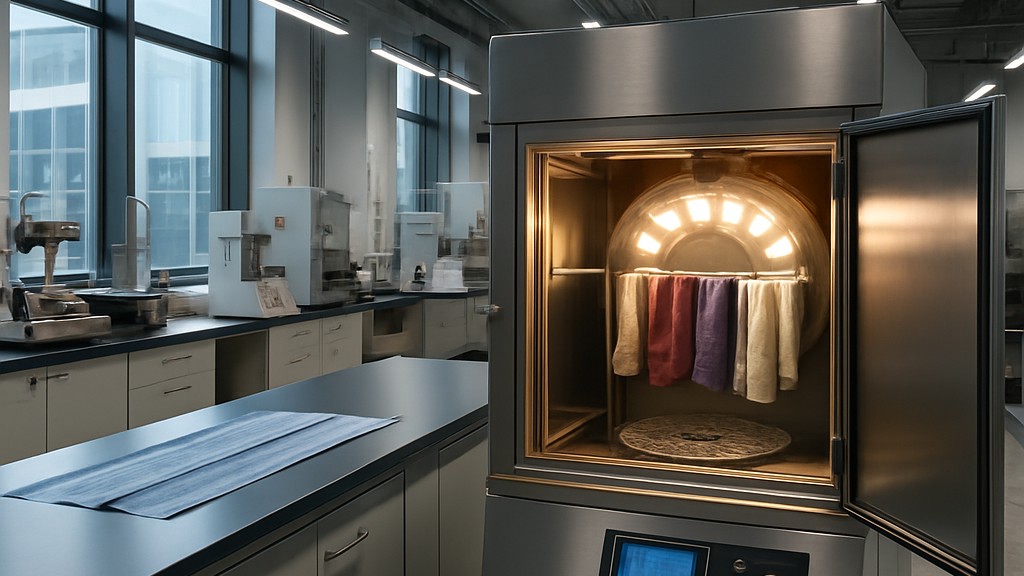
In principle, the textile sample to be tested is exposed to artificial light under controlled conditions along with a set of reference materials. Colour fastness is assessed by comparing the colour change in the test sample with the colour change in the reference materials used. General information on colour fastness to light is included in the standard appendix (Annex D).
For the purposes of this standard, the following terms and definitions apply:
Either of two blue wool reference sets may be used in the tests. The color fastness ratings specified in this standard are obtained by comparing them with blue wool references 1 to 8 (preferred in Europe) or blue wool references L2 to L9 (preferred in the United States). The results from the two reference sets are not interchangeable. Information regarding the relationship between the two sets of blue wool reference materials is included in ISO 105-B01.
Blue wool references, developed and manufactured in Europe, are identified by numerical designations ranging from 1 to 8. These references are blue wool materials dyed with the dyes listed in the table provided in the standard. Values range from 1 (very low lightfastness) to 8 (very high lightfastness), with each higher-numbered reference being approximately twice as fast as the previous one. Blue wool references 1 to 8 used in this test must meet the quality requirements specified in ISO 105-B08.
Blue wool references, developed and manufactured in the United States, are identified by the letter L followed by numerical designations 2 through 9. These eight references are prepared by mixing wool dyed with CI Mordant Blue 1 and wool dyed with CI Soluble Vat Blue 8 in varying proportions, so that each higher-numbered reference dries approximately twice as fast as the previous reference. Data in the appendix to the standard are presented to demonstrate the relevance of each blue wool reference to exposure to a fixed amount of radiant energy (Appendix C).
In moisture test control, effective moisture can only be measured by determining the color fastness of a particular moisture test control fabric to light.
The size of the test sample depends on the number of samples to be tested and the shape and dimensions of the sample holders provided with the instrument. The sample may be a strip of cloth, yarn closely wound on a sample mounting board, yarn laid parallel to the board and attached to the board, or a mat of fibers combed and compressed to obtain a smooth surface and attached to the board. Each exposed and unexposed area should be at least 10 mm x 8 mm. To facilitate handling, identical strips of test samples and references may be mounted on one or more boards.
Covers should make close contact with the surface of the unexposed areas of samples and references to create a sharp demarcation line between the exposed and unexposed areas, but should not unduly compress the sample.
The samples to be tested and the blue wool references should be of equal size and shape to avoid evaluation errors resulting from over-evaluation of the visual contrast between exposed and unexposed parts in a wider pattern compared to a narrower reference.
When testing specimens of appreciable thickness, the references should be arranged so that the top surface of the test specimens is the same distance from the light source. Covers for unexposed areas should avoid surface compression. Textiles of appreciable thickness, with fibers that can change position or texture, which could make it difficult to evaluate small areas, should be tested with an exposed area of at least 50 mm x 40 mm and preferably larger.
Testing may be conducted under different conditions to simulate different environments, as shown in the table titled "Exposure Conditions." The type of conditions must be agreed upon between the parties. The selected conditions must be reported.
Our organization, which has been supporting businesses across all sectors for years through a wide range of testing, measurement, analysis, and evaluation activities, boasts a strong team of employees who closely follow global developments in science and technology and are constantly improving themselves. In this context, we also provide testing services in accordance with the standard "EN ISO 105-B02 Textiles - Color fastness tests - Part B02: Color fastness to artificial light: Xenon arc fading lamp test."
To get an appointment, to get more detailed information or to request an evaluation, you can ask us to fill in our form and reach you.

