

The International Organization for Standardization (ISO) standard "ISO 137 Wool - Determination of fiber diameter - Projection microscope method" describes a procedure and measurement conditions for determining wool fiber diameter using a projection microscope. This method is suitable for wool fibers of all shapes, as well as other fibers with a reasonably circular cross-section. In the case of dyed, bleached, or finished fibers, the diameter may differ from the diameter of fibers that have not undergone such treatments. Fiber diameter estimates obtained at various stages of processing a lot of wool are not necessarily the same.
For the purposes of this standard, the following terms and definitions apply:
The test method described is based on the principle of projecting magnified images of the profiles of wool fiber particles onto a screen and measuring their widths using a graduated scale. This technique allows for random sampling of the fibers to be measured.
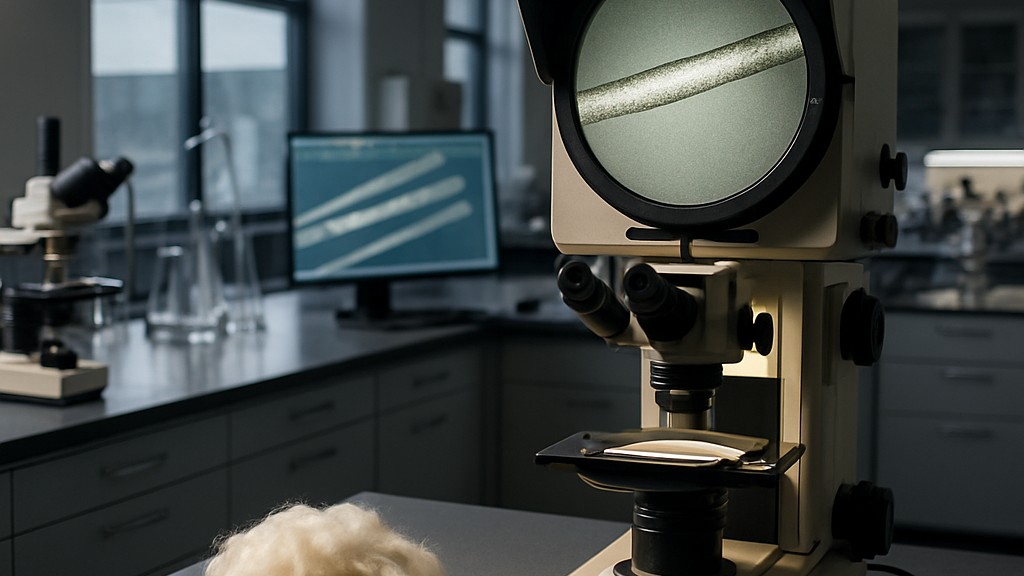
The projection microscope used in the tests consists of a light source, a light condenser, a stage supporting the slide carrying the fibers, an objective, an eyepiece, and a circular screen. The stage can be moved in two directions at right angles by means of a sliding mechanism capable of successive displacements in 1,0 mm increments. The objective and eyepiece can provide a magnification of 500X. The circular screen is equipped with a graduated scale that can measure the image of a piece of fiber projected onto the screen in any orientation and position within the measurement area. It is acceptable to mark a central circle with a diameter equal to one-fourth of the optical distance between the eyepiece and the center of the screen. All measurements should be made within this circle to ensure that no lens aberrations around the objective are present. However, some modern instruments incorporate highly sophisticated optics that ensure uniform magnification across the entire projected image. In these instruments, the marked circle is not required, and measurements can be made over the entire image area. In all cases where the marked circle is not on the screen, magnification must be checked on the entire projected image using a certified graduated scale to ensure the integrity of the instrument's optics. A movable graduated scale made of transparent material and graduated in millimeters on the underside, as shown in the figure, is suitable.
The projection microscope should be periodically calibrated using a micrometer graduated scale (certified to be accurate) placed on the stage, divided into hundredths of a millimeter. A micrometer division (i.e., 0,01 mm) projected onto the screen should cover exactly 5 mm of the graduated scale. The magnification then equals 500X.
The tests also use section cutters that are suitable for cutting fibers to a predetermined maximum length and can meet the requirements for cutting fiber segments.
The assembly medium has the following properties: a refractive index between 1,43 and 1,53 at 20°C, a suitable viscosity, zero water absorption, and no effect on fiber diameter. Cedarwood oil and liquid paraffin are examples of suitable media. Anhydrous glycerin is not suitable.
The tests require glass microscope slides measuring approximately 75 mm x 40 mm, as well as cover glasses (square or rectangular). Suitable cover glasses are 50 mm x 35 mm.
When preparing a raw wool sample, the ISO 1130 standard is followed. The total sample mass is divided into approximately 40 regions, and a handful of fibers are taken from each region. Each handful of fibers is split in half (the fibers must not be broken), and half is retained; the remaining half is chosen randomly. If the fibers are parallel, the splitting is done longitudinally, i.e., in a direction that prevents fibers from being picked at their ends. The retained half is split in half, and the remaining half is left randomly again. This process continues until 50 g of fiber remain. The reduced sample is subjected to a washing process consisting of two extractions in petroleum ether. The sample is dried and conditioned in a standard atmosphere for the conditioning specified in ISO 139.
When preparing ribbons, rovings, and yarns, sufficient material is removed from the total sample to fill the microtome to a sufficient depth (a microtome is a cutting tool that allows for the examination of tissue samples by cutting them extremely thinly). Long fibers are generally thick fibers, and therefore any manipulation that results in the selection of long fibers will result in a diameter greater than the average diameter. The resulting test sample is then conditioned in a standard atmosphere for the conditioning specified in ISO 139.
The ISO 137 standard is important from technical, commercial and quality perspectives:
In short, the ISO 137 standard is deemed necessary because it provides reliable, standardized and globally accepted measurement of wool fiber diameter, which is crucial for maintaining quality, fair trade and product performance in the wool industry.
Our organization, which has been supporting businesses across all sectors for years through a wide range of testing, measurement, analysis, and evaluation activities, boasts a strong team of employees who closely follow global developments in science and technology and are constantly improving themselves. In this context, we also provide testing services in accordance with the "ISO 137 Wool - Determination of Fiber Diameter - Projection Microscope Method" standard.
To get an appointment, to get more detailed information or to request an evaluation, you can ask us to fill in our form and reach you.

