

The standard "EN ISO 2060 Textiles - Yarn from packages - Determination of linear density (mass per unit length) by the skein method", which has its basis in a European standard and was subsequently published by the International Organization for Standardization (ISO), describes a method for determining the linear density of all types of yarn in packaging form, except for yarns that may be the subject of a separate international standard.
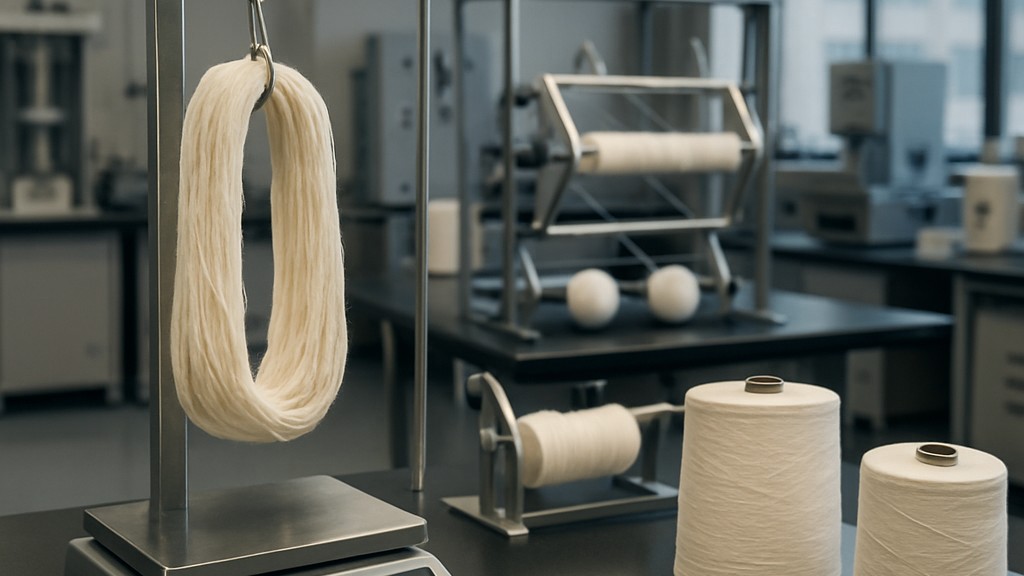
This standard includes seven optional procedures based on different conditioning and preparation methods. Because different procedures do not yield the same values, it is essential that the procedure used be accepted by all parties interested in the test results.
Although this method is designed solely for determining the mass per unit length of yarn, it is often preferred to combine this determination with strength tests and commercial mass tests. In such cases, if skein lengths other than those specified are used, the length used and any specific adjustments based on these lengths are subject to agreement between the parties involved.
This method can be applied to:
For the purposes of this standard, the following terms and definitions apply:
In principle, linear density is calculated from the length and mass of suitable samples. Samples of suitable length are prepared by winding test skeins for yarn counting under specified conditions from adequately conditioned samples after suitable preconditioning in skein form. In practice, the mass of the skeins is determined under various conditions as specified in this standard. If mutual agreement is reached, any of the following options given in this standard may be used.
Preconditioning, conditioning, and test atmospheres must be as specified in ISO 139. Air at 20°C and 65% relative humidity has a water vapor pressure of 1515 Pa, and when heated to 47°C plus or minus 3°C, an atmosphere containing 12,3% to 16,7% relative humidity is produced. Air at a maximum temperature of 22°C and 67% relative humidity has a water vapor pressure of 1770 Pa, and when heated to 44°C to 50°C, a humidity range of 14,3% to 19,4% is produced. Any deviation from the standard preconditioning atmosphere must be agreed upon by the parties involved, and the temperature and humidity used must be stated in the test report.
Sampling should be done by one of the following methods:
The bulk sample should be taken to be representative of the batch (shipment) to be tested.
One laboratory sample skein should be wound from each laboratory sample package. The skeins should be long enough to provide yarn for all required tests. When winding the skeins, the yarn should be wound from the end of the package if this is the normal method of use; otherwise, the yarn should be wound from the side of the package. A few meters of yarn at the beginning and end of the package should be discarded to prevent damage.
Preconditioning and conditioning of laboratory sample skeins must be carried out in accordance with this standard. The laboratory must precondition the sample skeins by exposing them to freely moving air for at least 4 hours in the atmosphere specified for preconditioning. Samples should not be oven-dried during preconditioning.
After the laboratory has preconditioned the sample skeins, they should be brought to moisture equilibrium for testing by exposing them to a standard atmosphere suitable for testing until there is no progressive change in mass of more than 0,1 percent for 24 hours or in successive exposures of at least 30 minutes.
Our organization, which has been supporting businesses across all sectors for years through a wide range of testing, measurement, analysis, and evaluation activities, boasts a strong team of employees who closely follow global developments in science and technology and are constantly improving themselves. In this context, we also provide testing services in accordance with the EN ISO 2060 Textile - Yarn from Packages - Determination of linear density (mass per unit length) by the Hank Method.
To get an appointment, to get more detailed information or to request an evaluation, you can ask us to fill in our form and reach you.

