

The standard "EN ISO 13937 Textiles - Tear properties of fabrics", which is based on a European standard and later published by the International Organization for Standardization (ISO), consists of the following subsections published under the same title:
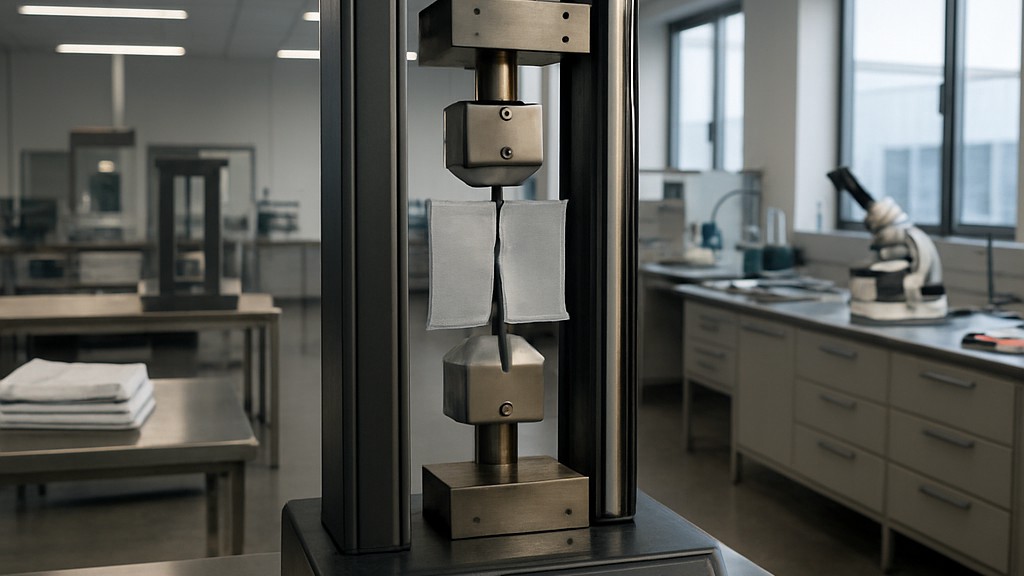
In general, the test is not applicable to knitted fabrics and woven elastic fabrics. It is not suitable for highly anisotropic fabrics or loose fabrics where tear transfer from one direction of the fabric to the other is likely to occur during the tear test. For tests using tensile testing machines, EN ISO 13937-2 describes the single tear method known as the trouser test, EN ISO 13937-3 describes the wing test, and EN ISO 13937-4 describes the single tear method known as the tongue test. For coated fabrics, ISO 4674-2 describes the ballistic pendulum method, and for the trapezoidal test method, ISO 9073-4 applies to nonwovens or ISO 4674 applies to coated fabrics.
In principle, the force required to maintain a slit in a fabric is determined by measuring the work done to tear the fabric a fixed distance. The apparatus consists of a pendulum carrying a clamp aligned with a fixed clamp when the pendulum is in its elevated starting position, which has maximum potential energy. The specimen is secured to the clamps, and tearing is initiated by opening a slit in the specimen between the clamps. The pendulum is then released, and the specimen tears completely as the movable jaw moves away from the fixed jaw. The tearing force is measured.
Samples are selected in accordance with the procedure specified in the material specification for the fabric or as agreed upon between the parties involved. In the absence of a suitable material specification, an example of a suitable sampling procedure is provided in Appendix B. An example of a pattern for cutting test samples from a laboratory sample is provided in Appendix C. Test areas with folds or creases, edges, and areas that are not representative of the fabric should be avoided.
This method is primarily applicable to woven textile fabrics. It can also be applied to fabrics produced using other techniques, such as some nonwovens (with the same limitations as for woven fabrics). In general, the method is not applicable to knitted fabrics or woven elastic fabrics. This method is not suitable for highly anisotropic fabrics or loose fabrics, where tear transfer from one side of the fabric to the other during the tear test is likely to occur. The method only allows the use of constant strain rate testing machines. For other tear test methods using tensile testing machines, EN ISO 13937-3 describes a method known as the wing test, and EN ISO 13937-4 describes a method known as the tongue test. For the trapezoidal test method, ISO 9073-4 applies to nonwovens or ISO 4674 applies to coated fabrics.
In principle, a rectangular test sample is cut from the center of the short side to create the trouser shape. The trouser legs are clamped to the clamps of a recording tensile testing machine to form a straight line and pulled in the direction of the cut to tear the fabric. The force required to continue tearing over a specified distance is recorded. Tear force is calculated from the force peaks in the autographic trace or electronically online.
This method is primarily applicable to woven textile fabrics and fabrics produced using other techniques. Because the sample wings are clamped obliquely to the yarns to be torn, this test can be used on most fabric types without causing tear transfer and is less susceptible to yarn shrinkage than other tear tests. In general, the method is not applicable to knitted fabrics, woven elastic fabrics, and nonwovens, for which the trapezoidal test method is preferred. This method only allows the use of constant strain rate testing machines. For other tear test methods using tensile testing machines, EN ISO 13937-2 describes a method known as the trouser test, and EN ISO 13937-4 describes a method known as the tongue test. EN ISO 13937-1 describes the ballistic pendulum (Elmendorf) method. For the trapezoidal test method, ISO 9073-4 applies to nonwovens or ISO 4674 applies to coated fabrics.
In principle, a specially shaped test specimen, cut to form two wings on one side, is mechanically stressed so that the stress is concentrated in one section, causing tearing in the desired direction. The wings of the specimen are compressed obliquely to the direction of the fibers to be torn. The force required to continue tearing along a specified tear length is recorded. The tear force is calculated online from the force peaks of the autographic trace or by electronic means.
This method is primarily applicable to woven textile fabrics. It can also be applied to fabrics produced using other techniques, such as some nonwovens (with the same limitations as those for woven fabrics). In general, the method is not applicable to knitted fabrics or woven elastic fabrics. This method only allows the use of constant elongation rate testing machines.
For other tear test methods using tensile testing machines, EN ISO 13937-2 describes a method known as the trouser test, and EN ISO 13937-3 describes a method known as the wing test. EN ISO 13937-1 describes the ballistic pendulum (Elmendorf) method. For the trapezoidal test method, ISO 9073-4 applies to nonwovens or ISO 4674 applies to coated fabrics.
In principle, two parallel slits connected by a slit at right angles are cut in a rectangular test specimen to form a tongue. The tongue is placed in one jaw of a recording tensile testing machine, and the remaining portion of the test specimen is clamped symmetrically in the other jaw to ensure that both cuts form straight parallel lines. A tensile force is applied in the direction of the cuts to simulate two parallel tears. The force required to sustain each tear for a specified tear length is recorded. The tear force is calculated from the force peaks of the autographic trace or by electronic means online.
Our organization, which has been supporting businesses across all sectors for years through a wide range of testing, measurement, analysis, and evaluation activities, has a strong team of employees who closely follow global developments in science and technology and are constantly improving themselves. In this context, we also provide testing services in accordance with the EN ISO 13937 Textiles - Tear Properties of Fabrics standard.
To get an appointment, to get more detailed information or to request an evaluation, you can ask us to fill in our form and reach you.

