

The standard “ISO 12947 Textiles - Determination of abrasion resistance of fabrics by the Martindale method”, which is based on a European standard and later published by the International Organization for Standardization (ISO), consists of the following subsections published under the same title:
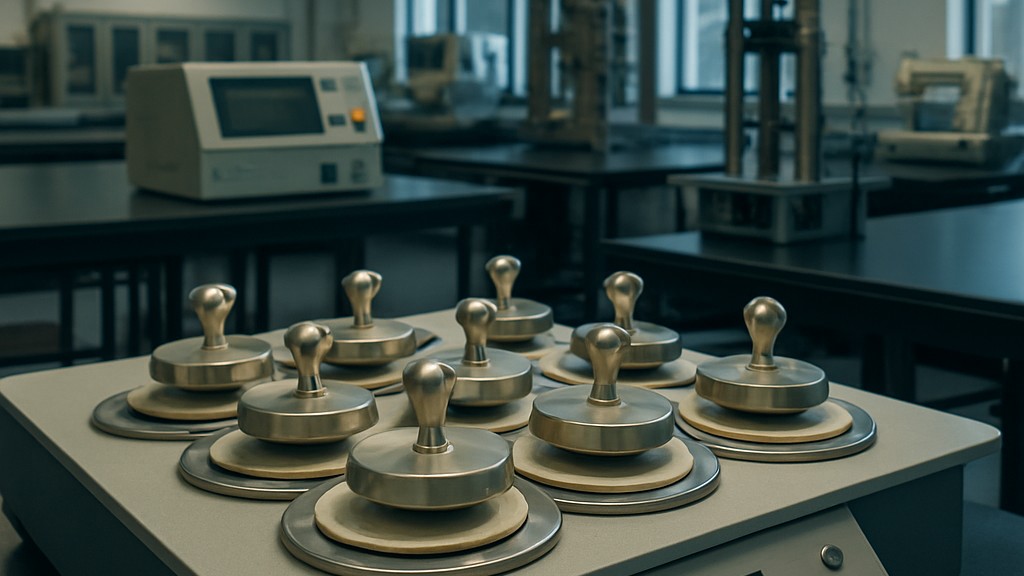
The Martindale abrasion tester subjects a circular specimen to a defined load and rubs it against an abrasive medium (i.e., standard fabric) in a translational motion following the Lissajous pattern. Depending on the method used, the specimen or the sample holder containing the abrasive medium can also rotate freely about its axis perpendicular to the horizontal plane. The specimen is subjected to abrasive wear for a predetermined number of abrasions. The number of abrasion abrasions that constitute the inspection range depends on the product type and the evaluation method.
The tester generally consists of a base plate to which the abrasion tables and drive mechanism are mounted. The drive mechanism consists of two external drives and one internal drive that cause the specimen holder guide plate to follow a Lissajous figure.
The sample holder guide plate is moved horizontally by the drive mechanism so that each point on the guide plate defines the same Lissajous figure. The sample holder guide plate is equipped with bearing housings and low-friction bearings that support the sample holder guide shafts. The lower end of each sample holder shaft is inserted into each sample holder body. Loading parts can be attached to the upper end of the shaft. The sample holder consists of a body, insert, and nut. The device is equipped with a presettable counting device that counts each rotation of one of the external drives.
In principle, a circular specimen mounted on a sample holder and subjected to a defined load is rubbed against an abrasive medium (standard fabric) with a translational motion following a Lissajous figure. The sample holder is also free to rotate about its axis perpendicular to the plane of the sample. The abrasion resistance of textile fabrics is determined from the inspection interval until the samples break down. Samples are mounted on foam-supported sample holders. Samples with a mass per unit area of at least 500 g/m2 are mounted on foam-free sample holders. Pile fabrics tested without foam support are subjected to a specified preparation process.
Two wear load parameters are specified. The total effective mass of the wear load (i.e., the mass of the sample holder assembly and the associated loading member) is:
The wear test continues until the test specimen fails. The inspection interval is determined by the specimen failure. The friction count at which specimen failure is not yet observed is recorded (this friction count is the upper limit of the time elapsed before specimen failure and also the lower limit of the wear range at which specimen failure occurs).
In principle, a circular sample is placed in a sample holder and, subjected to a defined load, is rubbed against an abrasive medium (standard fabric) with a translational motion following the Lissajous figure; the sample holder can also rotate freely around its own axis perpendicular to the plane of the sample. The abrasion resistance of the textile fabric is evaluated by the mass loss of the test samples. Samples are placed in foam-supported sample holders. Samples with a mass greater than 500 gm⁻² per unit area are placed in foam-free sample holders. Pile fabrics and cord fabrics tested without foam support undergo a specified preparation process. Two abrasion parameters are specified. The total effective mass of the abrasion load (i.e., the mass of the sample holder assembly and the appropriate loading part) is determined:
The mass loss of the sample is determined for each friction number determined by the friction number at which the sample breaks apart.
In principle, a circular sample is subjected to a defined load and rubbed against an abrasive medium (standard fabric) with a translational motion following a Lissajous figure. The sample holder containing the abrasive medium is also free to rotate about its axis perpendicular to the plane of the sample. The abrasion resistance of a textile fabric is determined by evaluating the change in appearance.
Tests are performed at 198 plus/minus 2 g using only the mass of the sample holder and spindle. The surface change of the test sample is evaluated and compared with an untested sample of the same fabric. There are two methods available:
For the conditioning and testing of textile products, the standard temperate atmosphere defined in the ISO 139 standard, i.e., 20 degrees plus/minus 2 degrees temperature and 65 percent plus/minus 5 percent relative humidity, is used.
Sampling is generally carried out in accordance with statistical rules (ISO 2859-1 standard). During sampling and sample preparation, the lowest possible tensile stress should be applied during handling to prevent incorrect elongation of the textile fabric.
Our organization, which has been supporting businesses across all sectors for years through a wide range of testing, measurement, analysis, and evaluation activities, boasts a strong team of employees who closely follow global developments in science and technology and are constantly improving themselves. In this context, we also provide testing services in accordance with the ISO 12947 Textiles - Determination of abrasion resistance of fabrics using the Martindale method.
To get an appointment, to get more detailed information or to request an evaluation, you can ask us to fill in our form and reach you.

