

The standard “PSA D45 5506 Resistance of textiles to surface wetting - spray test method” developed by the French automobile company Renault describes a test method for determining the resistance of a cut textile to surface wetting. This method is mainly applied to woven, knitted, non-woven water-repellent or non-woven textiles.
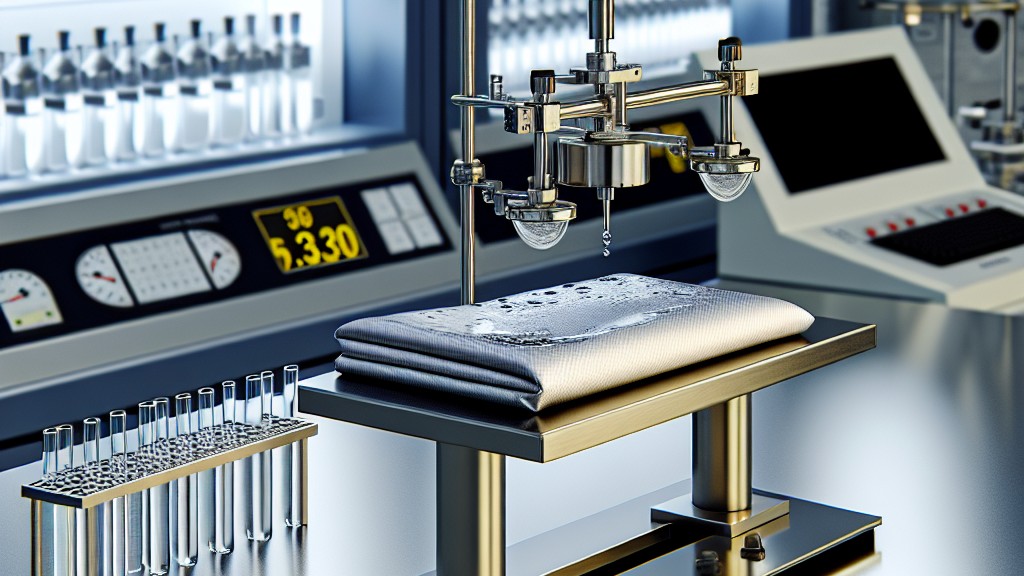
This test method consists in principle of spraying water onto a test specimen placed on an inclined plane. The result is a rating obtained by comparing the appearance of the specimen with a photographic scale.
The equipment used in these tests includes:
Test samples should be representative of the scale to be characterized. To ensure this representation, it is necessary to find out the basic characteristics of the population under study. Selection criteria for test samples should be stated in the test report in accordance with the PSA A10 0156 standard. In case of doubt about sampling, PSA should be contacted for the rules to be followed.
While preparing the test samples, three test samples are prepared in accordance with the cutting template given in the standard. The test samples are conditioned in the conditioned room for at least 24 hours.
When performing the test, distilled water is heated in a beaker on a heating plate and a constant, uniform temperature of 27 degrees plus/minus 1 degree is obtained. A test sample is placed on the support and the screw is tightened until the surface of the test sample is well stretched. The support is placed on the inclined plane. 250 mL of distilled water is poured into the funnel using the beaker. When the funnel is empty and all the water has poured into the textile, the support is held by the metal piece and a solid object (the cloth face towards the object) is struck to remove the water from the support that has not penetrated the textile. The tested sample is compared with the photographic scale. Thus, the textile is assigned a value between 1: very wet and 5: not wet. The result is the least good of the values determined for the three test samples.
The format and minimum contents of the test report are included in the PSA A10 0156 standard. The test report must include:
In short, this test method is designed only to evaluate the resistance of a material to surface wetting by water. This method is not designed to measure the ability of a fabric to resist water penetration. This method can be applied to all types of textile samples. Water resistant textiles are less water resistant but not completely water resistant. Examples of such fabrics include cotton, which is not as tightly woven as synthetic fabrics such as nylon and polyester.
Our organization has a strong staff that closely follows the developments in the world in the field of science and technology and constantly improves itself. Among the numerous test, measurement, analysis and evaluation studies provided for businesses in various sectors, there are also test services in accordance with the "PSA D45 5506 Spray test method for the resistance of textiles to surface wetting" standard.
To get an appointment, to get more detailed information or to request an evaluation, you can ask us to fill in our form and reach you.

