

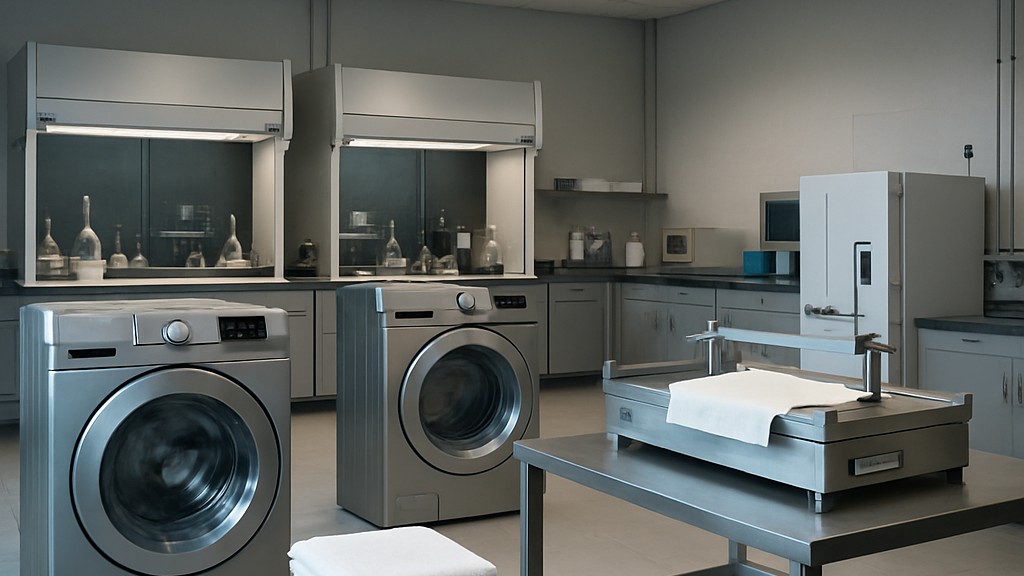
In principle, the sample is conditioned in a specified standard atmosphere and measured before being subjected to appropriate washing and drying procedures. Dimensional changes after drying, conditioning, and remeasuring of the sample are calculated.
The devices and reagents used in this method are as specified in ISO 3759 and ISO 6330 standards.
The atmospheric conditions required for preconditioning and testing are described in the ISO 139 standard.
The selection, dimensions, marking, and measurement of test samples are specified in ISO 3759 Textiles - Preparation, marking, and measurement of fabric samples and garments for testing to determine dimensional change. The number of samples to be tested is determined by the precision of the required results. For this test method, it is recommended to test four samples from each sample and wash these samples in two separate wash loads, with two samples per wash load (repeats per run). In some cases, it may be desirable not to test four samples, and in other cases, fewer samples may be used.
After the samples are preconditioned, conditioned, and measured according to the procedure specified in ISO 3759, the original length and width dimensions are determined, as appropriate. If agreed upon by the parties involved, the samples are washed and dried according to one of the procedures specified in ISO 6330. After washing and drying, the samples are conditioned and measured, and the dimensional change of the samples is calculated according to the procedure specified in ISO 3759.
In accordance with the regulations in the ISO 3759 standard, average changes in dimensions in both the length and width directions are calculated according to the formulas provided in the standard. Average dimensional changes are expressed to the nearest 0,5 percent. A minus sign indicates a decrease in dimension (shrinkage) or a plus sign indicates an increase (elongation).
The test report must include:
This standard is based on ISO 5077 Textiles - Determination of dimensional change on washing and drying. EN ISO 25077 reflects developments in test methods and provides more comprehensive guidelines for assessing dimensional changes in textiles.
This standard is important because it provides a uniform method for assessing the dimensional stability (shrinkage or elongation) of textile fabrics and garments after laundering. This ensures consistency and quality control within the textile and apparel industries. This standard is considered important for the following reasons:
In short, this test method determines the shrinkage or growth of a textile product in the warp (lengthwise) and weft (crosswise) directions. Test results are typically reported as a percentage of dimensional change. Textile manufacturers, apparel manufacturers, testing laboratories, retailers, brands, and regulatory and standards organizations use this standard.
In general, testing is performed in the following steps:
Our organization, which has been supporting businesses across all sectors for years through a wide range of testing, measurement, analysis, and evaluation activities, has a strong team of employees who closely follow global developments in science and technology and are constantly improving themselves. In this context, we also provide testing services in accordance with the EN 25077 Textile - Determination of Dimensional Change in Washing and Drying Standard.
To get an appointment, to get more detailed information or to request an evaluation, you can ask us to fill in our form and reach you.

