

The ISO 4920 “Textile fabrics – Determination of resistance to surface wetting (spray test)”, published by the International Organization for Standardization (ISO), describes a spray test method for determining the resistance of any fabric, with or without a water-resistant or water-repellent coating, to wetting by water. It is not intended to be used to estimate the permeability resistance of the fabric to rain, as it does not measure the permeability of water through the fabric.
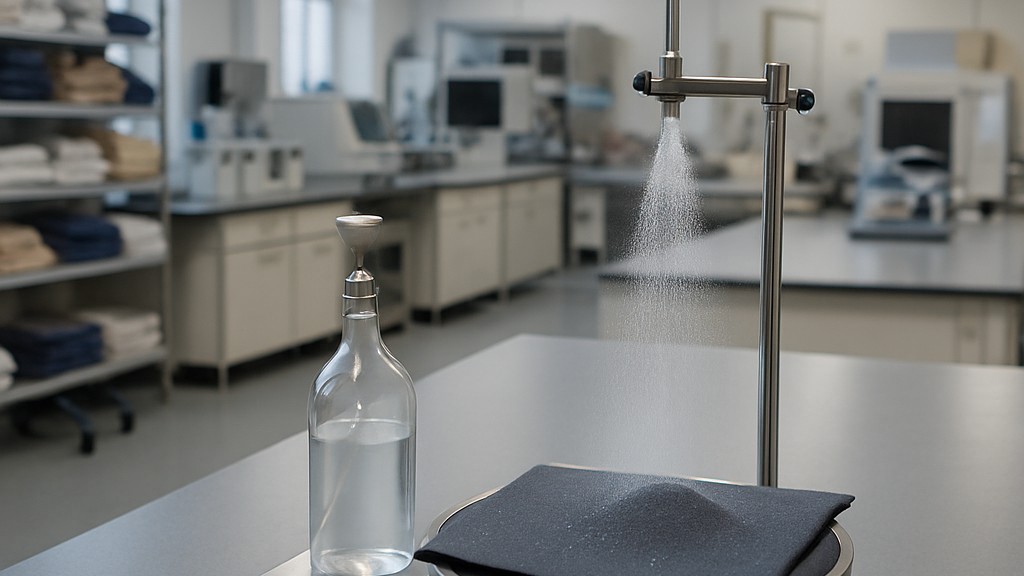
For the purposes of this standard, the following terms and definitions apply:
In principle, a specific volume of distilled or fully deionized water is sprayed onto a test sample mounted on a ring and positioned at a 45-degree angle, with the center of the sample a specified distance below the spray nozzle. The degree of spraying is determined by comparing the sample's appearance with descriptive standards and photographs.
The main devices and materials used in the tests are:
Conditioning and testing should be carried out in accordance with ISO 139 Textiles - Standard atmospheres for conditioning and testing. If agreed, conditioning and testing may be carried out in an ambient atmosphere.
At least three test samples, each at least 180 mm square, are taken from different parts of the fabric to provide the most complete representation of the material and to be held in place by the sample holder. Test samples are not taken from areas with wrinkles or folds.
Test samples are conditioned for at least 4 hours in the atmosphere defined herein. After conditioning, the test sample is securely placed in the sample holder with the fabric face up on the hoop support. The holder is placed on the support. Unless otherwise specified in the material specification, the sample should be oriented so that the warp or length direction is parallel to the water flowing down the sample.
250ml plus/minus 2ml of water is poured into the funnel quickly but steadily, so that the spray is continuous once it begins. The duration of the spray should be between 25 and 30 seconds.
Immediately after the spraying stops, the holder, along with the sample, is removed. The sample holder is held by its lower edge, with the fabric plane nearly horizontal and the fabric face down. The holder is struck firmly against a hard object, with the fabric facing the object. The sample holder is rotated 180 degrees and struck firmly again. Immediately after the strike, with the sample still attached to the holder, the degree of wetting of only the sample face is recorded.
Each test sample is assigned a rating that best corresponds to the degree of wetting, as described on the spray rating scale or the photographic spray rating standard scale. Intermediate ratings in increments of 0,5, corresponding to an ISO 1 or AATCC 50 or higher rating, may be used. Photographic standards are not entirely satisfactory for dark-colored fabrics, where verbal descriptions must be relied upon.
The spray rating scale is defined as follows:
The ISO 4920 standard is considered important for the following reasons:
Our organization, which has been supporting businesses across all sectors for years through a wide range of testing, measurement, analysis, and evaluation activities, has a strong team of employees who closely follow global developments in science and technology and are constantly improving themselves. In this context, we also provide testing services in accordance with the ISO 4920 Textile Fabrics - Determination of Resistance to Surface Wetting (Spray Test) standard.
To get an appointment, to get more detailed information or to request an evaluation, you can ask us to fill in our form and reach you.

