

The ASTM D4751-16 standard, published by the American Society for Testing and Materials (ASTM) , defines two test methods for determining the apparent opening dimension of a geotextile:
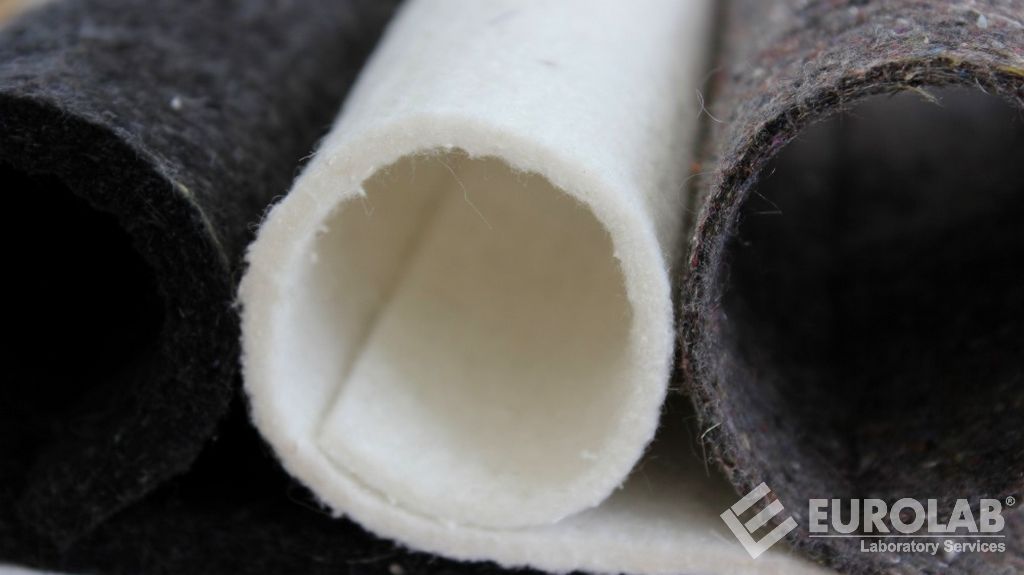
Non-woven geotextiles have many uses. The term non-woven fabric refers to fabrics with a web structure connected by entanglement of fibers. Non-woven geotextiles are multi-purpose fabrics.
Geotextiles are permeable fabrics made of polypropylene or polyester. These fabrics have the ability to separate, filter, reinforce, protect or drain when used in several different applications primarily associated with soil. Geotextile fabrics are produced in three basic forms: nonwoven geotextiles, woven geotextiles (needle punched) or heat bonded geotextiles (structural woven).
The use of geotextiles has been increasing in recent years. Geotextiles, when properly selected, provide significant environmental and economic benefits. The main applications of geotextiles are:
The apparent opening size of a geotextile is a geotextile property that specifies the approximate diameter of the largest particle that will effectively pass through the geotextile. At least 95 percent of openings apparently have this diameter or smaller. This opening size is determined by the dry sieve test described in ASTM D4751-16.
Among the numerous test, measurement, analysis and evaluation studies it provides for businesses in various sectors, our organization also provides standard testing services to determine the apparent aperture size of a geotextile, within the scope of ASTM D4751-16 standard, with its trained and expert staff and advanced technological equipment.
To get an appointment, to get more detailed information or to request an evaluation, you can ask us to fill in our form and reach you.

