

The standard "ASTM D2060-00 Standard test methods for measuring zipper dimensions" published by the American Society for Testing and Materials (ASTM) describes test methods for measuring the dimensions of zippers of all types and sizes. The main test methods include:
For definitions of terms related to zippers used in these test methods, the standard “ASTM D2050-19 Standard Terminology for Subassemblies Used in Textile Manufacturing” applies. For definitions of other textile terms, the standard “ASTM D123-19 Standard Terminology Related to Textiles” applies.
These test methods are considered satisfactory for acceptance testing of commercial shipments because the test methods have been widely used in commerce for this purpose and current estimates of interlaboratory precision are acceptable in most cases.
In the event of a dispute arising from differences in reported test results when this standard is used for acceptance testing of commercial shipments, the purchaser and supplier should conduct comparative tests to determine whether a statistical bias exists between their laboratories. Competent statistical assistance is recommended in investigating bias. At a minimum, the two parties should obtain a group of test samples consisting of a large number of materials of the type in question that is as homogeneous as possible. The test samples should then be randomly assigned in equal numbers to each laboratory for testing. The average results from the two laboratories should be compared using an acceptable probability level for unpaired data, selected by the two parties before testing begins. If a bias is found, either the cause should be found and corrected, or the purchaser and supplier should agree to interpret future test results in light of the known bias.
The test methods described in this standard, together with the test methods described in ASTM D2051, ASTM D2052, ASTM D2053, ASTM D2054, ASTM D2057, ASTM D2058, ASTM D2059, ASTM D2061 and ASTM D2062, are a collection of proven test methods. They can be used as an aid in evaluating zippers without requiring extensive knowledge of zippers. The test methods listed do not provide an evaluation of all zipper properties. In addition to the properties measured by the test methods listed, there are other properties that may be important for the satisfactory performance of a zipper. Test methods for measuring these properties have not been published because practical methods have not yet been developed.
A random number of individual containers are taken from each shipping carton as a lot sample for acceptance testing, as specified in an applicable material specification or other agreement between the purchaser and supplier. Individual containers from each shipping carton are considered primary sampling units. An adequate specification or other agreement between the purchaser and supplier requires that variability between shipping cartons and between zippers within a container be considered to provide a sampling plan that includes meaningful producer risk, consumer risk, acceptable quality level, and limiting quality level.
As a laboratory sample for acceptance testing, the number of zippers specified in this standard is randomly taken from each container in the batch sample. The zippers are accepted as both laboratory sample and test sample.
The test sample consists of a fully assembled piece of zipper or chain.
For some tests, the specimens are brought to moisture equilibrium for testing in a standard atmosphere for textile testing as specified in “ASTM D1776/D1776M-15 Standard Practice for Conditioning and Testing of Textiles”. Preconditioning is not required. For some tests, preconditioning or conditioning of the specimens is not required.
When testing the length of a zipper or parts, the chain or zipper is placed on a flat surface and the length of the zipper or desired zipper part is determined using a suitable scale. These measurements are useful in determining whether products using zippers meet purchase specifications and are suitable for end use.
When testing tape width, the chain or zipper is placed on a flat horizontal surface and the tape width is measured with the help of a scale. These measurements are used to determine the available tape width for the zipper to be installed.
When testing the slider opening width, a slider is cut in half and then the opening is measured. The slider opening width is only used to indicate the size of the zipper.
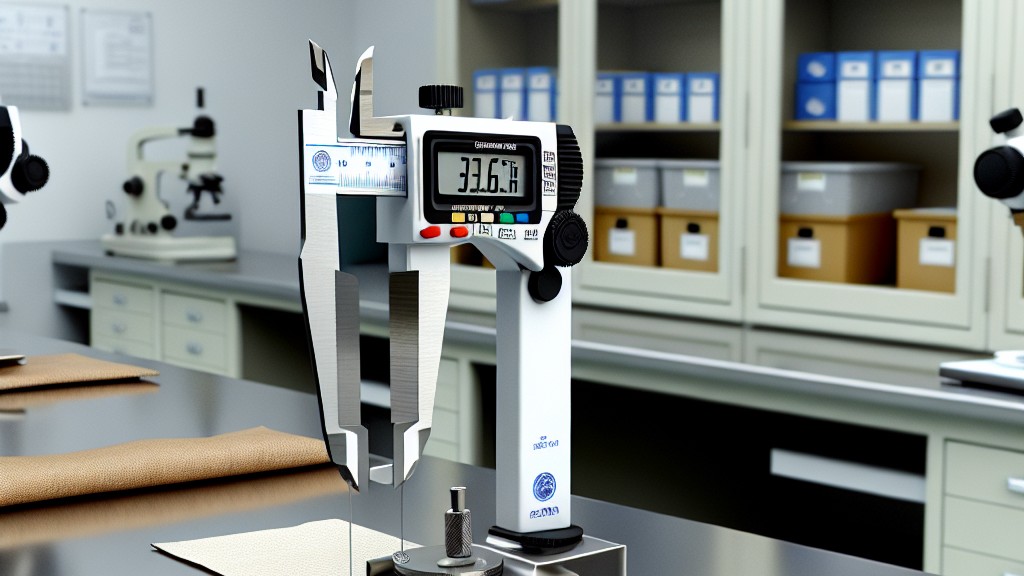
When testing chain thickness, a special measuring instrument is used to determine the chain thickness under certain conditions. This test method is useful for determining the chain thickness in conjunction with the design of sewing aids such as folders.
Our organization has a strong staff that closely follows the developments in the world in the field of science and technology and constantly improves itself. Among the numerous test, measurement, analysis and evaluation studies provided for businesses in various sectors, there are also test services in accordance with the "ASTM D2060-00 Standard test methods for measuring zipper dimensions" standard.
To get an appointment, to get more detailed information or to request an evaluation, you can ask us to fill in our form and reach you.

