

The standard “DIN 53894 Textile tests - Determination of dimensional change of textile fabrics”, published by the German Institute for Standardization (DIN), consists of the following sub-sections published under the same title:
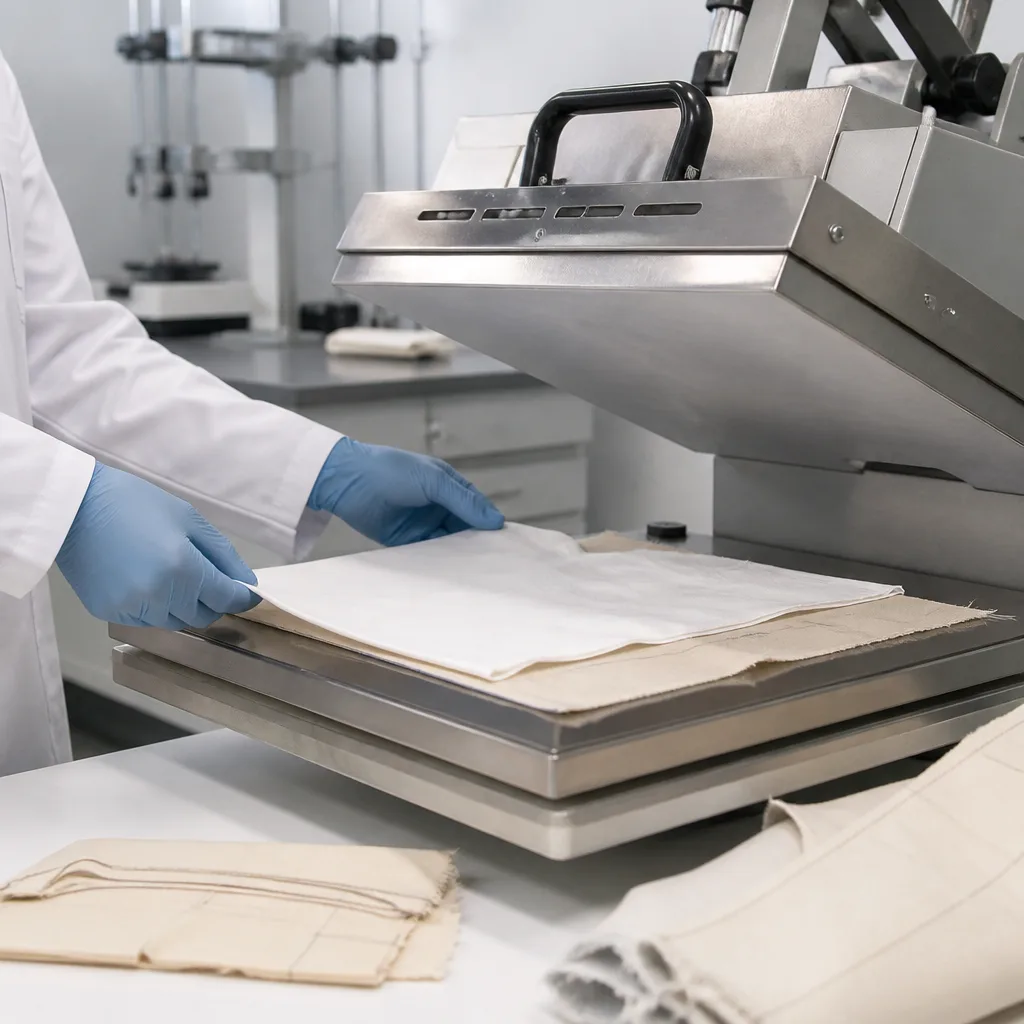
In this method, a damp ironing cloth (wet cloth) is placed over the fabric sample. Ironing is performed in an ironing press heated to the specified temperature, pressure, and time parameters.
This standard specifically evaluates the effects of heat, moisture, and mechanical pressure on fabric dimensions. This is particularly important for materials that may show shrinkage, deformation, or loosening during garment finishing, ironing, or care processes.
In short, the DIN 53894-1 standard focuses on ironing with a damp cloth in presses. Textile manufacturers, garment producers, and testing laboratories use this standard for the following purposes:
Typical sample sizes in laboratories are approximately 70 cm x 70 cm. Results are expressed as a percentage change in length and width (positive for growth, negative for shrinkage). Such dimensional stability tests help simulate real-life stresses that fabrics encounter.
This test method is generally applied in conjunction with other stability tests:
In conclusion, the DIN 53894-1 standard provides a standardized, repeatable method for measuring how much a textile fabric changes dimensions when ironed under moisture and pressure. This is a specialized tool in the field of textile physical testing, focusing on dimensional stability under ironing conditions, and helps ensure that finished garments maintain their intended fit and appearance after production or professional care.
In this method, the fabric sample is steamed without any mechanical stress or pressure holding it in place. This test simulates the effect of steam relaxation in industrial garment finishing or ironing processes. It measures how much the fabric relaxes and changes dimensions under the influence of steam (heat and moisture), allowing internal stresses to be released.
The elongation or shrinkage values obtained using this method generally cannot be directly compared with the results of other dimensional stability tests. These include:
Unlimited vaporization leads to different relaxation behaviors.
Manufacturers, garment producers, and testing laboratories use this standard for the following purposes:
This testing method is particularly important for fabrics that have not been fully stabilized or fixed during production.
Ultimately, while the DIN 53894-1 standard focuses on ironing with a damp cloth in heated ironing presses (involving mechanical pressure, moisture, and heat), the DIN 53894-2 standard focuses on pure steaming in irons in a completely free state (no pressure from the cloth or heavy pressing, just steam relaxation). Both methods simulate different real-world ironing scenarios.
This test is often combined with the following:
In short, the DIN 53894-2 standard provides a standardized laboratory method for measuring how textile fabrics change dimensions when freely steamed in ironing machines. By focusing on the effects of relaxation under steam without mechanical restraint, it helps manufacturers ensure that garments maintain the proper fit and appearance after professional finishing or care processes.
For many years, our organization, with its competent and experienced staff, has been understanding the needs of its clients, providing the advanced testing services they require, and assisting them in the establishment, implementation, and improvement of management systems. Within this framework, we also provide testing services in accordance with the DIN 53894 standard.
To get an appointment, to get more detailed information or to request an evaluation, you can ask us to fill in our form and reach you.

