DIN 54205 Textile Tests - Quantitative Analysis of Binary Blends - Blending of Natural or Regenerated Cellulose Fibers with Polyester Fibers - Sulfuric Acid Method
The standard “DIN 54205 Textile tests - Quantitative analysis of binary blends - Blending of natural or regenerated cellulose fibers with polyester fibers - Sulfuric acid method”, published by the German Institute for Standardization (DIN), describes a chemical method for determining the quantitative composition (blend ratio or percentage of fiber content) in binary textile blends consisting of the following:
- Natural cellulose fibers (e.g., cotton, linen, hemp)
- Regenerated cellulose fibers (e.g., viscose, modal, lyocell)
- Polyester fibers
This testing method is particularly useful in the textile industry for quality control, labeling compliance (fiber content declarations), and verification of material composition in blended fabrics such as cotton-polyester or viscose-polyester blends.
This method relies on the varying chemical resistance of the fibers to concentrated sulfuric acid:
- Cellulose fibers (natural and regenerated) are dissolved or degraded by acid.
- Polyester fibers (polyethylene terephthalate, PET) remain largely resistant and insoluble under the specified conditions.
In general, this method follows these steps:
- Sample preparation: Textile samples are cut to defined dimensions and marked for measurement.
- Initial measurement: Original dimensions are measured before processing.
- Conditioning: Samples undergo controlled processes such as washing, soaking, heating, and drying cycles.
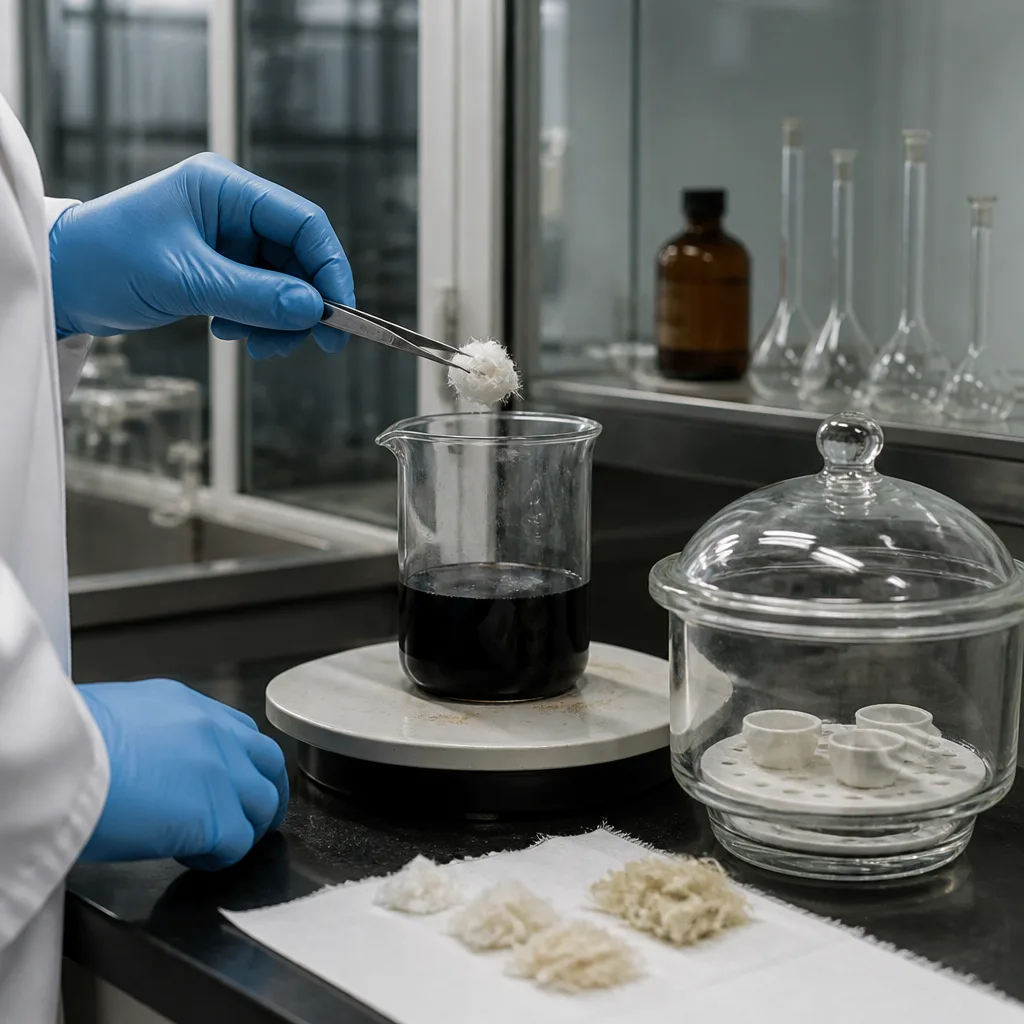
- The sample is treated with sulfuric acid at a defined concentration under controlled temperature and time conditions.
- The insoluble residue (primarily polyester) is filtered, washed, dried, and weighed.
- Final measurement: Dimensions are measured again after the process.
- Calculating the change: Shrinkage or expansion is calculated as a percentage. The polyester percentage is found by calculating the mass of the residue relative to the mass of the original sample. Cellulose content is determined by the difference method, and corrections are applied for small losses or moisture. Positive values indicate expansion, while negative values indicate shrinkage.
This standard provides precise details on reagent concentration, process parameters, calculation formulas, and necessary correction factors to obtain accurate results.
The scope of this standard is limited to binary blends of the specified fiber types. It is not intended for other fiber combinations or multi-component blends without adaptation.
The DIN 54205 standard is widely used in the following areas:
- Textile testing laboratories
- Clothing manufacturers
- Upholstery textile manufacturers
- Home textile manufacturers (curtains, bedding, towels)
- Automotive fabric manufacturers
- Importers
- According to regulations (e.g., EU fiber labeling rules or similar national requirements), certification bodies are required to verify fiber content claims.
Other DIN standards exist for different fiber combinations (e.g., using different solvents or enzymatic methods). Internationally, similar tests refer to ISO or EN equivalents for mixture analysis, but the DIN 54205 standard is a specific national method using sulfuric acid.
Accurate determination of fiber content is critical for:
- Correct product labeling
- Ensuring performance characteristics (e.g., durability, comfort, moisture management)
- Meeting buyer specifications and regulatory requirements.
- Preventing disputes in trade.
In short, the DIN 54205 standard belongs to the DIN 54xxx series, which focuses on test methods and quality requirements for textiles and related materials. This standard defines a test method for determining the dimensional stability and behavior of textile materials under defined conditions. Practically, it helps manufacturers and laboratories evaluate how fabrics or textile products respond to the following types of processes:
- Washing
- Drying
- Exposure to heat
- Humidity changes
- Training processes
This standard provides a structured procedure for measuring the following changes after exposure to specific conditions:
- Length
- Width
- Figure
- Surface appearance
Typical products tested include:
- Cotton fabrics
- Polyester blends
- Knitting materials
- Woven fabrics
- Coated textiles
The main advantages of using the DIN 54205 standard are as follows:
- Standardized test method
- Comparable results between laboratories.
- Better material selection
- Improved product durability
- Compliance with European quality standards.
The DIN 54205 standard is necessary because textile products rarely behave smoothly after production. A fabric may appear perfectly stable on the production line, but it can shrink, stretch, wrinkle, or deform after washing, drying, or exposure to heat. This standard is essential to establish a uniform method for measuring dimensional stability so that manufacturers, suppliers, and testing laboratories can assess textile performance in the same way.
The DIN 54205 standard is considered important for the following reasons:
- It prevents product shrinkage problems: Consumers expect products such as shirts, bedding, curtains, and upholstery fabrics to retain their size after cleaning. Without standardized testing,
- Clothes may shrink after the first wash.
- Curtains may no longer fit the windows.
- Seat covers or technical fabric components may become unusable.
This standard helps identify potential risks before products reach the market.
- It supports quality control: Manufacturers need objective criteria to approve or reject textile batches. This standard allows companies to:
- Comparing production batches
- Identifying variations in the process.
- Verifying the quality of the finish.
For example, changes in fabric tension, heat treatment, or chemical finishing can affect dimensional stability.
- Ensures supplier consistency: Textile supply chains often involve multiple suppliers in different countries. This standard provides a common testing method so that fabric suppliers, garment manufacturers, retailers, and certification laboratories all work with the same measurement rules.
- Improves customer satisfaction: Dimensional instability is one of the most common causes of complaints in textiles. Commonly seen are twisted garments, wrinkled seams, shrinkage, and deformation. Testing under this standard reduces the risk of returns and warranty claims.
- Important for technical performance: In technical textiles, dimensional stability is not just a cosmetic factor. For example,
- Automotive fabrics must fit the seats perfectly.
- Industrial covers must maintain tolerances.
- Filter materials must maintain their geometry.
- Even small size changes can affect safety or functionality.
- Supports contractual and legal requirements: Many customers specify size change limits in their purchase contracts. This standard provides an accepted method for verifying compliance with such specifications.
In conclusion, the DIN 54205 standard is a valuable textile testing standard that provides a consistent method for evaluating dimensional changes in fabrics after environmental or maintenance-related treatments. It supports quality assurance in textile production by ensuring materials remain stable, functional, and fit for purpose throughout their life cycle.
For many years, our organization, with its competent and experienced staff, has been understanding the needs of its clients, providing the advanced testing services they require, and assisting them in the establishment, implementation, and improvement of management systems. Within this framework, we also provide testing services in accordance with the DIN 54205 standard.



