

EN 24920 Textiles - Determination of Resistance to Surface Wetting of Fabrics (Spray Test)

EN 24920 Textiles - Determination of Resistance to Surface Wetting of Fabrics (Spray Test)

The European standard "EN 24920 Textiles - Determination of the resistance of fabrics to surface wetting (spray test)" describes a method applicable to all fabrics, whether or not they have been treated with a water-resistant or water-repellent coating. This standard is not intended to estimate the permeability of fabrics to rain, as it does not measure the permeability of water through the fabric. Before testing, the sample must be conditioned for at least 24 hours in the standard atmosphere for testing textiles.

EN 24920 Textiles - Determination of Resistance to Surface Wetting of Fabrics (Spray Test)

This standard is based on the “ISO 4920 Textile fabrics - Determination of resistance to surface wetting (spray test)” standard published by the International Organization for Standardization (ISO).

This standard specifies a spray test method for determining the resistance of any fabric, whether or not it has been treated with a water-resistant or water-repellent coating, to wetting by water. For the purposes of this standard, the spray rating is a measure of the resistance of a fabric's surface to wetting.

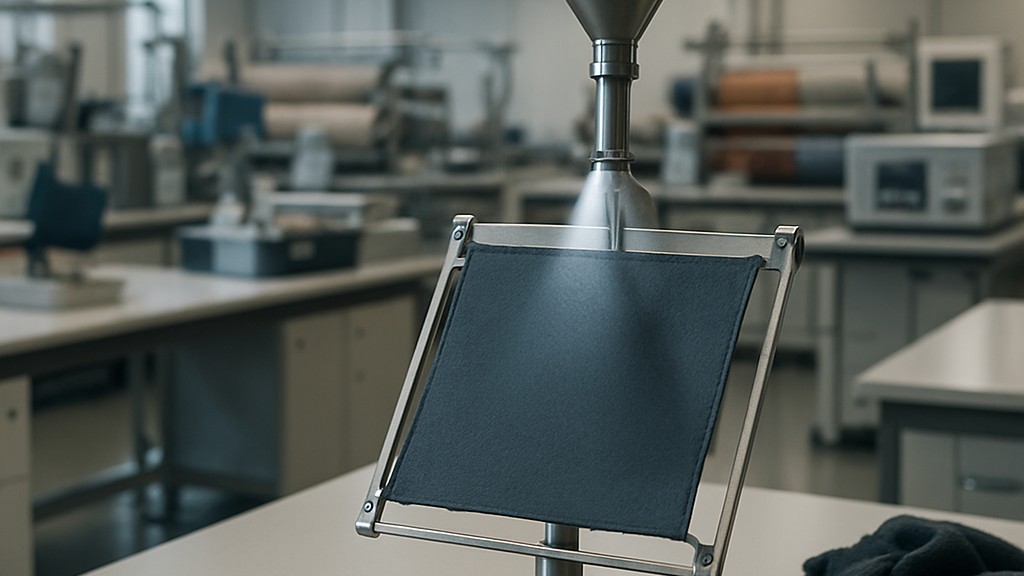
In principle, a specified volume of distilled or fully deionized water is sprayed onto a test sample mounted on a ring and positioned at a 45-degree angle, so that the center of the sample is a specified distance below the spray nozzle. The degree of spraying is determined by comparing the sample's appearance with descriptive standards and photographs.

The equipment and materials used in these tests include:

  • The spray device consists of a 150 mm vertically held funnel and a metal nozzle connected to the end of the handle by a 10 mm diameter rubber tube. The distance from the top of the funnel to the base of the nozzle is 190 mm.
  • The metal nozzle has a convex surface with 19 holes, each 0,9 mm in diameter. The holes are distributed evenly across the nozzle surface. For a specified volume of 250 ml of water poured into the funnel, the flow time should be between 25 and 30 seconds.
  • A specimen holder is a holder consisting of two interlocking wooden or metal rings, one with a 150 mm inner diameter and the other with a 150 mm outer diameter (for example, an embroidery hoop), to which the specimen can be secured. When positioned for a test, the rings should be inclined at a 45-degree angle to a suitable support, so that the center of the test area is 150 mm below the center of the spray nozzle face.
  • Distilled or fully deionized water should be at 20 degrees plus/minus 2 degrees or 27 degrees plus/minus 2 degrees.

Conditioning and testing must be carried out in accordance with ISO 139. If so agreed, conditioning and testing can be carried out in an ambient atmosphere.

Test samples are taken from at least three 180 mm squares of the fabric, representing the material as accurately as possible. Test samples should not be taken from areas with wrinkles or folds. Test samples are conditioned in the defined atmosphere for at least 24 hours. After conditioning, the test sample is securely placed in the sample holder and placed on the hoop support with the fabric face up. Unless otherwise specified in the material specification, the sample should be oriented so that the warp direction is parallel to the water flowing down the sample. Pour 250 ml of water into the funnel quickly but steadily, ensuring continuous spraying once it has begun.

Immediately after the spray has ceased, the holder, including the sample, is removed and struck twice sharply against a hard object (at diagonally opposite points on the frame). During this process, the fabric should be nearly horizontal, with the fabric face down.

After passing over, with the sample still in the holder, the sample is assigned the rating that best describes the degree of wetting observed on the descriptive scale below or on the photographic scale. Intermediate ratings should not be assigned.

Photographic standards are not entirely satisfactory for dark colours, for such fabrics greater reliance must be placed on verbal descriptions.

The spraying degree is as follows:

  • 1 = Wetting of the entire sprayed surface.
  • 2 = Wetting of half the sprayed surface. This is usually achieved by combining small separate wetting areas.
  • 3 = Wetting of the sprayed surface only in small discrete areas.
  • 4 = The sprayed surface does not get wet, but small drops stick.
  • 5 = The sprayed surface does not get wet and small drops do not stick.

The test report to be prepared must include the following information:

  • Reference to this international standard
  • Atmosphere used (standard temperate or standard tropical or other atmosphere)
  • Water temperature (20 degrees or 27 degrees or other temperature)
  • Spray degree for each sample tested

The EN 24920 standard is considered important in the textile industry for many reasons. Namely,

  • Standardized assessment of water repellency: Provides a consistent, repeatable method for assessing how well a fabric resists surface wetting. This is critical for comparing products across manufacturers or for verifying claims regarding water repellent coatings.
  • Performance and quality control: Used during quality assurance to ensure fabrics meet the required water repellency standards for their intended application (e.g., rainwear, outdoor clothing, uniforms). It ensures that functional textiles perform as expected, especially in protective or high-performance use.
  • Evaluation of chemical coatings: Many textiles are treated with water-repellent coatings (e.g., fluorocarbons, silicones). This standard helps measure the effectiveness and durability of these surfaces after abrasion, washing, or weathering.
  • Compliance and labeling: Supports regulatory and certification frameworks by providing a standard method that manufacturers must meet to label their fabrics as water repellent. It is often referenced in product specifications, supply contracts, and international trade.
  • International trade and communication: Enables clear communication between suppliers, buyers, and testers worldwide using a common testing methodology. Facilitates global interoperability and benchmarking within the textile industry.

In short, this standard is necessary because it guarantees the reliability, comparability and credibility of water repellency claims in textiles and plays an important role in product development, safety and consumer satisfaction.

Our organization, which has been supporting businesses across all sectors for years through a wide range of testing, measurement, analysis, and evaluation activities, boasts a strong team of employees who closely follow global developments in science and technology and are constantly improving themselves. In this context, we also provide testing services in accordance with the EN 24920 Textile - Determination of the resistance of fabrics to surface wetting (spray testing) standard.

WhatsApp

