

Developed by the American Society for Testing and Materials (ASTM), the standard "ASTM D751 Standard Test Methods for Coated Fabrics" describes test methods for rubber-coated fabrics, including, but not limited to, tarpaulins, raincoats, and similar products. The scope of each test method is included in the section describing the test method.
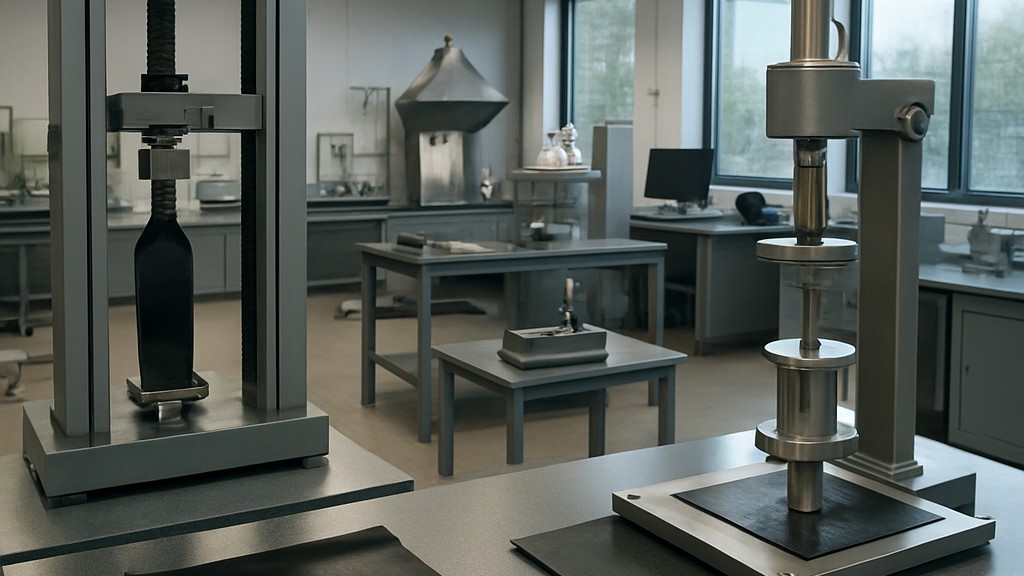
These testing methods include:
Coated fabrics and rubber products made from coated fabrics are important commercial items, and adequate test methods must be available to ensure the quality of these products. The test methods described in this standard provide this testing capability.
Coated fabrics should be tested in an environment meeting the conditions defined in this standard unless otherwise specified or by agreement between the supplier and purchaser. When it is known that the coated fabric will be used in a tropical environment, the atmosphere defined in this standard shall prevail.
The temperate atmosphere is the standard condition for testing coated fabrics when the fabric is in moisture equilibrium in a standard atmosphere of 50 percent relative humidity plus or minus 5 percent at 23 degrees plus or minus 2 degrees.
The tropical atmosphere is the standard condition for testing coated fabrics when the fabric is in moisture equilibrium in a standard atmosphere of 65 percent relative humidity plus/minus 5 percent at 27 degrees plus/minus 2 degrees.
Moisture equilibrium is considered to be reached when there is no gradual increase in mass after free exposure to moving air. Moisture equilibrium should be approached from the dry side (not the moisture-free side). Some coatings can significantly delay moisture penetration into the fabric, so fabrics coated on both sides may take 24 hours or more to reach equilibrium.
For all testing purposes, the minimum time between vulcanization and testing should be 16 hours. For non-product testing, the maximum time between vulcanization and testing should be four weeks, and for evaluations intended to be comparable, testing should be conducted after the same time interval whenever possible. For product testing, the time between vulcanization and testing should not exceed three months, if possible. In other cases, testing should be conducted within two months of receipt by the customer.
The sensitivity expressions for this standard are prepared in accordance with ASTM D4483. Terminology and other testing and statistical concepts apply to ASTM D4483. Sensitivity results provide an estimate of the sensitivity of these test methods with materials (rubbers) used in a specific interlaboratory program as described in the standard's appendix (Appendix A1). Sensitivity parameters should not be used for acceptance or rejection testing of any group of materials without documentation that they are applicable to those specific materials and to specific test protocols incorporating those test methods.
In test method statistical terminology, bias is the difference between an average test value and the reference or true test characteristic value. Because the value or level of the test characteristic is defined solely by the test method, reference values do not exist for these test methods. Therefore, bias cannot be determined.
The general method for measuring length is as follows: The coated fabric is laid flat on a horizontal surface without tension, and its length is measured parallel to the edges, or successive sections, each at least 5 m long, are measured under the same conditions. In the drum method, the coated fabric is moved over a measuring drum with sufficient uniform tension to ensure flat and accurate running. The length is determined from a dial or counter on the drum.
The general method for determining width is as follows: The coated fabric is laid flat on a horizontal surface, but without tension in both directions. The average of at least five separate measurements, evenly distributed along the entire length of the roll or piece, is reported as the average width of the roll or piece.
The gauge used to measure thickness shall be of the deadweight type, fitted with a dial graduated to read directly to 0,025 mm. The presser foot shall be circular with a diameter of 9,52 plus or minus 0,03 mm. The presser foot and its associated moving parts shall be weighted so that a total force of 1,7 plus or minus 0,03 N is applied to the specimen, equivalent to a pressure of 23,5 plus or minus 0,5 kPa. The presser foot and anvil surfaces shall be flat to within 0,0025 mm and parallel to each other to within 0,0025 mm. The gauge shall be calibrated for the actual load exerted by the presser foot by means of any device designed to measure the total vertical force exerted by the presser foot at the various readings or presser foot levels selected for calibration. The presser foot shall be brought to each calibration level from a higher level.
The general method for measuring thickness is as follows: The coated fabric is placed flat on the anvil of the measuring device, but without tension. The presser foot is gradually lowered (without impact) onto the material, held in place for 10 seconds, and then the dial reading is observed. Similar measurements are made at least five different locations, evenly distributed over the surface of the coated fabric, excluding the area adjacent to each edge of the fabric and the area one-tenth of the width of the fabric or 2,5 m from each end of a roll or piece. The average of five or more measurements is reported as the average thickness.
The mass method applicable to the piece, cut, or roll is generally applied for mass determination. The complete piece, cut, or roll is weighed on a calibrated balance to an accuracy of 0,25 percent, the length and width of the coated fabric are measured, and the mass is calculated and reported in grams per square meter to the nearest 2,8 g.
The applicable method for sampling by mass is as follows: A sample with an area of at least 129 cm2, or a series of samples with a total area of at least 50 mm square and at least 129 cm2, is cut from the coated fabric, weighed on a calibrated balance to an accuracy of 0,25 percent, and the mass is calculated and reported in grams per square meter. A sample should not be taken closer than one-tenth of the width of the fabric unless a sample across the entire width of the fabric is used.
Our organization, which has been supporting businesses across all sectors for years through a wide range of testing, measurement, analysis, and evaluation activities, has a strong team of employees who closely follow global developments in science and technology and are constantly improving themselves. In this context, we also provide testing services in accordance with ASTM D751 Standard Test Methods for Coated Fabrics.
To get an appointment, to get more detailed information or to request an evaluation, you can ask us to fill in our form and reach you.

