

The European standard "EN 13758 Textile - Sun UV protective properties" consists of the following subsections published under the same title:
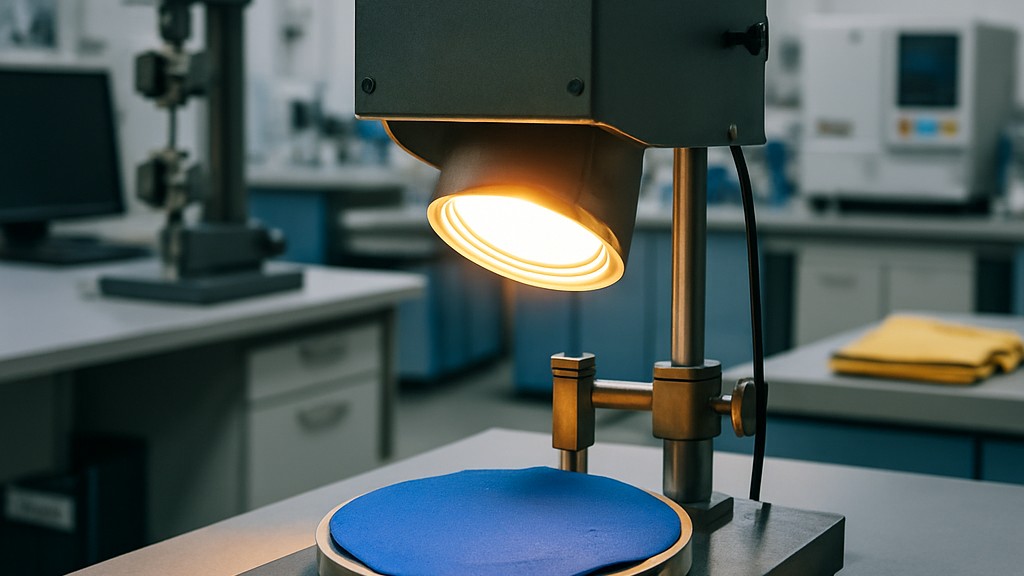
The ultraviolet protection factor of a textile material is determined from its total spectral transmittance, according to the formula given in the standard. Total spectral transmittance is measured by irradiating the sample with monochromatic or multichromatic UV radiation and summing the total (diffuse and direct) transmitted radiation. In the case of multichromatic incident radiation, the transmitted radiation is collected monochromatically. The instrument can irradiate the sample with a parallel beam and collect all transmitted radiation with an integrating sphere, or irradiate the sample hemispherically and collect a parallel beam of transmitted radiation.
For homogeneous materials, at least four samples should be prepared. These samples should be spaced as widely as possible across the fabric width. The first 5 cm from each edge should be discarded, and samples should be taken no closer than 1 m from the beginning or end of the fabric piece. For materials with varying tones or textures, at least two samples of each color and each texture area should be tested. The sample size should be sufficient to cover the sample opening of the device.
Conditioning and testing must be carried out in accordance with EN 20139. If the test device is not under these standard atmospheric conditions, transport and testing of the conditioned test sample must be completed within 10 minutes.
When performing the test, the sample to be tested is placed in front of the integrating sphere's entrance aperture so that the side of the fabric intended to be worn away from the skin is exposed to the UV source. Fluorescence is checked on monochromated instruments before the sample. If a fluorescent substance is present, a UV-transmitting filter is used and its effectiveness verified. Transmittance between 290 nm and 400 nm is recorded, and data is recorded at least every 5 nm.
Clothing designed to provide protection for the upper body must at least completely cover the upper body. Clothing designed to provide protection for the lower body must at least completely cover the lower body. Clothing designed to provide protection for both the upper and lower body must at least completely cover the upper and lower body.
The ultraviolet protection factor (UPF) of all materials used in garment assembly must be measured according to EN 13758-1. The minimum UPF value must be greater than 40. The average UVF transmittance for homogeneous samples, or the sample UVF transmittance for non-homogeneous samples, determined according to EN 13758-1, must be less than 5 percent.
Essentially, EN 13758 is a European standard that defines the requirements and test methods for textiles and clothing designed to protect against the sun's harmful ultraviolet (UV) rays. With increasing awareness of the risks associated with long-term sun exposure, such as skin damage and cancer, this standard ensures that UV-protective clothing provides reliable protection for outdoor workers and consumers.
This standard is divided into two parts:
UV-protective clothing certified to EN 13758 is critical for those working outdoors for extended periods, such as in the construction, landscaping, agriculture, or energy sectors. These garments offer a practical alternative to sunscreen, providing continuous protection without the need for reapplication. However, additional precautions such as hats, sunglasses, and shaded work areas are recommended for increased safety.
This standard's clear labeling helps consumers and employers quickly identify reliable UV-protective clothing, ensuring compliance with workplace safety regulations and reducing long-term health risks.
The EN 13758 standard shares similarities with international standards such as the Australian AS/NZS 4399 and the American AATCC TM 183, which use the Albuquerque solar spectrum for testing. However, EN 13758-2's focus on garment design and labeling sets it apart, ensuring effective protection for the entire garment, not just the fabric.
Consequently, the EN 13758 standard plays a vital role in the development of safe and effective UV-protective clothing. By establishing clear testing and labeling requirements, it ensures that clothing provides reliable protection against harmful UV radiation, benefiting both outdoor workers and consumers. Understanding this standard enables individuals and organizations to make informed sun protection choices, contributing to safer outdoor environments.
Our organization, which has been serving for many years and meticulously following global developments in science and technology, employs a team of experienced professionals and a broad infrastructure to conduct testing, measurement, and analysis in a wide range of areas for businesses across all sectors. In this context, we also provide testing services in accordance with the EN 13758 Textile - Sun UV protection properties standard.
To get an appointment, to get more detailed information or to request an evaluation, you can ask us to fill in our form and reach you.

