

The standard "DIN 53356 Testing of artificial leather and similar fabrics - Tear propagation test," developed by the German Institute for Standardization (DIN), describes a test method used to assess the resistance of a cut specimen to tear propagation. For this purpose, the tear propagation force is determined.
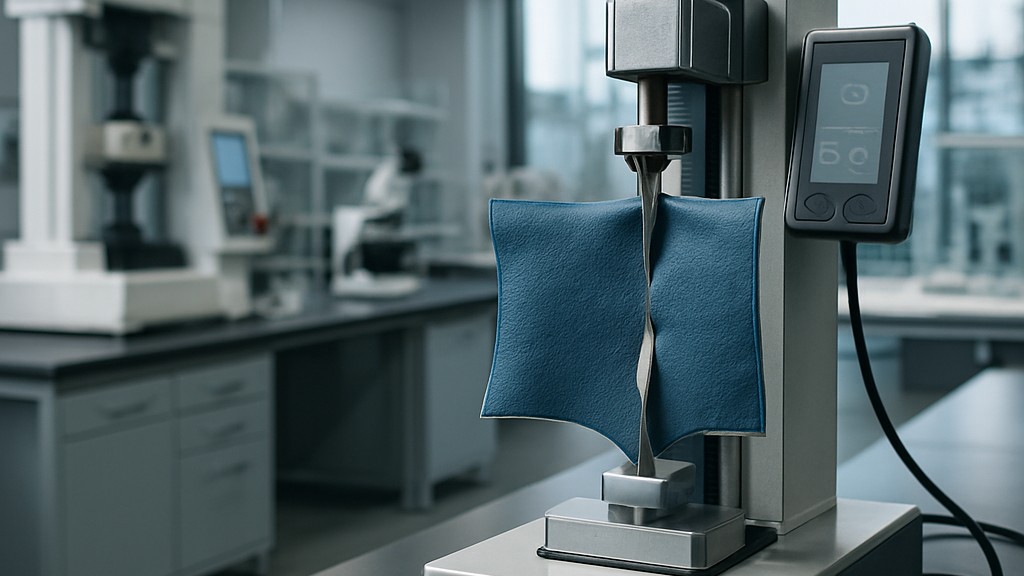
The test method described is applicable to all products according to DIN 16922, except for films and non-woven synthetic leather. The tear propagation test is performed on films according to DIN 53363 and on non-woven synthetic leather according to DIN 53329.
The tear propagation force as defined in this standard is the force required to cause a test specimen cut along an edge to tear and propagate along the extension of the cut.
Sampling and pretreatment must be carried out in accordance with DIN 16906 "Testing of plastic sheets and plastic films - Specimen and sample - Preparation and conditioning." Five test samples (Form A), each 50 mm wide and 100 mm long, are taken lengthwise and crosswise to the production direction. For woven synthetic leather, test samples should be taken with the grain in a straight line. Samples are cut 50 mm down the center of a narrow edge, straight as a thread and parallel to the long edge.
Products where threads may be drawn during testing (e.g., those with very large pores) are tested with samples 150 mm wide and 200 mm long (Form B). The samples are cut 100 mm down the center of one edge.
When performing this test, a Class 1 tensile testing machine, as defined in the DIN 51221 Tensile Testing Machines standard, must be used. This device operates on the constant deformation rate principle and records the tensile force acting on the sample at any given instant.
The tear propagation test is performed in five separate tests in the warp (lengthwise) and weft (transverse) directions under standard conditions according to DIN 50014. If the sample tears laterally, splits parallel to the surface, or the threads are pulled, the test should be repeated with another sample of the same shape. If the same behavior is observed with several Form A samples, the test should be repeated with Form B samples.
The legs of the cut specimen are clamped in the clamps of the tensile testing machine, with the longitudinal edges of the legs parallel to the direction of pull and the center of the cut clamp parallel to the clamp. If the legs of the test specimen (for example, for Form B specimens) are wider than the clamps of the tensile testing machine, the legs can be folded toward the notch, i.e., from the outside inward, parallel to the direction of pull.
The test speed is 100 plus/minus 10 mm/min (corresponding to the VI test speed according to DIN 53455). The diagram feed rate should be selected to ensure a clear evaluation. The clear distance between the clamps is 50 mm.
During the evaluation process, the first and last quadrants of the diagram are not considered in calculating tear strength. The remaining portion of the diagram is divided into nine equal quadrants using 10 grid lines. The forces corresponding to these intersections are used in the evaluation.
The evaluation method described here calculates a tear strength corresponding to the average tensile forces acting on the test specimens at specific test times. This method allows evaluation even if the diagrams do not show distinct peaks, a common situation for some nonwoven fabrics.
For products that inherently produce tear strength diagrams that exhibit periodic or near-periodic fluctuations, the evaluation must be agreed upon and stated in the test report. Results obtained from Form A and Form B test specimens may differ from each other.
The tear strengths determined for each of the five test specimens are averaged separately for the longitudinal and transverse directions and rounded to two decimal places.
If test results are being evaluated statistically, the following information should be included in the test report:
The DIN 53356 standard is important because it provides a standardized method for testing the tear resistance of artificial leather and similar sheet materials. This standard is considered important for the following reasons:
As a result, the DIN 53356 standard is important because it supports consistent performance, innovation and compatibility across various sectors by ensuring the quality, durability and reliability of artificial leather and similar materials.
Our organization, which has been supporting businesses across all sectors for years through a wide range of testing, measurement, analysis, and evaluation activities, has a strong team of employees who closely follow global developments in science and technology and are constantly improving themselves. In this context, we also provide testing services in accordance with the DIN 53356 "Testing of artificial leather and similar fabrics - Tear propagation test" standard.
To get an appointment, to get more detailed information or to request an evaluation, you can ask us to fill in our form and reach you.

