

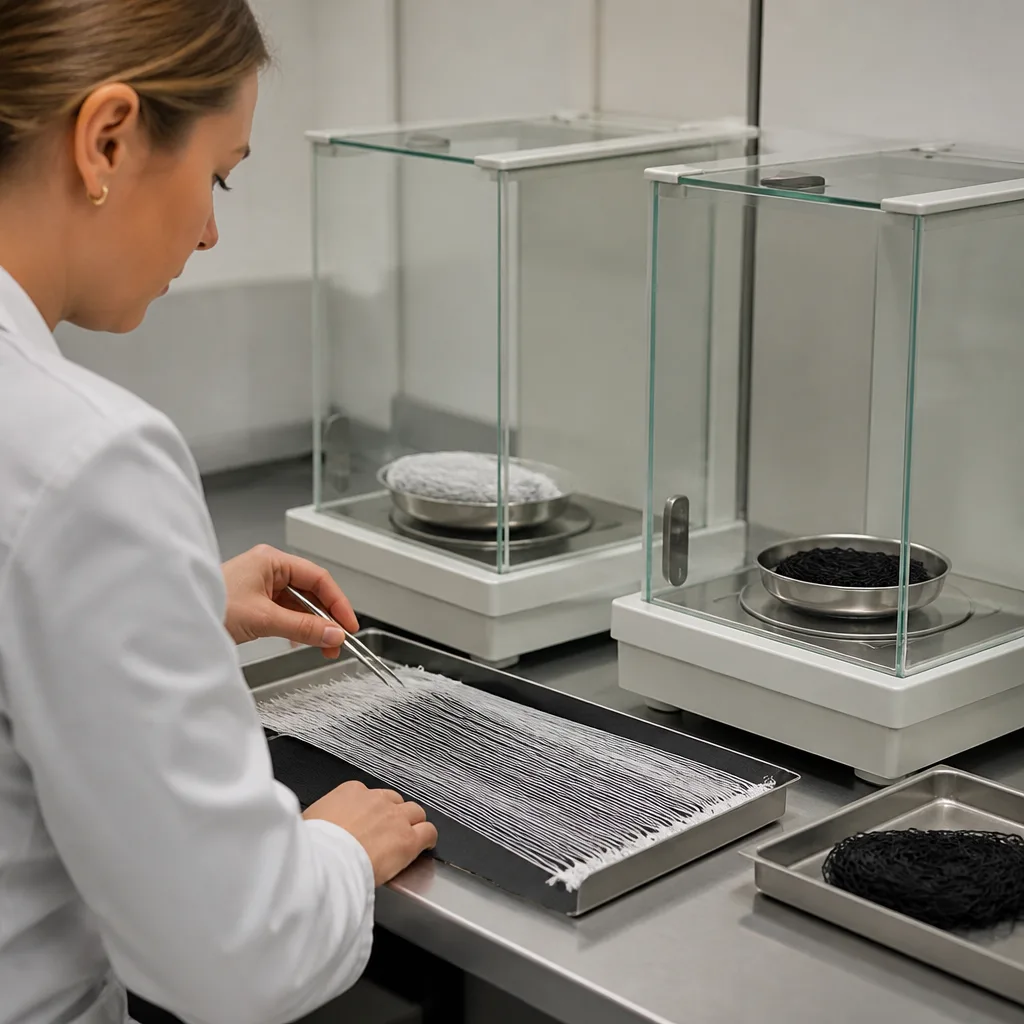
The standard “DIN 53856 Textile tests - Determination of warp and weft mass ratio”, published by the German Institute for Standardization (DIN), describes the method for determining the mass (weight) ratio of warp (longitudinal) and weft (transverse) yarns in woven textile fabrics. This is important for quality control and material analysis because,
This standard has been discontinued, but it remains a valid and current standard, particularly in many textile testing laboratories in Germany and Europe.
This standard is generally used in conjunction with other structural tests described in the following standards:
Textile testing laboratories routinely apply the DIN 53856 standard as part of comprehensive fabric analysis. Physical textile tests are included in laboratory test directories for quality verification of woven materials and R&D studies for new fabrics.
This standard provides repeatable results under controlled conditions (typically a standard atmosphere for textiles).
The method described in the DIN 53856 standard generally follows these steps:
These parameters are critical to determining how a textile product will perform under real-world usage conditions (e.g., wearing, stretching, or load-bearing).
In the textile industry, uneven warp/weft mass distribution can lead to problems such as warping, distortion, or differential shrinkage during finishing or use. This test provides objective data for:
In short, the DIN 53856 standard focuses on evaluating the behavior of textiles under specific mechanical or functional conditions. Like many standards in the DIN 538xx series, it is widely used in textile laboratories and quality assurance processes.
The DIN 53856 standard includes a test method for determining the resistance of textiles to mechanical stress. This typically relates to seam strength, shear, or deformation under load. The exact application may vary depending on the type of textile (woven, knitted, or nonwoven), but the fundamental aim is to assess how fabrics behave when subjected to forces similar to those in real-life use.
The main objectives of the DIN 53856 standard are as follows:
Typical applications of this standard include:
The DIN 53856 standard is necessary because woven fabrics do not always have a symmetrical or homogeneous structure. In most woven textiles, the warp (longitudinal threads) and weft (transverse threads) can differ significantly in the following respects:
These differences directly affect the overall performance, appearance, and behavior of the fabric. Without a standardized, repeatable method for measuring the warp-to-weft mass (weight) ratio, it would be impossible to objectively verify or compare these structural properties.
The main reasons why this standard is necessary are as follows:
Without the DIN 53856 standard or a similar standardized method, an objective, comparable method for measuring one of the fundamental structural properties of woven fabrics would be lacking. This standard has made quality assurance, material selection, failure analysis, and innovation far more subjective.
In conclusion, the DIN 53856 standard is a valuable standard within the textile testing framework, providing a structured and reliable method for evaluating how fabrics respond to mechanical stress. By ensuring consistency and repeatability, it helps manufacturers produce high-quality, durable textile products suitable for a wide variety of applications.
For many years, our organization, with its competent and experienced staff, has been understanding the needs of its clients, providing the advanced testing services they require, and assisting them in the establishment, implementation, and improvement of management systems. Within this framework, we also provide testing services in accordance with the DIN 53856 standard.
To get an appointment, to get more detailed information or to request an evaluation, you can ask us to fill in our form and reach you.

