

The standard “ISO 1973 Textile fibers - Determination of linear density - Gravimetric method and vibroscope method” published by the International Organization for Standardization (ISO) describes a gravimetric method and a vibroscope method for determining the linear density of textile fibers, applicable to fiber bundles and individual fibers.
This method can also yield useful data on man-made fibers and, to a lesser extent, natural fibers. This standard applies only to fibers that can be kept straight and parallel in bundles during test preparation. It can be applied appropriately if the fibers are easily uncoiled. The methods in this document cannot be applied to conical fibers. The vibroscope method cannot always be applied to hollow and flat (ribbon-like) fibers.
For the purposes of this standard, the following terms and definitions apply:
In general, two methods are described for determining linear density:
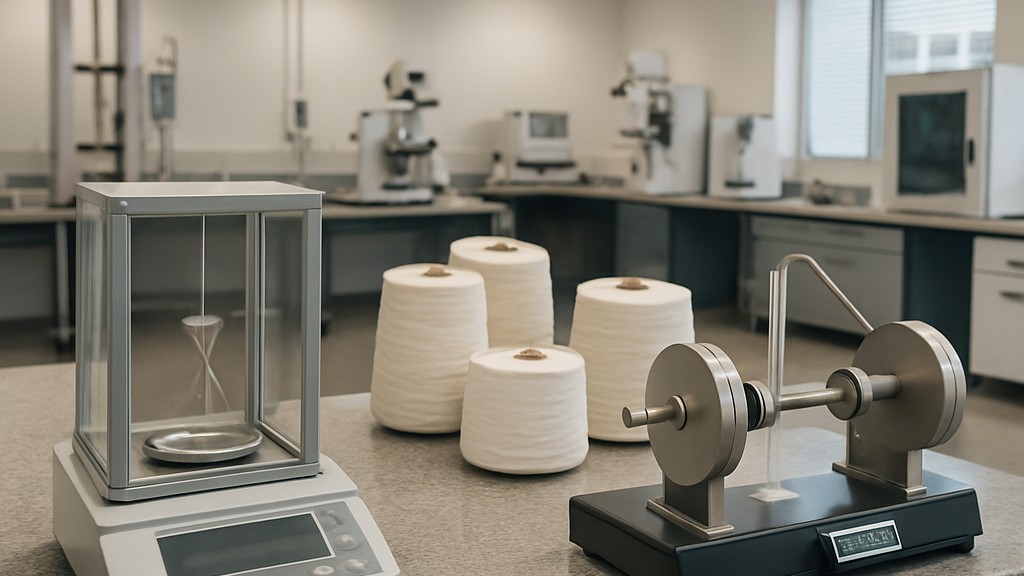
The apparatus used in the gravimetric method includes:
The device used in the vibroscope method includes:
To ensure that the laboratory sample is representative of the material and that the test sample is representative of that sample when taken from the laboratory sample, sampling must be carried out in accordance with the ISO 1130 standard.
Preconditioning, conditioning and testing environments must comply with the ISO 139 standard.
When applying the gravimetric method, test samples are conditioned and the tests are conducted in a standard atmosphere. Ten strands, each weighing a few milligrams, are taken from the laboratory sample, and the fibers from each strand are carefully combined with the comb separator several times to align them parallel. The center of each combed strand is cut to the maximum length possible with a cutting device, under the minimum tension required to eliminate crimp. Necessary precautions are taken to ensure that no free fiber ends remain anywhere except at the two ends of the strand. The resulting ten strands are placed on a textile backing fabric and covered with a glass plate, with the polished edge slightly protruding. Five fibers are removed from each of the ten strands, creating a 50-fiber strand, each time pulling from one cut end. A minimum of ten of these is made. If necessary, the sample is reconditioned. These strands are weighed individually to an accuracy of plus or minus 1 percent. If the 50-fiber strand cannot be weighed to the desired accuracy of 1 percent, the number of fibers is increased accordingly (up to a maximum of 500).
When using the vibroscope method, the vibroscope is checked before the sample is examined. 100 individual fibers are tested using the vibroscope. The same fibers are tested using the gravimetric method for comparison. The arithmetic mean and coefficient of variation of the linear density readings obtained from the vibroscope are calculated. If the coefficient of variation of the vibroscope readings is greater than 10 percent, the sample is not suitable for determining linear density using this vibroscope. A bundle of 100 fibers tested with the vibroscope is weighed. The length of all fibers is measured to an accuracy of plus or minus 1 percent in accordance with ISO 6989 or, where appropriate, 100 fibers are cut to a known length using a cutting device. The fiber's average linear density is calculated using the formula provided. This average linear density is compared with the average linear density reading on the vibroscope. The relative difference should not exceed plus or minus 3 percent of the average value of the vibroscope readings. If the relative difference exceeds this, a correction factor should be applied. The use of the correction factor is decided by the parties involved.
Ten strands weighing a few milligrams are taken from a laboratory sample and, by repeatedly dividing and doubling these strands, a bundle is formed. From this strand, a strand of at least 50 fibers is taken and conditioned.
Each fiber is clamped to the vibroscope using forceps or by specifying the tension force, with sufficient tension to eliminate the crimp. The fiber must not be damaged or distorted in any way.
The tensile force to be applied is calculated from the nominal linear density. If the nominal linear density is unknown, an approximate value for the linear density should be determined through preliminary tests. Once this tensile force is selected, it must be applied and maintained with the necessary precision.
Our organization, which has been supporting businesses across all sectors for years through a wide range of testing, measurement, analysis, and evaluation activities, has a strong team of employees who closely follow global developments in science and technology and are constantly improving themselves. In this context, we also provide testing services in accordance with the ISO 1973 Textile Fibers - Determination of Linear Density - Gravimetric and Vibroscopy Standards.
To get an appointment, to get more detailed information or to request an evaluation, you can ask us to fill in our form and reach you.

