

The International Organization for Standardization (ISO) standard "ISO 5084 Textiles - Determination of Thickness of Textiles and Textile Products," describes a method for determining the thickness of textiles and textile products under a specified pressure. This standard does not apply to geotextile floor coverings and coated fabrics, for which specific international standards exist.
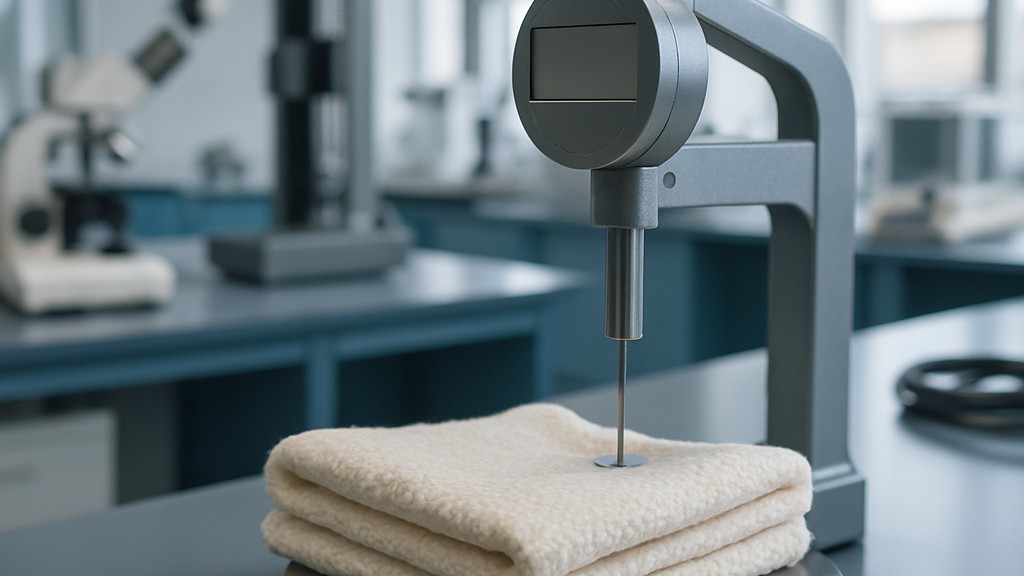
For the purposes of this standard, the thickness of a textile is the perpendicular distance between two reference plates that exert a pressure of 1 kPa or less on the textile.
In principle, the thickness of a sample is measured as the distance between the reference plate on which the sample rests and a parallel circular presser foot that applies a specified pressure to the area of the textile being tested. A test sample is placed between two reference plates that apply a known pressure to the sample. The perpendicular distance between the reference plates is measured and recorded after a specified time.
Before testing, textile samples are conditioned and the test is carried out in the standard atmosphere for conditioning and testing of textiles specified in the ISO 139 standard.
Samples should be taken by one of the following methods:
Test areas for samples are selected in accordance with this standard. For fabrics sensitive to deformation, such as certain knitted fabrics, test samples are cut in accordance with this standard. If large fabrics cannot be processed without deterioration, the test samples are cut. The test samples are conditioned in a relaxed state until they reach equilibrium with the standard atmosphere for testing. It is recommended that the samples be conditioned in a relaxed state for at least 16 hours.
The presser foot and reference plate are cleaned before the test is performed. The presser foot is loaded onto the reference plate to apply the appropriate specified pressure, and the thickness gauge is adjusted to indicate zero. An applied pressure of 1 plus/minus 0,01 kPa is recommended. The presser foot is lifted, and the specimen or test piece is placed on the reference plate without tension or distortion, with no part of the area to be measured closer than 150 mm to the edge. The area selected for testing should be free of wrinkles. The presser foot is slowly lowered onto the specimen, and after 30 plus/minus 5 seconds, the measurement value is noted. Following the procedure described here, the thickness of at least five different areas on the specimen or at least five test specimens is determined. The arithmetic mean of the determined measurements is calculated to an accuracy of 0,01 mm. The coefficient of variation is calculated to the nearest 0,1 percent, and the 95 percent reliability is calculated to the nearest 0,01 mm.
In the textile world, precise measurement of material properties is crucial for quality control, performance evaluation, and regulatory compliance. One of the key physical properties of textiles is thickness, which directly impacts properties such as insulation, comfort, durability, and appearance.
The ISO 5084 standard specifies a standardized method for determining the thickness of textile fabrics and other related textile products. The measurement is performed under specified pressure and field conditions, ensuring consistency and reproducibility between laboratories and manufacturers.
This standard applies to a wide range of textile materials, including:
During testing, fabrics with irregular surface textures (e.g., naps, tufts, or loops) may give variable readings and require special handling or different pressure settings. Some textiles compress under pressure, affecting the reading. ISO 5084 attempts to standardize pressure to mitigate this. Temperature and humidity can also affect the results. Therefore, conditioning in a controlled environment is important.
Industries and products based on the ISO 5084 standard include:
The ISO 5084 standard is important for several practical and industrial reasons, particularly in the textile and clothing industries. This standard is considered important for the following reasons:
Using a consistent method helps ensure that products meet these performance standards.
In these contexts, slight differences in thickness can affect fit, installation, and performance.
Thickness is a critical performance parameter and ISO 5084 ensures that measurements are both accurate and comparable.
As a result, the ISO 5084 standard is a vital tool for textile manufacturers and quality assurance professionals, providing a uniform method for measuring fabric thickness. Adherence to this standard ensures consistent product quality, facilitates international trade, and supports research and innovation in textile engineering. For professionals in textile testing or manufacturing, understanding and applying this standard is crucial to maintaining accuracy and meeting customer and regulatory expectations.
Our organization, which has been supporting businesses across all sectors for years with a wide range of testing, measurement, analysis, and evaluation activities, has a strong team of employees who closely follow global developments in science and technology and are constantly improving themselves. In this context, we also provide testing services in accordance with the ISO 5084 Textiles - Determination of the Thickness of Textiles and Textile Products standard.
To get an appointment, to get more detailed information or to request an evaluation, you can ask us to fill in our form and reach you.

