

The European standard "EN 12127 Textiles - Fabrics - Determination of mass per unit area using small samples" describes methods for determining mass per unit area using small samples tested in a standard atmosphere or by oven drying. These methods are applicable to woven and knitted fabrics. They may also be applicable to fabrics produced using other techniques.
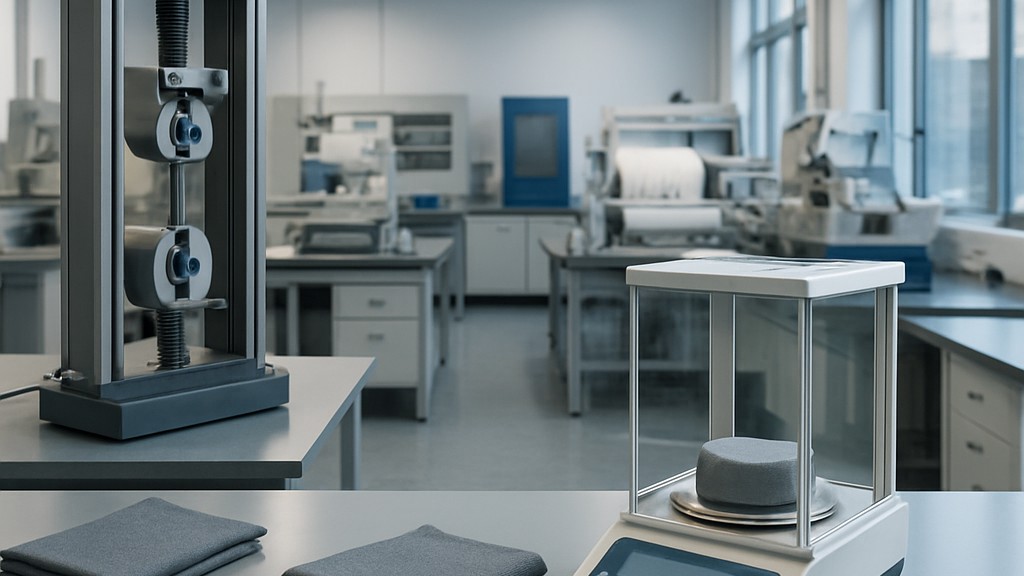
This method for determining mass per unit area is based on the measurement of small fabric samples in the conditioned or oven-dried state. Other possible methods are included in ISO 3801 Textiles - Woven fabrics - Determination of mass per unit length and mass per unit area.
For the purposes of this standard, the term mass per unit area refers to the mass of a known area of fabric divided by that area, expressed in grams per square metre.
In principle, the fabric sample is conditioned in the loose state, samples are cut and weighed in the conditioned or oven-dried state, and the mass per unit area is calculated.
Samples are selected in accordance with the procedure specified in the fabric material specification or as agreed upon between the parties involved. In the absence of a suitable material specification, an example of a suitable sampling procedure is given in the appendix to the standard (Annex A).
An example of selecting a test sample from a laboratory sample is provided in Appendix B. Test samples with folds or creases, edges, and areas that are not representative of the fabric should be avoided. For non-homogeneous fabrics, samples representative of the various areas to be identified as agreed upon between the parties involved are selected.
When sampling garments, if possible, take one sample from each separate piece or element of the garment. For example, for long-leg underwear, take two samples from each leg and one sample from the upper part.
The test equipment used in the tests must comply with the EN 30012-1 standard. In general, the following equipment is used in the tests:
Preconditioning, conditioning and test atmosphere must comply with EN 20139 standard.
It is important to ensure that fabrics are in a relaxed state before testing. Fabrics should be kept flat and tension-free for at least 24 hours during conditioning as specified herein. Knitted fabrics may require additional relaxation as agreed upon between the parties. This must be noted in the test report.
Using a cutting device or scissors, avoiding deformation of the fabric, cut at least five test samples, each measuring at least 100 cm². When using a cutting device, the area of the cutting device is used for calculations. When using scissors, take three measurements of the length and three measurements of the width of each test sample, rounded to the nearest 1 mm. The cut area of each test sample is calculated from the average values of the length and width, and the result is rounded to three significant digits. This measured area is used for calculations.
When determining the mass in standard atmosphere for the test, each test sample is weighed and each value is recorded, rounded to the nearest 1 mg.
When determining oven-dried mass, the oven is preheated to 105°C plus or minus 3°C. Test samples are placed individually in weighing vials, the vials are placed in the oven with their caps on their sides, and dried until a constant mass is achieved. This constant mass is considered achieved when no more than a 0,1 percent change in mass occurs in successive weighings separated by a drying time of at least 40 minutes.
Experience has shown that a four-hour drying time is sufficient for most textile fabrics. After drying, the weighing bottles are capped and cooled in a desiccator. The sample in the bottle, as well as the bottle itself, is weighed, and each value is recorded. The oven-dried mass of each test sample is calculated. For each test sample, the mass per unit area in grams per square meter is calculated using the formula given in the standard. The average mass per unit area in grams per square meter is calculated, and the result is rounded to three significant figures. If necessary, the coefficient of variation, 95 percent confidence intervals, and minimum and maximum values are calculated, rounded to three significant figures.
The EN 12127 standard is important for the following reasons :
In general, the EN 12127 standard is widely used in the following areas:
Our organization, which has been supporting businesses across all sectors for years through a wide range of testing, measurement, analysis, and evaluation activities, boasts a strong team of employees who closely follow global developments in science and technology and are constantly improving themselves. In this context, we also provide testing services in accordance with the EN 12127 Textiles - Fabrics - Determination of mass per unit area using small samples standard.
To get an appointment, to get more detailed information or to request an evaluation, you can ask us to fill in our form and reach you.

