

The standard “DIN 54280 Textile tests - Determination of the acidity of wool”, published by the German Institute for Standardization (DIN), describes the method for determining the acidity of wool as part of textile testing. Wool, a natural protein fiber, can exhibit varying acidity levels depending on processing, washing, dyeing, or environmental exposure. Excessive acidity (or alkalinity) can affect fiber integrity, dye absorption, handling behavior, and long-term durability.
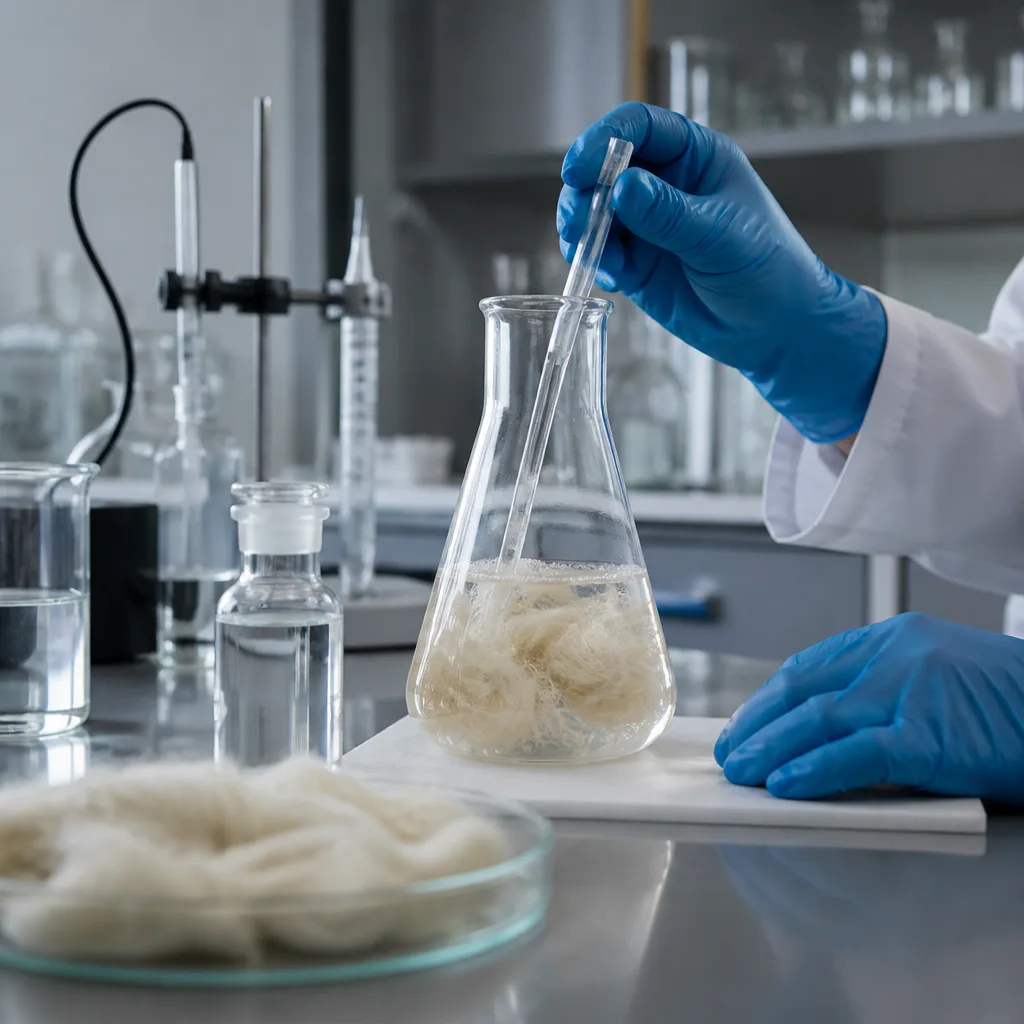
Acidity testing helps assess wool quality and its suitability for further processing or end use. Wool performs best in a pH range of slightly acidic to neutral (typically around 5-8). Too much residual acid from production can lead to fiber degradation over time, while an unsuitable pH can affect dyeing processes or cause yellowing and brittleness.
This standard is part of a broader series of DIN standards for the chemical analysis of wool and textiles, and includes the following tests:
The described test method essentially follows these steps:
Results are typically reported as pH value or milliequivalent acid per unit wool mass. This method emphasizes standardized sample preparation, conditioning, and extraction conditions to ensure reproducibility.
The chemical behavior of wool is influenced by its keratin structure, which contains both acidic and basic groups. Acidity testing supports quality control in the wool industry and helps manufacturers ensure that fibers are properly neutralized after acid treatments (e.g., carbonization or dyeing). It also retains its importance in textile laboratories, conservation, and forensic analysis of historical textiles.
This standard was later withdrawn and largely replaced by “ASTM D2165 Standard test method for determining the pH of aqueous extracts of wool and similar animal fibers.” Nevertheless, due to its brevity and age, it is still used primarily as a historical reference or to align with older standards.
In short, the DIN 54280 standard provides a standardized test method for measuring the acid content in wool, which is critically important in textile processing and quality control for various reasons:
This standard has been withdrawn and is no longer an active standard. However, it is still in demand for historical, reference, or legacy compatibility purposes.
Methods defined in various standards collectively assess wool damage, chemical treatments, and overall condition. Acidity testing typically involves extraction and titration techniques. Here, wool samples are treated with a solvent, and the extracted acids are measured, typically by titration with a base. Although now largely obsolete, understanding the DIN 54280 standard is still beneficial.
Modern equivalents of this standard typically use pH measurement of aqueous extracts or advanced spectroscopic/chemical analysis for fiber damage.
Today, the DIN 54280 standard supports the consistent evaluation of textile materials, ensuring quality, safety, and comparability among manufacturers, laboratories, and buyers.
The DIN 54280 standard is widely used in the following sectors:
Manufacturers may refer to the DIN 54280 standard in product specifications, supply contracts, or conformity certificates.
The DIN 54280 standard is necessary because textile performance can be affected by many variables, including fiber type, finishing processes, environmental exposure, and production methods. Without a standardized method, test results can vary significantly between laboratories.
This standard helps with the following:
Typical users of this standard include:
In conclusion, the DIN 54280 standard is part of a broader framework of German textile standards designed to bring reliability and consistency to textile testing. By defining a repeatable test method, this standard promotes better product quality, technical communication, and trust throughout the textile supply chain.
For many years, our organization, with its competent and experienced staff, has been understanding the needs of its clients, providing the advanced testing services they require, and assisting them in the establishment, implementation, and improvement of management systems. Within this framework, we also provide testing services in accordance with the DIN 54280 standard.
To get an appointment, to get more detailed information or to request an evaluation, you can ask us to fill in our form and reach you.

