DIN 53354 Synthetic Leather Tests - Tensile Test
The standard "DIN 53354 Testing of synthetic leather - Tensile testing", developed by the German Institute for Standardization (DIN), describes a test method used to determine the ultimate tensile force, breaking force, ultimate tensile elongation, elongation at break and the relationship between tensile force and elongation.
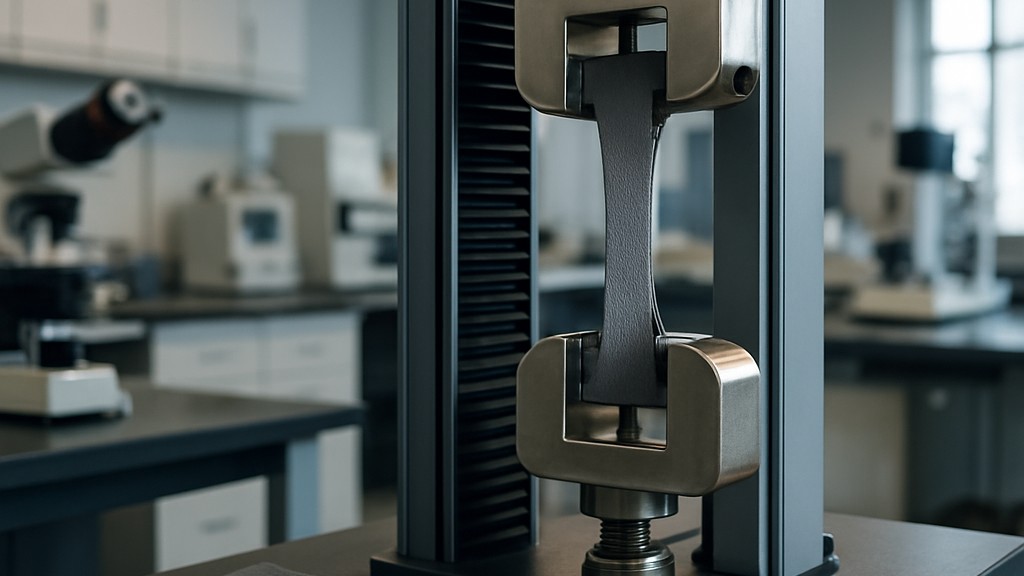
For the purposes of this standard, the following terms and definitions apply:
- Maximum tensile force: The maximum tensile force measured during the tensile test.
- Breaking force (breaking force): The force measured during a tensile test at the instant of fracture of the specimen. If the maximum tensile force and the breaking force coincide, the term "maximum tensile force" is used for the tensile force.
- Maximum tensile stress: It is the ratio of the difference between the measured lengths and the free compression length of the sample.
- Elongation at break: It is the ratio of the difference between the gage lengths measured under breaking load and the free compression length of the sample.
- Tensile force: The force acting on the sample in the tensile direction at any time during the tensile test.
- Length change: The difference between the length measured at any time during the tensile test and the free compression length of the specimen.
- Tensile force-length change curve: This describes the relationship between tensile force and the change in length of the specimen during a tensile test. It provides an overview of the specimen's overall elongation behavior and allows the determination of various characteristic values.
When performing this test, a Class 1 tensile testing machine, defined in the DIN 51221 standard for tensile testing machines, must be used, operating with a constant feed rate of the tensile clamp. The clamping device of the tensile testing machine must be designed to ensure that the specimen is held securely across its entire width without damaging the clamps. The tensile testing machine must be equipped with a suitable recording device to record the tensile force-length change curve.
Sampling and pretreatment must be carried out in accordance with DIN 16906 "Testing of plastic sheets and plastic films - Specimen and sample - Preparation and conditioning." Five test samples, each 50 mm wide and 300 mm long, are taken both longitudinally and transversely to the production direction. For woven synthetic leather, test samples should be taken with the fibers facing straight.
In this standard, the test conditions are specified as follows:
- Free clamp length: The free clamp length for woven synthetic leather is 200mm, and for knitted and foil synthetic leather is 100mm.
- Preload: Preload is approximately 1 percent of the maximum tensile force. However, it should not cause more than 1 percent elongation.
- Feed rate: The feed rate of the pulling clamp is 100 mm/min plus/min 10 mm/min.
The tensile test shall be carried out in the standard atmosphere according to DIN 50014, immediately after pretreatment of the samples according to this standard.
The specimen should be clamped so that the prestressing force is distributed as evenly as possible across its width. The prestressing force should be applied using a clamp wider than 50 mm. It is important to ensure that the longitudinal axis of the specimen is aligned with the tensile axis.
If the breaking force does not coincide with the maximum tensile force, the tensile force-length curve must be recorded. Recording the tensile force-length curve is also necessary when specific parameters need to be determined, such as the length change at a given tensile force and vice versa.
During the evaluation process, tests performed on specimens that break directly from the clamps should not be considered. Other evaluations include:
- Maximum tensile force: Given in N without specifying the specimen width.
- Breaking force: It is given in N without specifying the sample width.
- Maximum tensile strain: It is calculated according to the formula given in the standard as a percentage of the free compression length.
- Elongation at break strength (percentage): It is calculated according to the formula given according to the free compression length.
- Tensile force and length change parameters: A tensile force value is assigned to each length change value and vice versa, so that the corresponding parameters can be determined.
- Statistical evaluation: If the test results are evaluated statistically, the following information must be included in the test report separately for each direction:
- All individual values
- Number of measurements
- Arithmetic mean
- Standard deviation
The DIN 53354 standard is important because it provides a standard method for testing the tensile strength of artificial leather. This standard includes procedures for measuring how much force artificial leather can withstand before breaking. This is critical for assessing its durability and suitability for various applications.
This standard is considered important for the following reasons:
- Quality assurance: The DIN 53354 standard ensures that artificial leather meets consistent quality criteria. By specifying a standard tensile test, it allows manufacturers to evaluate the material's strength and elongation properties, ensuring reliability in products such as upholstery, automotive interiors, footwear, and clothing.
- Industry compliance: Many industries, such as automotive and furniture, rely on faux leather for its cost-effectiveness and versatility. This standard provides a universally accepted testing method that enables manufacturers to comply with regulatory requirements and customer requirements, particularly in markets where DIN standards are widely adopted.
- Product development and innovation: This standard helps engineers and designers select suitable materials by providing reliable data on tensile properties. This is crucial for developing new synthetic leather products with improved performance, such as enhanced durability or flexibility, tailored to specific uses, such as automotive diaphragms or packaging materials.
- Comparability: This standard standardizes the testing process, ensuring consistent comparison of faux leather products across manufacturers and regions. This is crucial for buyers and engineers specifying materials for projects and ensures they can trust the performance data provided.
- Consumer safety and performance: Faux leather is often used in applications where durability under stress is critical, such as car seats or protective equipment. Tensile testing ensures the material can withstand real-world forces, contributing to the safety and longevity of the final product. While DIN 53354 has been proposed to be replaced by DIN EN ISO 1421 for some applications, it remains the reference in certain industries.
- Practical applications:
- Automotive industry: Ensures that artificial leather used in vehicle interiors or apertures is resistant to mechanical stress and environmental conditions.
- Furniture and upholstery: Guarantees that the faux leather on sofas or chairs is resistant to wear and tear.
- Testing laboratories: Laboratories use the DIN 53354 standard to provide certified testing services to help manufacturers validate their products.
Consequently, the DIN 53354 standard is critical to ensuring the quality, reliability, and comparability of artificial leather, supporting industries in producing safe and durable products. While it is supplemented by newer standards, its role in specific applications and historical significance keep this standard relevant.
Our organization, which has been supporting businesses across all sectors for years through a wide range of testing, measurement, analysis, and evaluation activities, has a strong team of employees who closely follow global developments in science and technology and are constantly improving themselves. In this context, we also provide testing services in accordance with the DIN 53354 Synthetic Leather Testing - Tensile Testing standard.



