

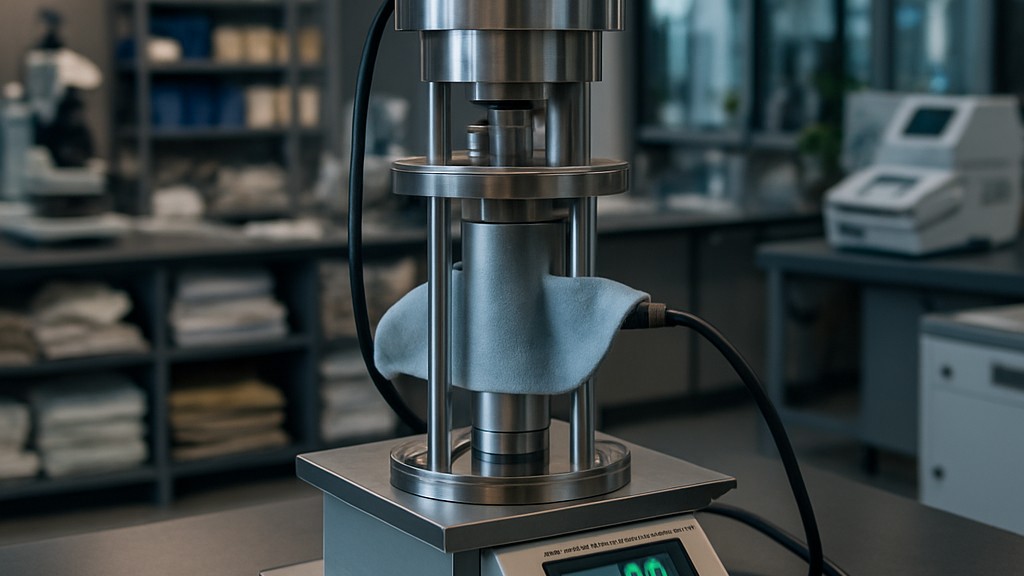
Water resistance depends on the repellency of the fibers and yarns and the fabric structure. Results obtained with this method may not be the same as those obtained with AATCC methods against rain or water spray. This test method is performed without any restrictions. If a restriction is required, the AATCC standard "Water resistance - Hydrostatic pressure test using restrictions" should be used.
In principle, hydrostatic pressure is applied to one surface of the test specimen, increasing at a constant rate until three leakage points form on the other surface. Water can be applied from either the top or bottom of the test specimen. This test method is performed without any restrictions.
For the purposes of this standard, the following definitions apply:
These tests use a hydrostatic tester and distilled or deionized water.
At least three fabric samples should be taken diagonally across the width of the fabric, representing the fabric's material. To ensure proper compression, the samples should be cut to a minimum of 200 mm x 200 mm. Handle the samples as small as possible, and avoid folding or contaminating the test area. Test samples should be air-conditioned for at least four hours before testing at a temperature of 21°C (plus/minus 2°C) and a relative humidity of 65% (plus/minus 5%). The surface of the fabric to be exposed to water should be indicated, as different results may be obtained on the front and back surfaces. This surface should be marked on one corner of each sample.
When performing the test, verify that the water in contact with the test sample is set at 21°C plus/minus 2°C. The clamping surface is dried. The sample is clamped with the surface to be tested facing the water.
Option 1 If using a hydrostatic pressure tester, start the engine, press the lever to raise the overflow device at a speed of 10 mm/s and close the vent as soon as water begins to flow.
Option 2 If using a hydrostatic pressure tester, select a gradient of 60 mbar/min (1 mbar/sec) and press the start button.
Ignoring the water droplets appearing approximately 3 mm from the sample compression ring, the hydrostatic pressure at the moment when the water droplets penetrate the fabric from three different places is recorded.
The average hydrostatic pressure is calculated for each sample.
The report to be prepared should include the following information:
In short, the AATCC TM 127 standard is a widely accepted test method used to evaluate the water repellency of textile fabrics. This test specifically determines a fabric's resistance to water penetration under hydrostatic pressure. It is a fundamental standard for evaluating waterproof or water-repellent materials used in outdoor clothing, tents, medical textiles, and protective clothing. This standard evaluates a fabric's resistance to water penetration when subjected to gradually increasing water pressure. This test is particularly important for determining the performance of coated, laminated, or treated textiles designed to keep users dry in wet conditions.
While interpreting the results,
Results may vary depending on factors such as:
Industries based on the AATCC TM 127 standard include:
The key advantages of the AATCC TM 127 standard are:
This standard is considered important for the following reasons:
This standard objectively measures a fabric's water resistance, helping manufacturers verify that their products perform as intended.
Without AATCC TM 127 and a similar standard, companies may rely on subjective or non-comparable testing.
As a result, the AATCC TM 127 standard is a vital standard for evaluating hydrostatic resistance in the textile industry, helping manufacturers ensure their products meet water repellency performance expectations. With the growing demand for high-performance textiles in both consumer and industrial applications, this test remains a cornerstone of textile quality assurance and innovation.
Our organization, which has been serving for many years and meticulously following global developments in science and technology, employs a skilled team and extensive infrastructure to conduct testing, measurement, and analysis in a wide range of areas for businesses across all sectors. In this context, we also provide testing services in accordance with the AATCC TM 127 Water Resistance - Hydrostatic Pressure Testing standard.
To get an appointment, to get more detailed information or to request an evaluation, you can ask us to fill in our form and reach you.

