

ASTM D4632 Determination of Bucket Load and Elongation Values of Geotextiles
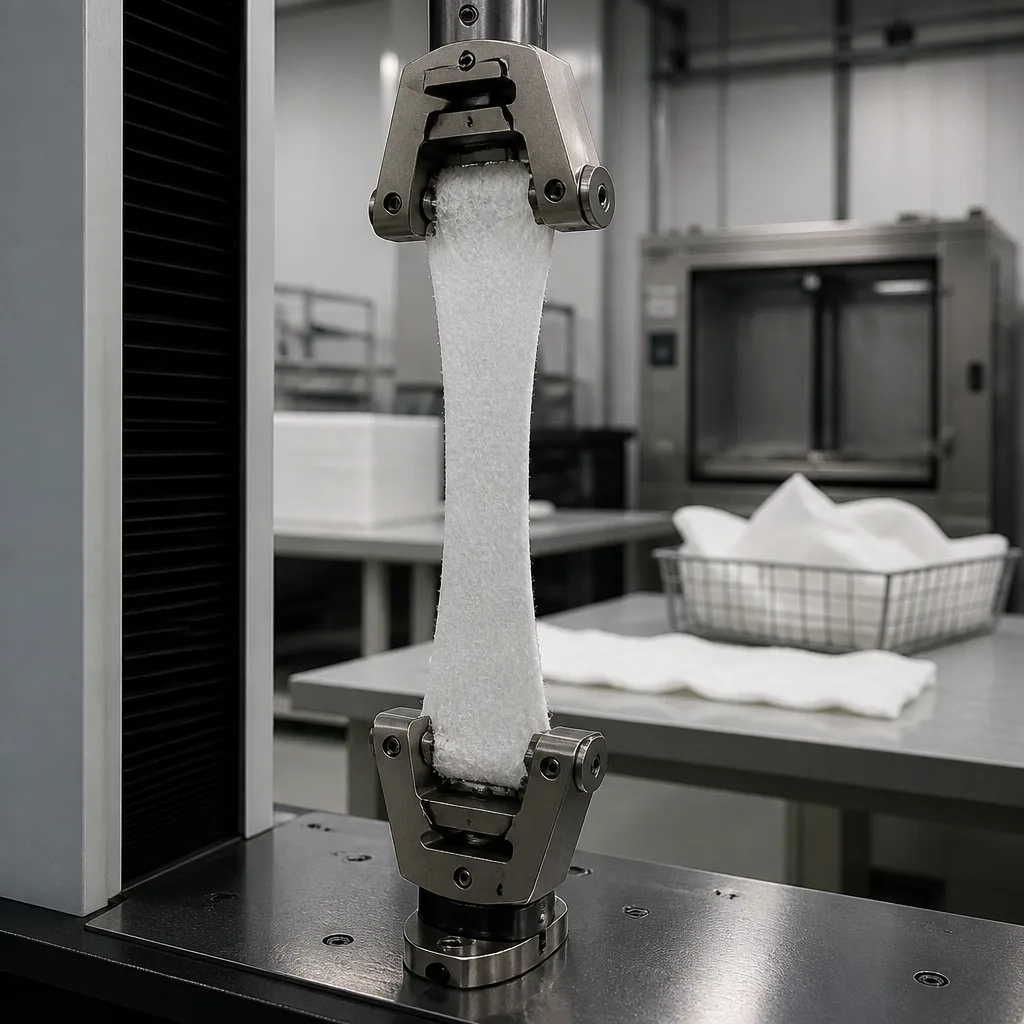
The ASTM D4632 Standard Test Method for Determining the Breaking Load and Elongation of Geotextiles by Holding, developed by the American Society for Testing and Materials (ASTM), describes a procedure for determining the breaking load (holding strength) and elongation (holding elongation) of geotextiles using the holding method. This test method is not suitable for knitted fabrics, and alternative test methods should be used. While useful for quality control and acceptance testing for a given fabric structure, the results can only be used comparatively between fabrics with very similar structures, as each different fabric structure performs uniquely and characteristically in this test. The holding test method does not provide all the necessary information for all design applications, and other test methods should be used.
Procedures for measuring breaking load and elongation using both dry and wet holding methods are included; however, unless otherwise specified in an agreement or specification, the test is normally performed in the dry condition.
The holding method can be applied when it is desired to determine the effective strength of the fabric used, i.e., the strength of the material over a given width, along with the additional strength provided by the adjacent material. Since the amount of fabric support varies depending on the fabric structure, there is no simple relationship between holding tests and strip tests. It is useful as a quality control or acceptance test.
The test method described here for determining the tensile strength of geotextiles can be used in acceptance testing of commercial shipments, but caution is advised due to a lack of information regarding inter-laboratory accuracy.
In short, the ASTM D4632 standard is a widely used test standard that determines the tensile strength (tensile strength) and elongation at break of geotextile materials. This method evaluates the tensile performance of woven and non-woven geotextiles by gripping only a portion of the sample's width and pulling until rupture occurs.
Breaking elongation refers to the percentage elongation of the sample at the breaking point. This method is not suitable for knitted fabrics that require alternative testing procedures.
The test is conducted separately in the following aspects:
Because geotextiles generally exhibit different strengths in each direction.
These parameters help ensure consistent and reproducible results across laboratories. It is the preferred method, and in cases of dispute, constant elongation rate results take precedence. Constant elongation rate refers to test results obtained using a tensile testing machine. Quality derived from standard procedure shipments, recognized by engineers, manufacturers, and regulatory bodies, represents more than just the strength of individual yarns, making it a practical indicator of field performance.
In a constant elongation rate test, one handle of the testing machine moves at a constant speed, and as the distance between the handles continuously increases, the machine measures the force required to stretch the sample. Most modern universal testing machines operate using the constant elongation rate principle.
For geotextiles tested according to the ASTM D4632 standard, constant elongation rate results typically include the following:
Constant elongation rate results are used for the following purposes:
For the ASTM D4632 standard, the reported constant elongation rate results are essentially the tensile strength at the point of contact and the elongation at break, measured using a constant elongation rate tensile testing machine.
The ASTM D4632 standard is important because it provides a standardized and reproducible method for measuring the tensile strength and elongation properties of geotextiles. These properties are critical for determining whether a geotextile can withstand the stresses encountered during installation and use. This standard is necessary for the following reasons:
This standard helps engineers assess whether a geotextile has sufficient tensile strength to perform effectively in these applications.
In conclusion, the ASTM D4632 standard is a fundamental geotextile testing standard because it provides reliable tensile strength and elongation measurements, supports product comparison and quality assurance, and helps ensure that geotextiles used in civil engineering projects can withstand the mechanical demands of installation and long-term service.
For many years, our organization, with its competent and experienced team, has been understanding the needs of its clients, providing the advanced testing services they require, and assisting them in the establishment, implementation, and improvement of management systems. Within this framework, we also provide testing services in accordance with the ASTM D4632 standard.
To get an appointment, to get more detailed information or to request an evaluation, you can ask us to fill in our form and reach you.

