

Method C is used in cases of dispute regarding the yarn's elongation at break. Methods A, B, and C are expected to yield the same results for yarn strength, but Method C may yield slightly higher actual (and higher) elongation values than either A or B. Method D is likely to yield results for both breaking strength and elongation at break that differ from those obtained by Methods A, B, or C.
This international standard specifies methods using constant specimen extension (CRE) tensile testing instruments. Tests performed on obsolete constant rate of movement (CRE) and constant loading rate instruments are discussed in the annex to the standard (Annex A) for informational purposes, in recognition of the fact that these instruments are still in use and may be used by agreement.
This standard applies to all yarn types except glass, elastomeric, aramid, high molecular polyethylene (HMPE), ultra high molecular polyethylene (UHMPE), ceramic and carbon yarns and polyolefin tapes.
A method for testing glass yarns is given in ISO 3341. This standard is applicable to yarns obtained from packages, but may also be applied to yarns extracted from fabrics, subject to agreement between the parties involved. This standard is for single-end (single-strand) testing of yarns. The skein test method is given in ISO 6939.
For the purposes of this standard, the following terms and definitions apply:
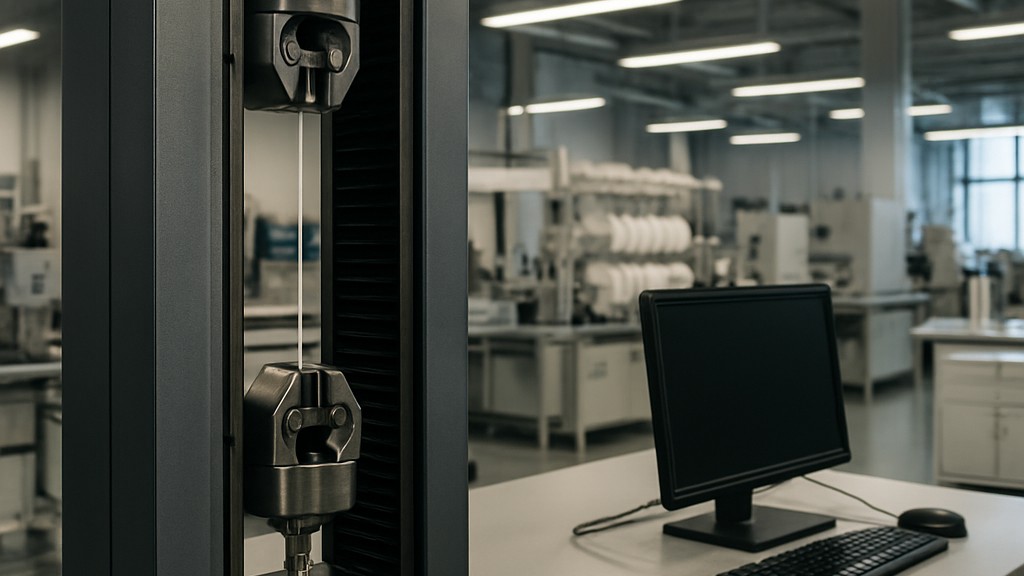
In principle, a yarn sample is stretched to break by a suitable mechanical device, and the breaking force and elongation at break are recorded. A constant extension rate of 100 percent per minute (based on the gauge length) is used, although higher or lower rates are permitted by agreement. Two gauge lengths are permitted: typically 500 mm (with an extension rate of 500 mm/min) and, exceptionally, 250 mm (with an extension rate of 250 mm/min).
Samples should be taken in accordance with the instructions given in the material specification, if any, or in accordance with the procedures described herein. Bulk samples should be taken from one or more cases representative of the lot to be tested, as shown in the table titled "Sampling frequency."
If only average values are required, 10 packages should be taken from the bulk sample and distributed as evenly as possible among the cases and levels in each case. The minimum number of samples to be tested should be 50 for single-spun yarns and 20 for other yarns. The samples should be distributed as evenly as possible among the 10 packages.
If the variability of the test is known and only average values are needed, then the sample size should be calculated as 0,17 CV² , where CV is the coefficient of variation (expressed as a percentage) of individual breaks obtained from experience on similar material. This sample size provides a sensitivity of plus/minus 4% at a 90% probability level (1,96 times the mean standard error). The strength test is a one-tailed test, meaning “the yarn will not be weaker than…” but “may be stronger than…”. When a 90% probability is specified, one tail of the distribution is 5%, or exactly the sum of the two tails, or the more common 95% probability suitable for a two-tailed test.
If the coefficient of variation needs to be determined in addition to the average, 20 packages should be taken from the bulk sample and at least 200 samples for single-spun yarns and at least 100 samples for all other yarn types should be tested.
If fabric samples are to be taken (not suitable for automated testing devices, Method B), the fabric sample should be large enough to provide a sufficient number and length of samples. Test samples should be taken to ensure that the yarn twist does not change during sampling. For woven fabrics, warp samples should be taken from different ends, and weft samples should be taken randomly from several sections of the sample to ensure the yarn is as representative as possible. For knitted fabrics, samples should represent as many different yarns as possible.
Preconditioning, conditioning, and test atmospheres should be as specified in ISO 139. For Methods A to C, sample packs or test skeins should be preconditioned for at least 4 hours. If samples are conditioned directly from the dry side, preconditioning can generally be omitted. After preconditioning, the sample should be brought to moisture equilibrium under the conditioning atmosphere. For skeins, overnight conditioning is usually sufficient, but for tightly wrapped packs, at least 48 hours are required. Preconditioning and conditioning are not required for wet tests (Method D).
Our organization, which has been supporting businesses across all sectors for years through a wide range of testing, measurement, analysis, and evaluation activities, boasts a strong team of employees who closely follow global developments in science and technology and are constantly improving themselves. In this context, we also provide testing services in accordance with the standard "EN ISO 2062 Textiles - Yarns from packages - Determination of single-end breaking force and elongation at break using a constant elongation ratio (CRE) tester."
To get an appointment, to get more detailed information or to request an evaluation, you can ask us to fill in our form and reach you.

