

The ISO 8543 Textile floor coverings - Mass determination methods standard, published by the International Organization for Standardization (ISO), describes methods for determining the total mass per unit area, the total pile mass per unit area, and the pile mass per unit area on the substrate of textile floor coverings, as well as methods for calculating the measured surface pile density and the measured pile fiber volume ratio.
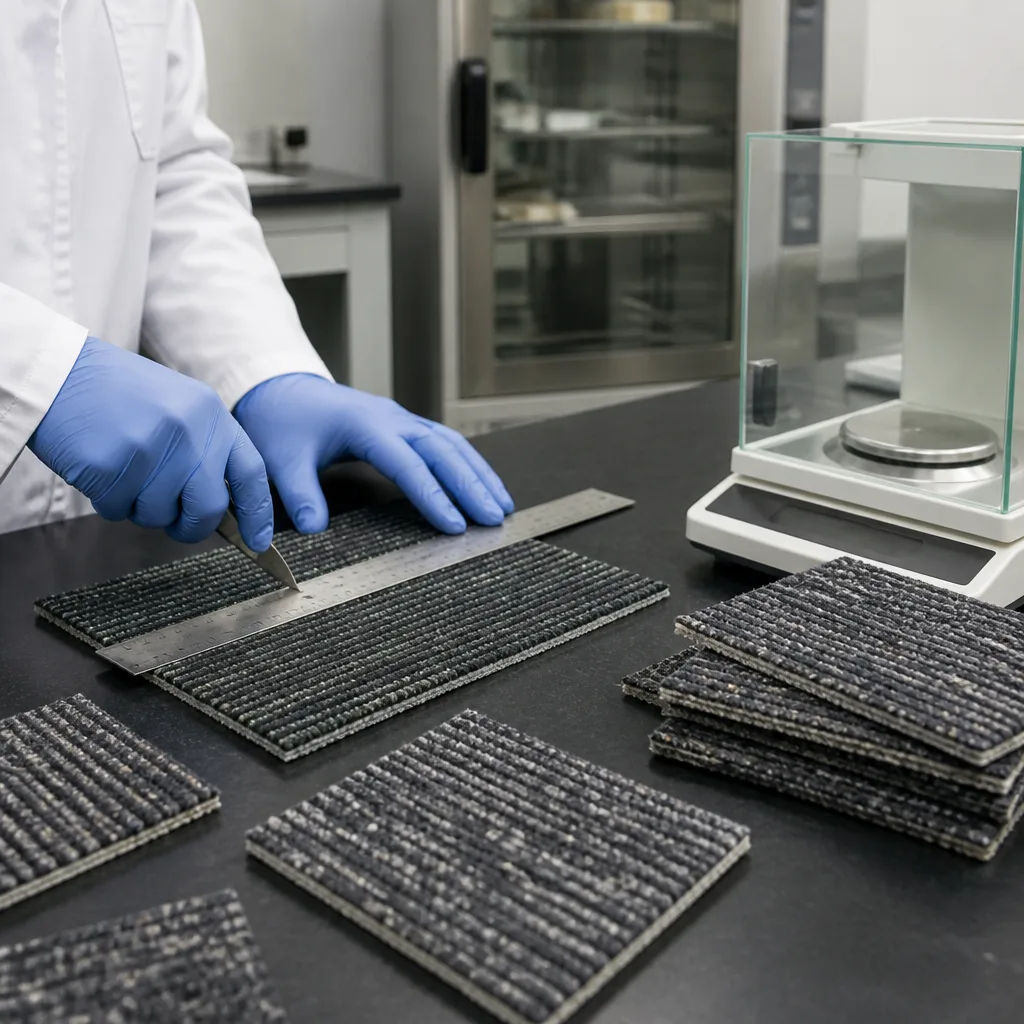
According to this method, samples should be conditioned and tested in one of the standard environments specified in ISO 139 for the conditioning and testing of textiles. The number of samples for each test should be sufficient to provide a 95% confidence interval of plus/minus 6%. Initially, four samples should be tested, and if the coefficient of variation calculated from these tests is at least 4%, then more samples should be tested as follows:
This standard describes the following methods:
The tests utilize a sharp-edged knife or drilling machine, a ruler graduated in millimeters, and a balance with a reading resolution of 0,01 g and an accuracy of 0,1 g.
Samples are selected according to the standard procedure specified in ISO 1957. Using a sharp blade or punch, at least four rectangular samples are cut or punched, each measuring at least 200 mm x 200 mm and having 15 rows of pile, with edges parallel to and at a right angle to the machine production direction. For artificial turf, it is very important to try to cut midway between two rows of pile to minimize variability. More than four samples may be required to reach confidence intervals.
In short, total mass per unit area measurement represents the total mass of flooring material over a given area and includes:
This value helps determine overall product durability and material consumption.
The tests utilize a pointed knife or piercing machine, a ruler graduated in millimeters, a balance with a reading resolution of 0,01 g and an accuracy of 0,1 g, and dissection needles and forceps.
In short, the total pile mass per unit area refers specifically to the portion of the fiber that makes up the visible surface of the carpet. According to this standard, this includes the pile yarn embedded in the substrate but excludes the backing compounds adhering to the yarn. Higher pile mass generally indicates:
Manufacturers often use this metric in product development and optimization.
In short, the ISO 8543 standard defines methods for determining the bulk properties of textile floor coverings such as carpets, rugs, and tufted floor coverings. This standard is widely used in the floor covering and textile industries to evaluate the physical structure and quality consistency of carpets and similar products. This standard provides standardized procedures for determining:
These measurements are necessary for product classification, quality assurance, durability assessment, and commercial specification.
The ISO 8543 standard applies to textile floor coverings produced using the following methods:
This standard establishes repeatable laboratory procedures so that manufacturers, suppliers, and testing laboratories can compare products under the same conditions.
This standard emphasizes sensitivity to the following issues:
The ISO 8543 standard is important because textile floor coverings must meet strict requirements in the following areas:
This standard helps manufacturers in the following areas:
It is also valuable for the following:
This standard is generally applied in the following areas:
In conclusion, the ISO 8543 standard is a fundamental international standard for evaluating the bulk properties of textile floor coverings. By defining standardized methods for measuring pile mass, density, and related structural properties, the standard enables reliable comparison of carpet products across manufacturers and markets.
For many years, our organization, with its competent and experienced staff, has been understanding the needs of its clients, providing the advanced testing services they require, and assisting them in the establishment, implementation, and improvement of management systems. Within this framework, we also provide testing services compliant with the ISO 8543 standard.
To get an appointment, to get more detailed information or to request an evaluation, you can ask us to fill in our form and reach you.

