

The standard “EN ISO 12958 Geotextiles and geotextile-related products - Determination of water flow capacity in surface planes”, developed by the International Organization for Standardization (ISO) and later published as a European standard within the scope of harmonization efforts, describes the method for determining the water flow capacity of a geotextile or geotextile-like product in a plane under constant pressure.
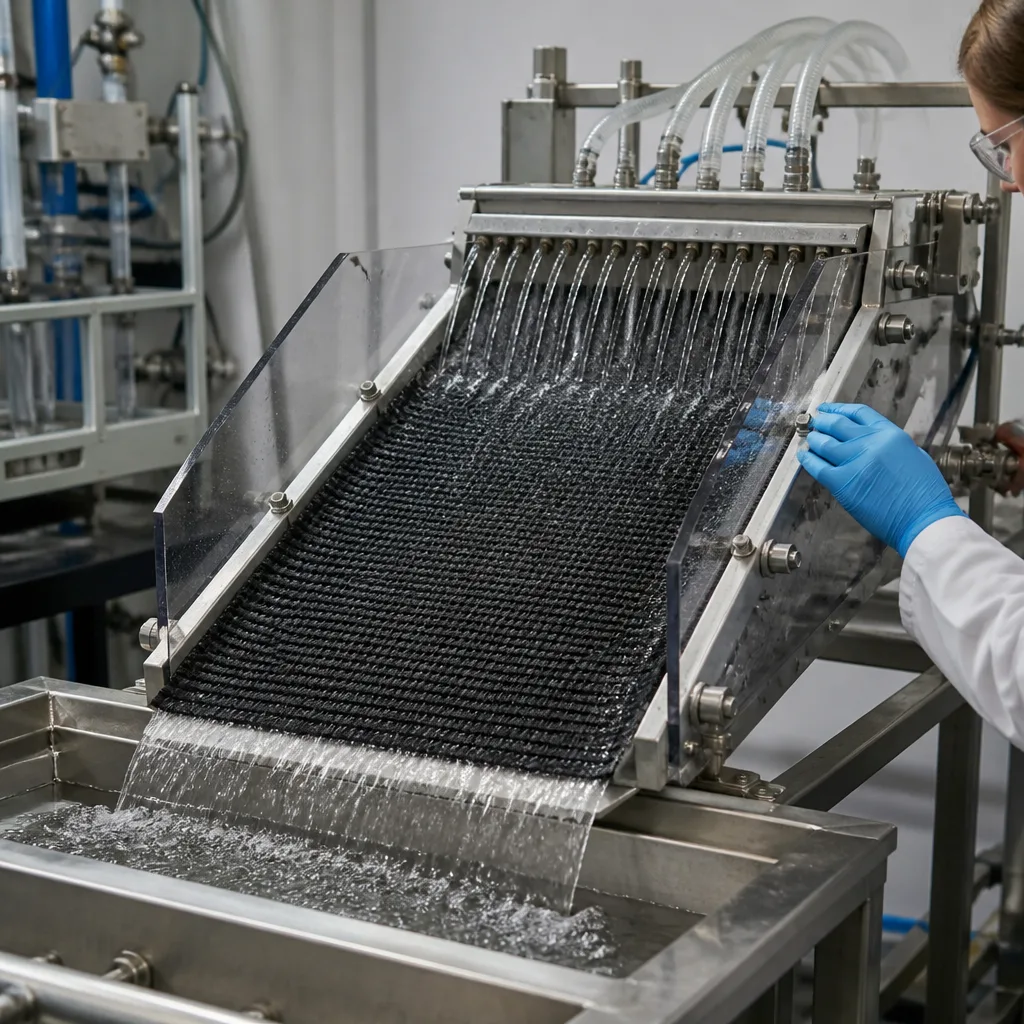
If the exact water flow capacity characteristics of the geotextile or geotextile-like product have been determined beforehand, it may be sufficient to determine the water flow capacity at two loads and both slopes for verification purposes.
The compressibility of the product over time significantly affects its in-plane water flow capacity.
Water flow in the plane of a geotextile or geotextile-like product is measured under varying normal pressure stresses, typical hydraulic gradients, and defined contact surfaces.
In general, the EN ISO 12958 standard is an international standard specifying test methods for measuring the in-plane water flow capacity (also known as permeability or planar flow) of geotextiles and geotextile-related products (e.g., geocomposite drainage layers). These materials are widely used in civil engineering, environmental, and geotechnical applications for drainage, filtration, separation, and containment.
This standard is critically important because water flow in the plane (parallel to the surface) of these products differs from flow perpendicular to it. In-plane flow is essential for drainage systems where water needs to move laterally. For example, in landfills, roads, retaining walls, green roofs, or slope stabilization.
In the latest update of this standard, the standard is divided into two sections to separate indexing and performance testing:
This update also introduced clearer distinctions between index and performance tests, allowed for different boundary conditions (hard/hard, soft/soft, or soft/hard), added guidance for indented slabs and multi-line drainage geocomposites, and included various technical and editorial improvements.
The test method described in this standard determines the volumetric flow rate of water per unit width of the sample under the following conditions:
For the purposes of this standard, hydraulic gradient represents the ratio of head loss to flow path length. In terms of permeability, flow may not always be laminar; water prefers flow capacity.
The test method uses a constant-pressure device that applies a normal load while allowing water to flow horizontally through the sample. Results are reported under specific stresses, slopes, and boundary conditions.
Boundary conditions are important in this respect: Geocomposite drainage systems typically contain a core (e.g., pointed or mesh-like) sandwiched between geotextile filters. Under load,
This standard explicitly allows testing with different contact surfaces (hard/hard, soft/soft, or soft/hard) to suit the intended applications, making the results more relevant to the design.
The application areas of this standard are as follows:
Design engineers use test results to calculate drainage capacity under expected top-load pressures and hydraulic conditions. Incorrect limit simulation can lead to over- or under-estimation of flow, affecting long-term performance and stability.
The ISO 12958 standard is compatible with European norms and is conceptually similar to the American standard “ASTM D4716/D4716M Standard test method for determining the flow rate and hydraulic permeability per unit width (in-plane) of a geosynthetic under constant pressure”. Many manufacturers report both ISO and ASTM values for global markets.
The ISO 12958 standard is necessary because in-plane water flow capacity (also called permeability or planar flow) is a critical performance characteristic of geotextile and geocomposite drainage products, but it cannot be reliably predicted from theory alone. Without a standardized test method, engineers encounter inconsistent, incomparable, or unrealistic data when designing drainage systems, leading to potential failures in real-world applications.
This standard is deemed necessary for the following reasons:
In short, this standard bridges the gap between laboratory tests and field performance. This ensures reliable measurement of the drainage function, which is often the primary role of geosynthetics, guaranteeing that the infrastructure remains safe, durable, and cost-effective for decades to come.
Due to the compression and creep of the drainage core, in-plane flow capacity is generally significantly reduced under higher normal stresses. This standard helps manufacturers certify their products and allows specifiers to select appropriate materials based on realistic, test-based performance data rather than theoretical values.
For many years, our organization, with its competent and experienced staff, has been understanding the needs of its clients, providing the advanced testing services they require, and assisting them in the establishment, implementation, and improvement of management systems. Within this framework, we also provide testing services in accordance with the EN ISO 12958 standard.
To get an appointment, to get more detailed information or to request an evaluation, you can ask us to fill in our form and reach you.

