

The standard “DIN 53811 Textile tests - Determination of fiber diameter from longitudinal view by microscopic projection”, published by the German Institute for Standardization (DIN), describes a microscopic method for measuring the diameter of textile fibers using longitudinal projection (side view of the fiber instead of cross-section). It is part of the broader DIN 538xx series of standards dedicated to textile testing procedures.
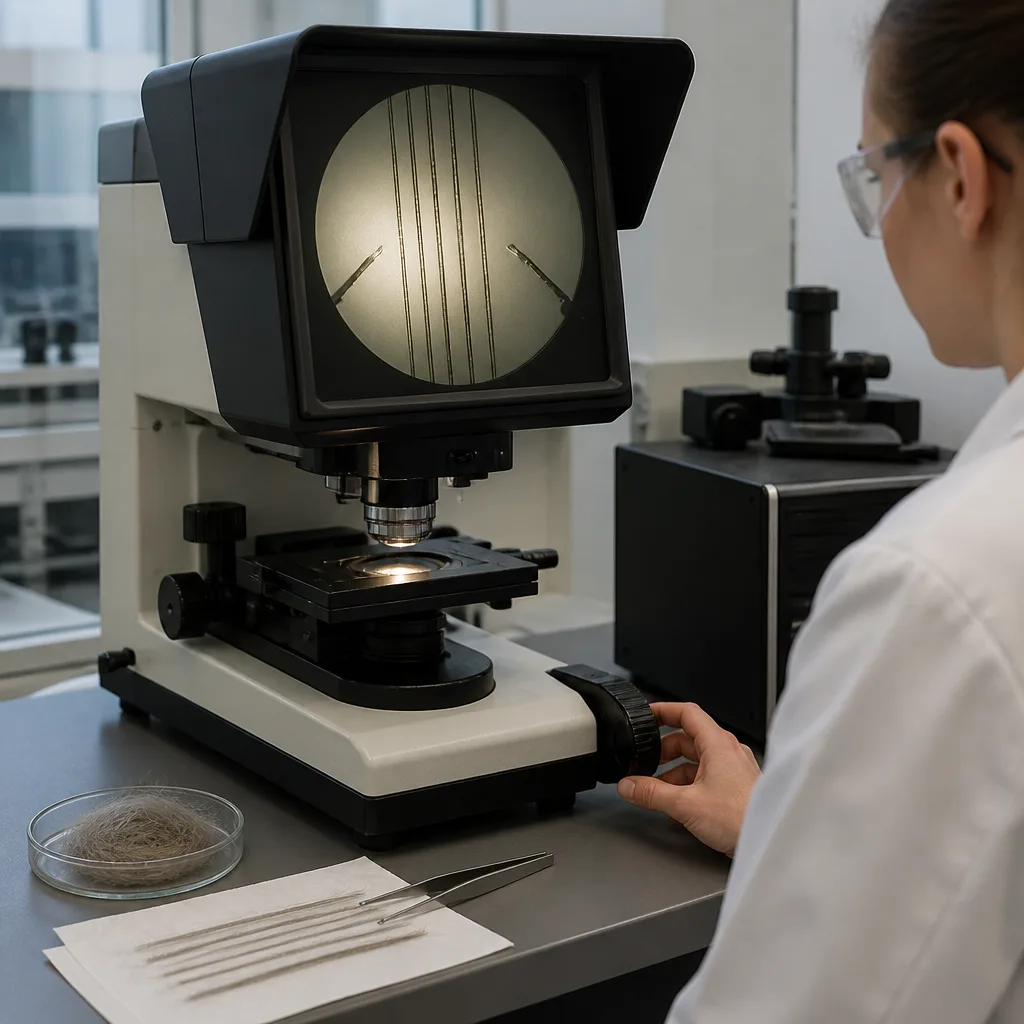
This method includes the following:
This approach is particularly useful for determining fiber fineness or diameter without the need to take precise cross-sections, and is faster for certain routine quality control or research applications in textiles. In material data sheets for synthetic fibers (e.g., carbon fibers), it has been used as a reference to specify filament diameters, typically in the range of 7 µm plus/minus 0,4 µm for high-strength types.
This standard has been officially withdrawn, but it is listed in many modern testing laboratories and under accreditation as the replacement or equivalent standard, “DIN EN ISO 137 Wool - Determination of fiber diameter - Projection microscopy method”. This standard focuses on a similar projection microscopy technique but is internationally harmonized and has a wider range of applications, while being specifically adapted for wool.
The relevant or supplementary standards are as follows:
The main applications of this method are as follows:
Equipment commonly associated with this method includes projection microscopes and precision fiber microtomes for sample preparation (however, the DIN 53811 method uses longitudinal views instead of sections).
In short, the DIN 53811 standard focuses on how textile materials behave under tensile forces, outlining a method for determining the tensile properties of textiles. This standard is widely used in the textile industry to evaluate the strength and elongation properties of fabrics, yarns, and related materials.
The main objectives of the DIN 53811 standard are as follows:
These properties are important for understanding how a textile will perform during production, use, and wear.
The DIN 53811 standard applies to a wide variety of textile materials, including:
This standard is also widely used in the following sectors:
The DIN 53811 standard describes a tensile test method in which a textile sample is pulled in the following manner:
Typical equipment used in DIN 53811 standard tests includes the following:
The machine must provide the following:
To ensure consistency, the standard specifies the following:
These controlled conditions reduce variability and increase repeatability.
The DIN 53811 standard evaluates several key characteristics:
These parameters help manufacturers evaluate durability and performance.
The DIN 53811 standard is important for the following reasons:
It ensures consistent quality control in textile production.
In conclusion, the DIN 53811 standard plays a crucial role in the textile industry by providing a reliable and standardized method for evaluating tensile properties. By enabling accurate measurement of strength and elongation, it helps manufacturers produce textiles that meet performance, safety, and quality expectations.
For many years, our organization, with its competent and experienced staff, has been understanding the needs of its clients, providing the advanced testing services they require, and assisting them in the establishment, implementation, and improvement of management systems. Within this framework, we also provide testing services in accordance with the DIN 53811 standard.
To get an appointment, to get more detailed information or to request an evaluation, you can ask us to fill in our form and reach you.

