

The standard "ASTM D2594/D2594M Standard Test Method for Flexibility Properties of Low-Strength Knitted Fabrics," published by the American Society for Testing and Materials (ASTM), describes a test method for measuring fabrics that exhibit high flexibility and good recovery from low stress. Fabric flexibility is measured when a known load is applied. Fabric growth is evaluated after a known strain is applied and then removed.
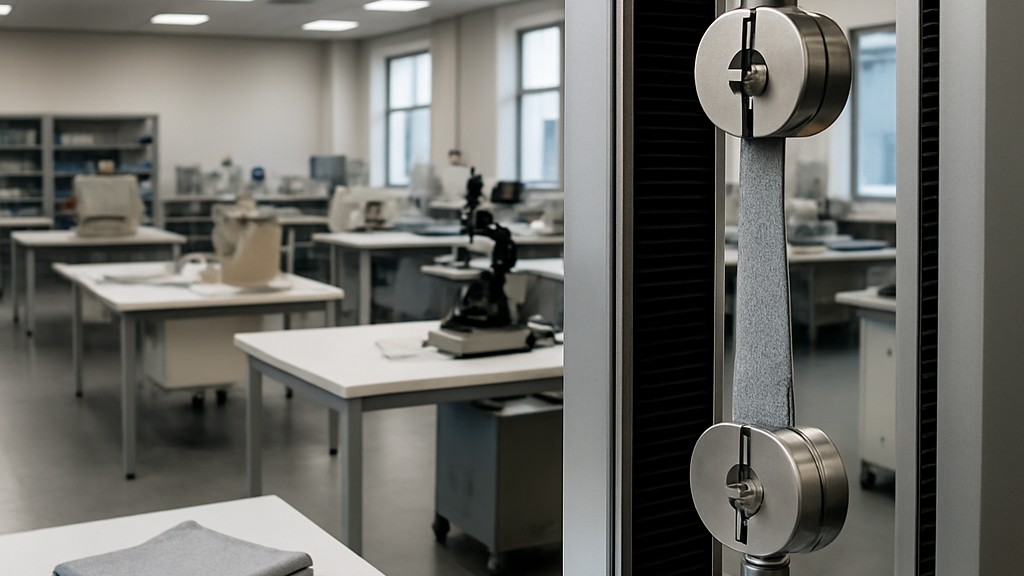
Fabric elasticity and fabric growth procedures can be used together or separately. While this test method can be used for knitted fabrics, fabrics designed for support or other applications are better evaluated using ASTM D3107, ASTM D4964, ASTM D6614 and other similar test methods.
Fabric stretch and fabric growth are useful in selecting fabrics that need to stretch and also return to their original shape. Fabric stretch in clothing can be caused by a variety of factors. Momentary stress occurs when a fabric, such as athletic wear and other loose-fitting garments (also known as comfort stretch garments), must conform to movement or is subjected to external stresses such as pinching and pulling. Additionally, casual clothing can be subjected to long-term stress, such as stretching to accommodate positions such as sitting. Another example of long-term stress occurs when a fabric must stretch to conform to the body shape, such as swimsuits, form-fitting trousers, and other form-fitting garments (also known as semi-supportive garments).
Fabric growth can also occur in response to various stresses. This method assesses fabric growth due to exposure to long-term stresses. In close-fitting garments, fabric growth can be observed when the garment is worn for extended periods or subjected to prolonged stress, such as sitting. When the garment is removed or subjected to stress, the growth can be observed and assessed.
This test method is not recommended for acceptance testing of commercial shipments because interlaboratory precision is known to be poor.
If there are practically significant differences between the test results reported for two (or more) laboratories, comparative tests should be conducted with the assistance of a qualified statistician to determine whether a statistical deviation exists. At a minimum, ensure that the test samples to be used are as homogeneous as possible, are taken from the same material from which the different test results were obtained, and that an equal number are randomly assigned to each laboratory for testing. Test results from the two laboratories should be compared using a statistical test for unpaired data, using a probability level chosen before the test series. If a deviation is detected, the cause should be identified and corrected, or future test results for the material in question should be adjusted to account for the known deviation.
ASTM D2594/D2594M specifically targets knitted fabrics that exhibit low-force stretch properties. These fabrics elongate under low to moderate force but prioritize recovery over high elasticity. This standard includes:
This method is not intended for high-stretch fabrics (e.g., fabrics containing significant amounts of spandex) subject to other standards, such as ASTM D3107 for woven fabrics or ASTM D4964 for general elasticity. It is applicable to apparel fabrics where stretch aids provide a snug fit but excessive stretch can lead to bagging or sagging over time.
The purpose is twofold: to aid in material selection during design and to verify quality control in production. For example, a sportswear brand might use the results of ASTM D2594/D2594M to ensure a jersey has sufficient stretch for athletic movements but also fully recovers after washing to prevent deterioration.
Fabric stretch and recovery are vital to the end-user experience. While stretch allows garments to conform to body movements, improving comfort and mobility, inadequate recovery can lead to ill-fitting garments that lose their shape after wearing or washing. As industry analysis indicates, these characteristics influence everything from consumer reviews to retail return rates.
In a comparative study of woven and knitted fabrics, this standard revealed that knitted fabrics offer superior initial elasticity (typically up to 20-30 percent elongation under a 4-pound load) compared to woven fabrics, but can exhibit higher elongation if not designed correctly. This insight is invaluable for sustainable fashion, where durable, low-maintenance fabrics reduce waste. Accredited testing laboratories worldwide routinely apply ASTM D2594/D2594M to confirm compliance with apparel specifications.
Essentially, this testing method includes the following steps:
At least five samples are tested in each direction, and the results are averaged. The method emphasizes low force application to mimic real-world use to avoid damage to delicate weaves.
Testing under ASTM D2594/D2594M shows that low-strength knits offer 10-25 percent stretch with less than 5 percent growth, making them ideal for everyday wear. An evaluation of cotton-spandex blends showed improvements in post-finishing processes such as heat setting. These criteria guide yarn selection (e.g., choosing ring-spun yarns for better uniformity) and inform care labels.
In addition to clothing, this standard also applies to upholstery and medical textiles, where slight stretch prevents pressure points.
As a result, the ASTM D2594/D2594M standard stands out as a fundamental element in evaluating low-strength knitted fabrics, closing the gap between innovative design and practical performance. By standardizing stretch and growth measurements, it enables the textile industry to offer garments that stretch and literally conform to the body. As consumer demand for comfortable and durable clothing grows, compliance with these standards is crucial.
Our organization, which has been serving businesses for many years and meticulously following global developments in science and technology, conducts testing, measurement, and analysis in a wide range of areas with a skilled team and extensive infrastructure for businesses in every sector. In this context, we also provide testing services in accordance with the "ASTM D2594/D2594M Standard Test Method for the Elasticity Properties of Low-Strength Knitted Fabrics" standard.
To get an appointment, to get more detailed information or to request an evaluation, you can ask us to fill in our form and reach you.

