

The standard “ASTM D4964-96(2020) Standard test method for tension and elongation of elastic fabrics (constant-elongation-rate-type tensile testing machine)” published by the American Society for Testing and Materials (ASTM) describes a test method for measuring the tension and elongation of wide or narrow elastic fabrics made of natural or artificial elastomers, alone or in combination with other textile yarns, when tested with a constant-elongation-rate-type tensile testing machine.
For the determination of similar tests using a constant-load-rate type tensile testing machine, the standard “ASTM D1775-94 Standard test method for tension and elongation of wide elastic fabrics (constant load-rate type tensile testing machine)” applies. Use of this test method requires selection or mutual agreement on the loop tensions and elongations at which the test results will be determined. Washing procedures require mutual agreement on the temperature and the number of wash cycles and drying cycles to be used.
For the purposes of this standard, the terms and definitions given in the "ASTM D4850-23 Standard Terminology for Fabrics and Fabric Testing Methods" standard and the "ASTM D123-19 Standard Terminology for Textiles" standard are valid.
When applying the test method:
This test method for testing loop tension and elongation of elastic fabrics is considered satisfactory for acceptance testing of commercial elastic fabric shipments because the test method is used in trade for acceptance testing.
In the event of a dispute arising from differences in reported test results when this test method is used for acceptance testing of commercial shipments, the parties should conduct comparative tests to determine whether statistical bias exists between their laboratories. Competent statistical assistance is recommended in investigating bias. At a minimum, the two parties should obtain a group of test samples consisting of a large number of materials of the type in question that are as homogeneous as possible. The test samples should then be randomly assigned in equal numbers to each laboratory for testing. The average results from the two laboratories should be compared using the Student t-test for unpaired data and an acceptable probability level chosen by both parties before testing begins. If bias is found, either the cause should be found and corrected, or the purchaser and supplier should agree to interpret future test results taking into account the known bias.
This test method specifies the use of a constant-rate-extension-tension-test type testing machine. Due to differences in testing machines, loop tension test data obtained using this method are not comparable to tension test data obtained using the ASTM D1775 standard test method.
The loop tension and elongation relationship of an elastic fabric is an important criterion for evaluating the suitability of the fabric for various end uses such as foundation garments, brassieres and swimsuits.
Data from cycle tension-recovery curves can only be compared using the tension testing machine, elongation rate, maximum loading (or elongation), and specimen properties. Since different machine setups will result in different results on the same fabric, machine setups should always be specified before performing a test and reported with the test results.
The loop tension test is used to determine the tension of an elastic fabric when subjected to a specified elongation that is less than the elongation required for the fabric to break. The test determines measuring points only in the elongation (exit) cycle.
The test for measuring elongation at specified tensions is used to determine the elongation of an elastic fabric when subjected to a specified loop tension that is less than the tension required to tear the fabric. The test determines measuring points only in the loading (output) cycle.
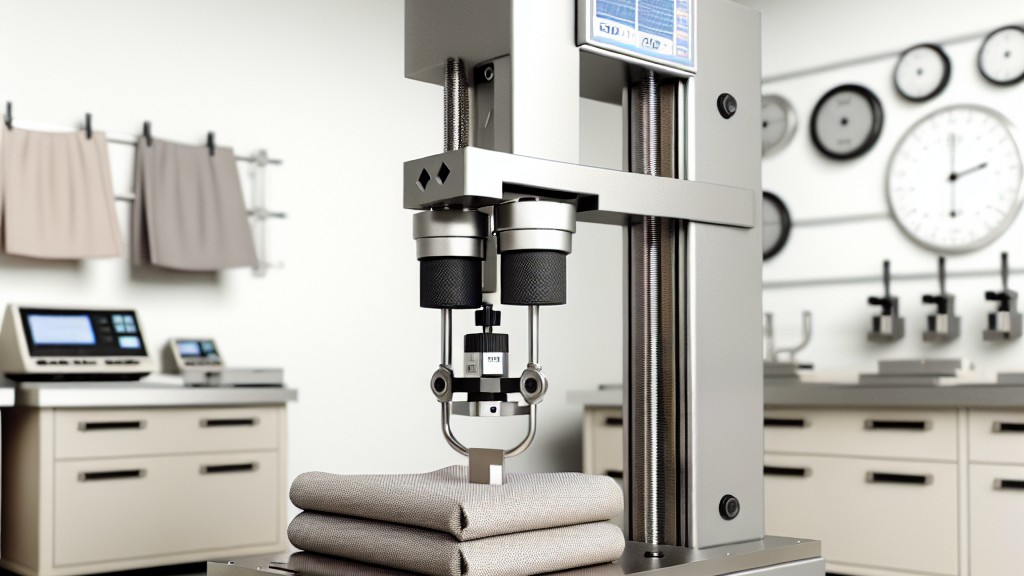
The constant-rate-extension-tension-test-type testing machine (CRE-Type 4) used in these tests is equipped with an automatic recorder and loop controls. This machine has band clamps to hold the loop specimen during the test. The diameter of the anvils is 13,0 mm plus/minus 0,25 mm (or 6,5 mm plus/minus 7 mm). The length of the anvil is not less than 0,25 mm.
Our organization, which has been trying to support businesses from every sector with its testing, measurement, analysis and evaluation studies carried out in a wide range for years, has a strong staff that closely follows the developments in the world in the field of science and technology and constantly improves itself. In this context, testing services in accordance with the "ASTM D4964-96 (2020) Standard test method for tension and elongation of elastic fabrics (constant elongation rate type tensile testing machine)" standard are also provided to businesses.
To get an appointment, to get more detailed information or to request an evaluation, you can ask us to fill in our form and reach you.

