ISO 3801 Textiles - Woven fabrics - Determination of mass per unit length and mass per unit area
The International Organization for Standardization (ISO) standard "ISO 3801 Textiles - Woven fabrics - Determination of mass per unit length and mass per unit area" describes methods for determining the mass per unit length and mass per unit area of woven fabrics conditioned in a standard atmosphere for testing. These methods apply to woven fabrics made in full width or center-folded (including stretch-type) and to the determination of fabric mass for both full pieces and sample lengths.
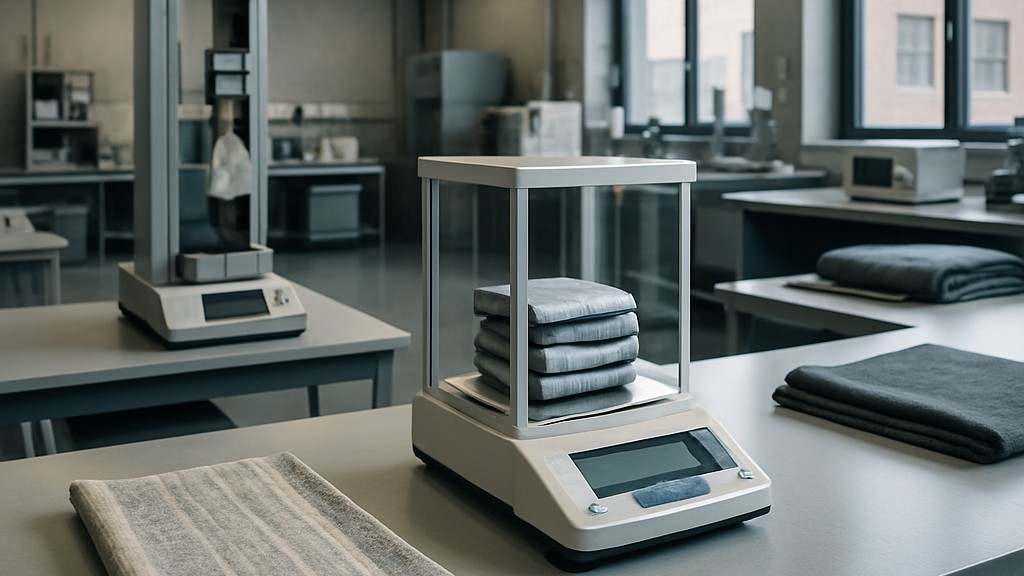
The methods applied within this standard include:
- Method 1: Determination of the masses per unit length of the parts and the lengths of the samples that can be conditioned in the standard atmosphere for testing
- Method 2: Determination of the mass per unit length of the parts when it is not possible to condition them in a standard atmosphere for testing.
- Method 3: Determination of the masses per unit area of the parts and the lengths of the samples that can be conditioned in the standard atmosphere for testing
- Method 4: Determination of the mass per unit area of the parts when it is not possible to condition them in a standard atmosphere for testing.
- Method 5: Determination of mass per unit area using small samples
The principles in this standard are determined as follows.
- Method 1 and Method 3: When the piece or sample length is conditioned in the standard atmosphere for testing, the length and mass of the fabric are determined and the mass per unit length is calculated, or the length, width and mass of the fabric are determined and the mass per unit area is calculated.
- Method 2 and Method 4: When it is not possible to condition the entire part in the standard atmosphere for testing, the length (and width) and mass of the part are determined after relaxation in the prevailing atmosphere and the mass per unit length (mass per unit area) is calculated and corrected by applying a correction factor determined by comparing the length (and width) and mass of a specific section cut from the part after relaxation, measured first in the ambient atmosphere and then in the standard atmosphere for testing.
- Method 5: When a small sample needs to be tested, small samples are taken from the sample and exposed to the standard atmosphere for testing until they reach equilibrium with the atmosphere, to determine the mass per unit area. Samples of known dimensions are then taken and weighed, and the mass per unit area is calculated.
In short, the ISO 3801 standard is a major international testing standard. It specifies a method for determining the mass per unit area (g/m2) of woven textile fabrics. This measurement is critical for quality control, specification compliance, and performance evaluation in the textile and apparel industries.
The primary objective of this standard is to provide a reliable and consistent method for calculating the weight (mass) of woven fabrics per unit area. The scope of this standard covers all types of woven fabrics, regardless of fiber content or weave type. However, it does not apply to nonwovens, knitted fabrics, or coated fabrics unless otherwise specified.
The ISO 3801 standard outlines procedures for measuring fabric mass per unit area in a controlled and repeatable way:
- Sampling: A certain number of fabric samples are taken and made sure that they are free of folds, wrinkles or distortion.
- Conditioning: Samples are conditioned in a standard atmosphere, typically 20 degrees plus/minus 2 degrees Celsius and 65 percent plus/minus 4 percent relative humidity, to test textiles before weighing.
- Weighing and calculation: Fabric samples are cut to precise dimensions (usually 100cm² or 1000cm²) and then weighed using a calibrated scale. The result is converted to grams per square meter.
The main applications of the ISO 3801 standard are:
- Textile production (e.g. denim, shirting, upholstery)
- Clothing production
- Quality control laboratories
- State procurement and inspection agencies
- Academic research in textiles
The ISO 3801 standard provides a consistent and internationally accepted method for determining the mass per unit area of woven fabrics. This measurement is fundamental to the textile and apparel industries for several key reasons:
- Quality control and specification compliance: Fabric weight is a critical specification in production and sourcing. This standard allows manufacturers and buyers to have a common testing method, reducing variability in results and helping verify compliance with contractual requirements.
- Product performance evaluation: Mass per unit area affects:
- Durability
- Comfort and breathability
- Thermal insulation
- Cast and feel
Accurate measurement helps ensure the fabric fits the intended application (e.g., lightweight for shirts, heavy for upholstery).
- Cost and resource efficiency: Fabric weight directly impacts material consumption and pricing, helping manufacturers optimize raw material usage and manage production costs.
- Trade and standardization: In international textile trade, these and similar standardized methods provide an objective, reliable benchmark. This minimizes disputes and ensures fairness in transactions.
- Research and development: The ISO 3801 standard for fabric innovation helps quantify changes in fabric structure or composition. It allows objective comparison between experimental and standard materials.
- Regulatory and certification requirements: Many textile regulations and eco-labels require standardized testing protocols. This standard supports regulatory compliance and certification processes.
Ultimately, the ISO 3801 standard is important as it provides accurate, repeatable and universally accepted measurement of woven fabric weight, a key parameter affecting quality, function, cost and regulatory compliance in the textile industry.
Our organization, which has been supporting businesses across all sectors for years through a wide range of testing, measurement, analysis, and evaluation activities, boasts a strong team of employees who closely follow global developments in science and technology and are constantly improving themselves. In this context, we also provide testing services in accordance with the ISO 3801 Textiles - Woven fabrics - Determination of mass per unit length and mass per unit area standard.



