

DIN 53855-1 Textile Tests - Determination of Thickness of Textile Fabrics (Excluding Floor Coverings) - Apparent Density Above 0,05 g/ cm³
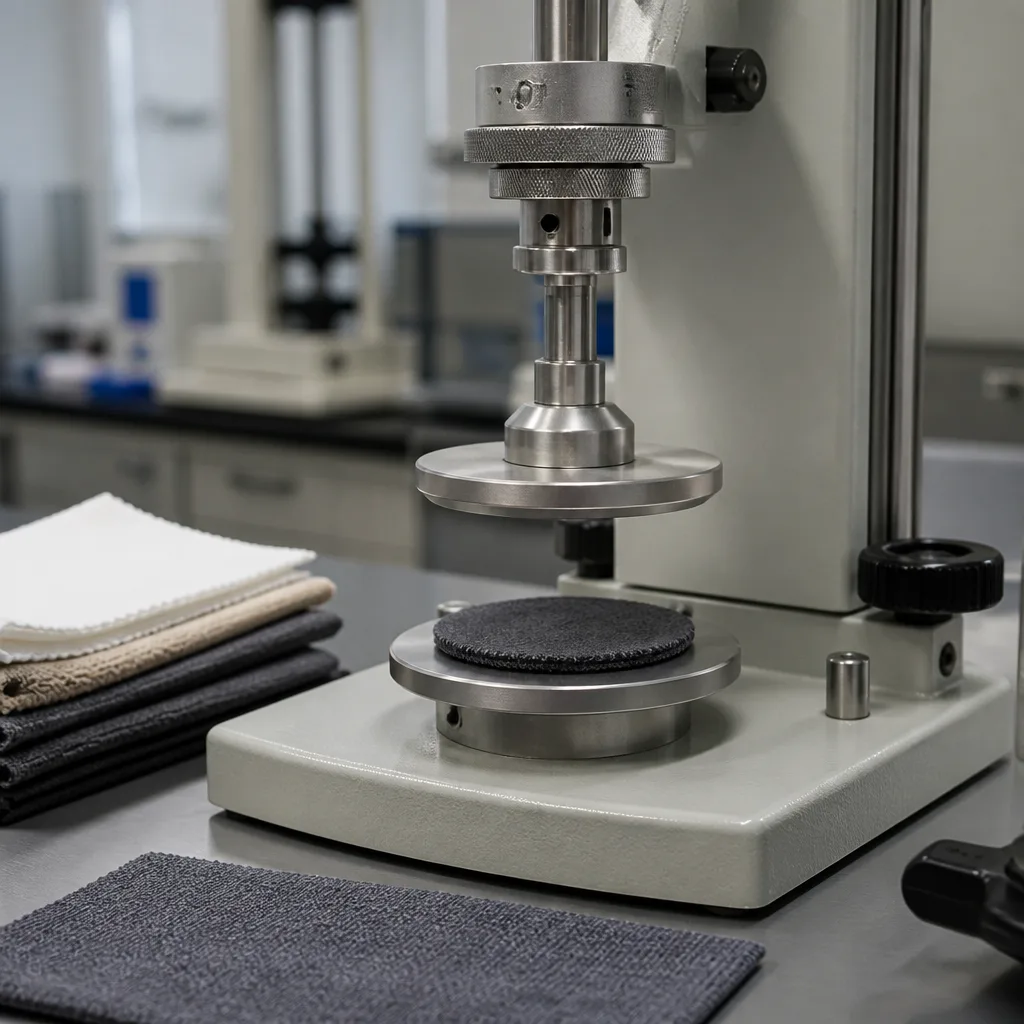
The standard “DIN 53855-1 Textile tests - Determination of the thickness of textile fabrics (excluding floor coverings) - Apparent density above 0,05 g/cm³”, published by the German Institute for Standardization (DIN) , describes a test method for measuring the thickness of most textile fabrics and similar flat textile structures. This standard is particularly applicable to materials with an apparent density (voluminous density) greater than 0,05 g/cm³ and explicitly excludes floor coverings (for floor coverings, the DIN 53855-3 standard applies).
This method determines thickness under a defined low pressure using a specialized measuring device, aiming to provide consistent and comparable results for quality control, material specification, and product development in the textile industry. It is particularly important for woven, knitted, and nonwoven fabrics, technical textiles, felts, and similar materials.
This standard has been superseded, and modern testing methods generally follow EN ISO 5084 or related ISO standards (e.g., ISO 9073-2 for nonwoven fabrics) that are closely consistent with the principles of the original DIN method.
The DIN 53855-1 standard defines compression-based thickness measurement using a special device:
The device is typically mounted on a recessed, stable table that allows the sample to lie completely flat without edge effects. Measurements are usually taken on multiple samples (e.g., three) at different locations to account for variability, and the average thickness is calculated.
This design ensures repeatable results under standardized low-pressure conditions while minimizing deformation of soft or compressible textiles.
The DIN 53855-1 standard and its successors are commonly referenced for the following materials:
Since the method remains a reference point for thickness determination at low pressure, many product specifications still include the phrase "Thickness according to DIN 53855-1 standard".
The DIN 53855-1 standard is commonly used with the following:
Other thickness measurement methods are also available for high-pressure or specialized applications (e.g., using dome anvil micrometers).
In short, the DIN 53855-1 standard outlines a method for determining the dimensional change (shrinkage or expansion) of textile fabrics when subjected to defined conditions such as washing, drying, or finishing processes. This standard is part of the broader DIN 53855 series of standards, which focuses on dimensional stability testing of textile materials.
The DIN 53855-1 standard defines the following:
The primary objective of this standard is to ensure that textile materials maintain their intended size and shape during use and maintenance.
The testing method generally follows these steps.
The basic test conditions are as follows:
This standard is widely used in the following areas:
The DIN 53855-1 standard was designed because without a standardized way of measuring dimensional stability, one of the most critical performance characteristics of textiles, the results would be inconsistent, unreliable, and often misleading. This standard is considered important for the following reasons:
In conclusion, the DIN 53855-1 standard provides a reliable and standardized framework for evaluating how textiles behave under real-life care conditions. By accurately measuring dimensional changes, it helps ensure product quality, durability, and consumer satisfaction across the textile industry.
For many years, our organization, with its competent and experienced staff, has been understanding the needs of its clients, providing the advanced testing services they require, and assisting them in the establishment, implementation, and improvement of management systems. Within this framework, we also provide testing services in accordance with the DIN 53855-1 standard.
To get an appointment, to get more detailed information or to request an evaluation, you can ask us to fill in our form and reach you.

