DIN 53808-1 Textile Tests - Determination of Length of Spun Fibers - Single Fiber Measurement Method
The standard “DIN 53808-1 Textile tests - Determination of the length of spun fibers - Single fiber measurement method”, published by the German Institute for Standardization (DIN), describes a direct, manual method for determining the length of individual fibers (yarn fibers, e.g., cotton, wool, polyester, viscose, or other short fibers used in yarn spinning). This method involves the physical measurement of individual fibers under controlled conditions, usually using precision instruments such as rulers, projectors, or specialized fiber measuring equipment.
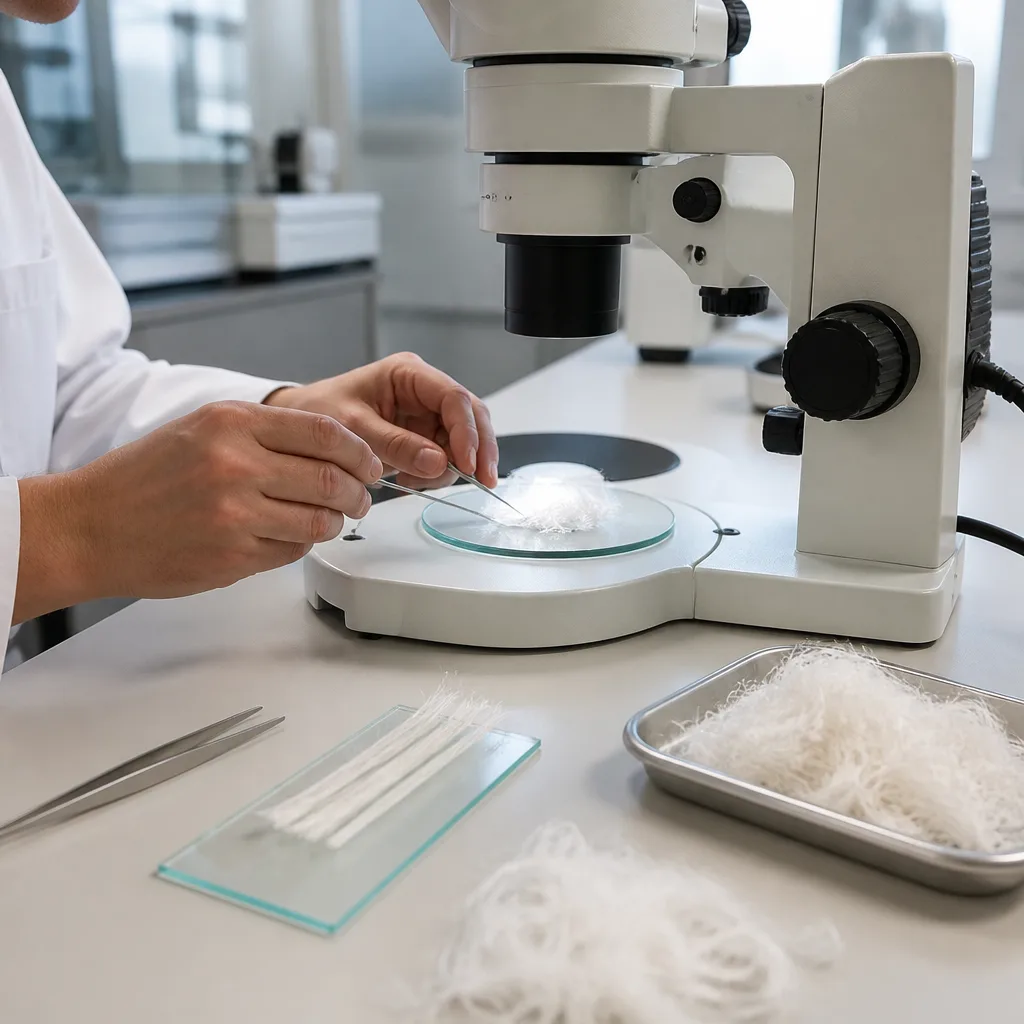
This method is widely used in textile laboratories, research, and quality control to obtain accurate fiber length distribution data. The basic parameters obtained typically include:
- Average fiber length
- Length distribution (e.g., percentage of fibers in specific length classes)
- Short fiber content
- Criteria for uniformity or variability
Fiber length is a critical quality parameter as it directly affects yarn spinning ability, yarn strength, uniformity, and the final properties of fabrics or nonwovens.
The measurement process generally follows these steps:
- Sample preparation: Careful selection and conditioning of fibers (e.g., from raw materials, strips, or yarns) to prevent damage or distortion.
- Individual fiber extraction: The fibers are gently separated and aligned, and a controlled mechanical action is applied (such as pulling, stretching, or deformation).
- Measurement: The straight-line length of each fiber (usually under slight tension or extended forward) is measured. For statistical reliability, a minimum number of fibers (typically 300 or more in relevant laboratory practices) is measured. The elongation, strength, and deformation behavior of the fibers are measured and recorded.
- Data evaluation: Statistical values such as mean length, coefficient of variation, and length distribution histograms are calculated. The obtained data are analyzed according to standard criteria.
This is generally considered a reference (direct) method used to calibrate or validate faster automated systems, such as image analysis tools.
The main applications of this method are as follows:
- Raw material quality control for yarn and fiber manufacturers.
- Research and development of new fibers or blends.
- Addressing processing problems (e.g., high short fiber content causing yarn breakage)
- Compliance testing in textile supply chains.
Advanced laboratories use this method in combination with other methods (for example, for microdust analysis or linear density).
Relevant standards include the following:
- DIN 53808 standard series: May include additional sections (e.g., terminology or other measurement principles in older versions).
- ISO 6989 standard: A similar international method for determining fiber length by measuring individual fibers.
- Other fiber lengthening methods include: automated, comb separator methods, or optical systems.
The following standards are supplementary to this standard:
- DIN EN ISO 1973 (linear density)
- DIN 53811 (fiber diameter)
- ISO 1833 series (quantitative chemical analysis of mixtures)
In short, the DIN 53808-1 standard is designed to evaluate specific physical and performance characteristics of textile materials. This standard plays a significant role, particularly in the durability, performance, and quality control processes of textile products.
The main purpose of the DIN 53808-1 standard is as follows:
- To determine the mechanical behavior of textile materials.
- To evaluate the performance of the products during use.
- Ensuring quality control in production processes.
- Obtaining comparable results among different manufacturers.
This ensures reliable data for both producers and users.
The DIN 53808-1 standard is generally applied to the following textile products:
- Woven fabrics
- knitted fabrics
- Technical textiles
- Industrial textile products
This standard analyzes how these materials behave under specific test conditions.
The DIN 53808-1 standard is widely used in the following sectors:
- Textile production (fabric quality control)
- Automotive industry (seat fabrics, upholstery)
- Furniture industry (covering fabrics)
- Technical textiles (industrial applications)
The necessity of the DIN 53808-1 standard stems from the need to objectively measure and guarantee the performance of textile materials under defined and repeatable conditions. Without such a standard, the assessment of textile quality would be inconsistent and unreliable. This standard is considered important for the following reasons:
- Ensures consistent quality: Textile products can vary significantly due to raw materials, weaving/knitting methods, and finishing processes. This standard ensures:
- A single type of test method
- Reproducible and comparable results.
This enables manufacturers to maintain consistent product quality across batches.
- It ensures fair comparison between products: Without a standard, comparing two fabrics relies on subjective judgment. This standard...
- It establishes common test conditions.
- It allows for direct comparison between suppliers and products.
This is crucial for sourcing and material selection.
- It supports product development: Engineers and designers rely on measurable data when developing textiles. This standard helps to:
- Optimizing strength, flexibility and durability.
- Evaluating how design changes affect performance.
- Reducing trial and error in R&D.
- It enhances safety and reliability: In industries such as automotive or technical textiles, material failure can have serious consequences. This standard helps to:
- Identifying weak or unsuitable materials.
- To enable textile products to perform under real-world stresses.
- Reducing the risk of premature failure.
- It provides a basis for quality control: During production, manufacturers need to verify that products conform to specifications. This standard,
- It serves as a criterion for acceptance/rejection.
- It helps detect manufacturing defects early.
- It reduces waste and encourages reprocessing.
In conclusion, the DIN 53808-1 standard is an important testing standard that evaluates the performance of textile products using objective and repeatable methods. It guarantees quality for manufacturers and contributes to the market delivery of reliable and durable products for consumers.
For many years, our organization, with its competent and experienced staff, has been understanding the needs of its clients, providing the advanced testing services they require, and assisting them in the establishment, implementation, and improvement of management systems. Within this framework, we also provide testing services in accordance with the DIN 53808-1 standard.



