

The standard “DIN 53354 Tests of artificial leather - Tensile test”, published by the German Institute for Standardization (DIN), describes a specific method for determining the tensile strength and elongation properties of artificial leather, including coated textiles, synthetic leather materials, and similar flexible sheet materials such as PVC-coated fabrics or PU-coated substrates.
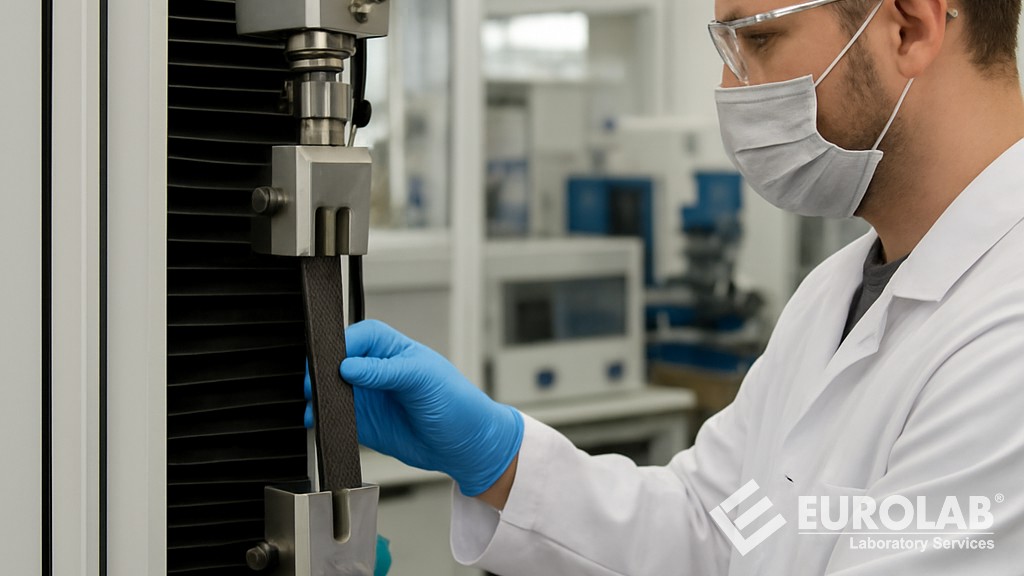
The purpose of this standard is to define a uniaxial tensile test to measure how much force a sample of material can withstand before fracturing (tensile strength, typically reported in N/5 cm or similar units) and how much it elongates (elongation at fracture).
In principle, a strip-shaped sample is fixed to a tensile testing machine and pulled at a constant speed until it breaks. This test evaluates both warp and weft directions for anisotropic materials such as coated fabrics.
This method is widely used for quality control and material specification in the following industries:
Generally, tensile strengths range from 2000-8000 N/5 cm depending on fabric weight and type (e.g., 3000/3000 N/5 cm for 750 g/m2 materials).
This standard has been repealed and replaced by the compatible standard “DIN EN ISO 1421 Rubber or plastic coated fabrics - Determination of tensile strength and elongation at break”. This new standard has a wider range of application for coated fabrics and is compatible with global ISO methods.
However, many companies and testing laboratories still use or reference the DIN 53354 standard in older specifications, product brochures, or test reports, especially for older products or markets where it was required in the past. Accredited laboratories offer testing services according to this standard when customers request the original method.
Although the DIN 53354 standard has been repealed, it is frequently included in technical data sheets for PVC-coated polyester fabrics, banner materials, and membrane structures. Videos and demos often demonstrate the practical application of testing on modern coated fabrics, typically using the DIN 53354 procedure to verify warp/weft tensile strength and elongation.
In short, the DIN 53354 standard is widely used in industries where synthetic leather is used, including automotive interiors, furniture upholstery, footwear, bags, and technical textiles.
The primary purpose of the DIN 53354 standard is to evaluate the mechanical strength and elasticity of artificial leather materials. Tensile testing helps manufacturers ensure that the material can withstand tensile forces during production and actual use. The main reasons for conducting this test are as follows:
The DIN 53354 standard is based on the uniaxial tensile loading method. A standardized strip-shaped sample of artificial leather is fixed to a tensile testing machine and pulled at a constant speed until it breaks. During the test, the machine records the following:
These measurements are used to calculate the tensile properties of the material.
The main equipment used in these tests is as follows:
The testing machine must be able to apply the force evenly and record the force-elongation curve during the test.
Samples are typically cut from artificial leather sheets into rectangular strips. Key sample characteristics include:
Testing in different directions helps to evaluate anisotropy in coated fabrics or layered materials.
The DIN 53354 tensile test method generally follows these steps:
The DIN 53354 standard method typically reports the following parameters:
These values define the strength and flexibility of artificial leather materials.
The DIN 53354 standard test method is important for evaluating artificial leather used in the following areas:
Manufacturers use the results to ensure that materials meet durability and safety requirements.
The DIN 53354 tensile test standard helps manufacturers in the following areas:
Since synthetic leather typically consists of a textile backing and a polymer coating (such as PVC or PU), tensile testing provides valuable information about the combined mechanical behavior of the composite structure.
For many years, our organization, with its competent and experienced staff, has been understanding the needs of its clients, providing the advanced testing services they require, and assisting them in the establishment, implementation, and improvement of management systems. Within this framework, we also provide testing services in accordance with the DIN 53354 standard.
To get an appointment, to get more detailed information or to request an evaluation, you can ask us to fill in our form and reach you.

