

The method described in this standard is based on the following principles:
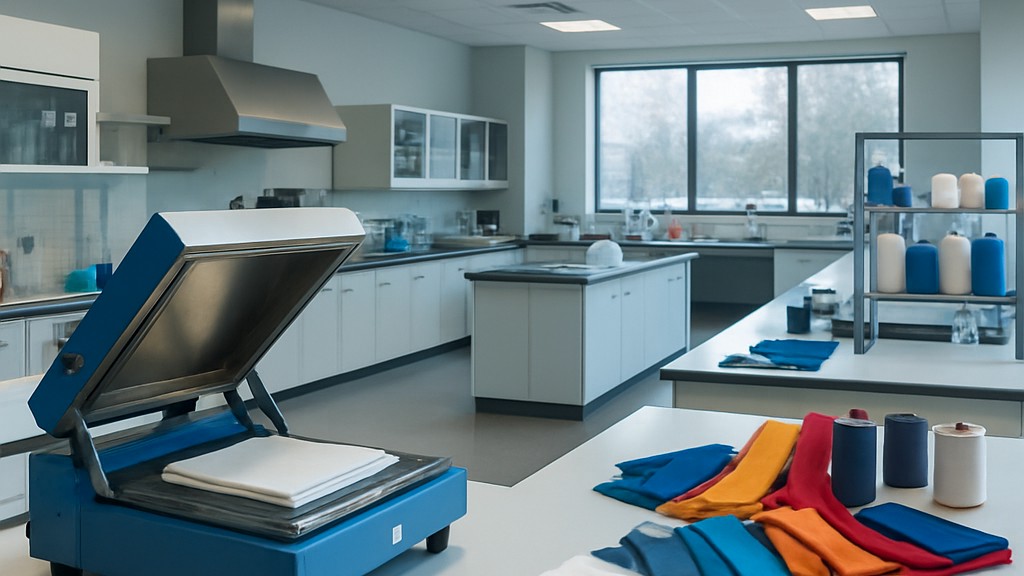
The heating device used in these tests consists of a pair of smooth, parallel plates, equipped with a precisely controlled electric heating system, and applies a pressure of 4 plus/minus 1 kPa to the sample. Heat should be transferred to the sample only from the top; if the bottom plate is equipped with a heating system that cannot be closed, the heat-resistant plate to which the device is attached serves as a heat shield.
The smooth heat-resistant board should be 3 mm to 6 mm thick.
Wool flannel has a mass per unit area of approximately 260 g/m². Two layers of this material are used to make a pad approximately 3 mm thick. Similar smooth wool fabrics or felt can be used to make a pad approximately 3 mm thick.
In addition, undyed, unbleached and unmercerized cotton fabric with a mass per unit area of 100 to 130 g/m2 and a smooth surface and a cotton adjacent fabric measuring 10 cm x 4 cm are used in the tests.
If the textile to be tested is fabric, a 10 cm x 4 cm sample is used. If the textile to be tested is yarn, it is fabricated and a 10 cm x 4 cm piece is used, or a thin, 10 cm x 4 cm piece of inert material is tightly wrapped around it to form a layer just as thick as the yarn. If the textile to be tested is loose fiber, it is carded to a 10 cm x 4 cm layer, compressed, and the sheet is sewn to an adjacent piece of cotton fabric to support the fibers.
The following temperatures are used when performing the test: 110°C plus/minus 2°C, 150°C plus/minus 2°C, or 200°C plus/minus 2°C. Other temperatures may be used if required, provided they are specifically stated in the test report.
Material samples that have been subjected to any heating or drying process should be conditioned in the standard temperate atmosphere for testing textiles, i.e., 65 percent plus/minus 2 percent relative humidity and 20 degrees plus/minus 2 degrees Celsius, before testing.
The bottom plate of the heating device, whether heated or not, is covered with heat-resistant board, wool flannel and dry, undyed cotton cloth.
In dry pressing, the dry sample is placed on a cotton cloth covering the wool flannel padding. The top plate of the heating device is lowered, and the sample is held at the specified pressing temperature for 15 seconds.
In wet pressing, the dry sample is placed on top of the cotton cloth covering the wool flannel batting. A piece of cotton flannel, measuring 10 cm x 4 cm, is soaked in distilled water and squeezed or removed to contain its own mass. The wet sample is placed on top of the dry sample. The top plate of the heating device is lowered, and the sample is held at the specified pressing temperature for 15 seconds.
In wet pressing, the sample and a piece of cotton fabric measuring 10 cm x 4 cm are immersed in distilled water and squeezed or removed to contain their own mass. The wet sample is placed on a dry cotton cloth covering a wool flannel pad, and the wet fabric is placed on top of the sample. The top plate of the heating device is lowered, and the sample is held at the specified pressing temperature for 15 seconds.
The change in colour of the sample is immediately assessed with the appropriate grey scale and re-evaluated after allowing the sample to condition for 4 hours in the standard atmosphere used in textile testing.
Staining of cotton adjacent fabric is assessed using the appropriate gray scale. The more heavily stained side of the cotton adjacent fabric is used for assessment.
Our organization, which has been supporting businesses across all sectors for years through a wide range of testing, measurement, analysis, and evaluation activities, has a strong team of employees who closely follow global developments in science and technology and are constantly improving themselves. In this context, we also provide testing services in accordance with the EN ISO 105-X11 Textiles - Color fastness tests - Part XI1: Color fastness to hot pressing standard.
To get an appointment, to get more detailed information or to request an evaluation, you can ask us to fill in our form and reach you.

