

The ASTM D6241 standard, "Standard test method for determining the static puncture resistance of geotextiles and geotextile-related products using a 50 mm probe," developed by the American Society for Testing and Materials (ASTM), describes a test method used to measure the force required to puncture geotextiles and geotextile-related products. The relatively large size of the piston provides a multi-directional force on the geotextile. The described method measures the static puncture resistance of geotextiles and related products.
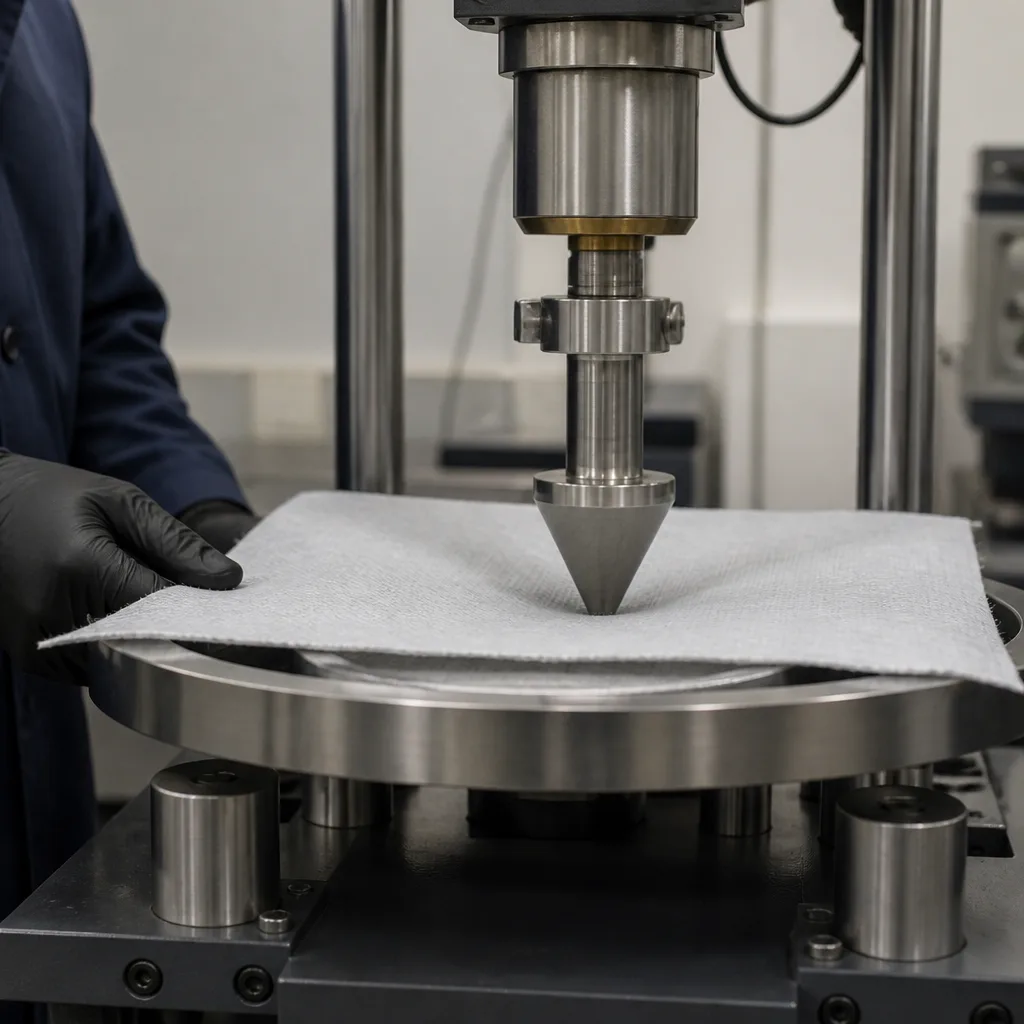
This geotextile puncture resistance determination test method is used by the industry as a puncture resistance index. The purpose of this test method is to establish an index value, providing a basis for standard criteria and uniform reporting. This test method is considered sufficient for acceptance testing of commercial geotextile shipments.
The ASTM D6241 standard is widely used in the geosynthetic industry to evaluate how well these materials resist puncture under static loads caused by sharp aggregates during installation or in civil engineering applications.
Geotextiles are permeable fabrics used in civil engineering for functions such as separation, filtration, drainage, reinforcement, and protection. Throughout their installation and service life, they may be exposed to sharp objects such as rocks, gravel, or construction debris. This standard serves as an index test, providing a standardized way to compare different geotextiles, but it does not directly replicate site-specific conditions. It assists manufacturers, engineers, and specifiers in:
The ASTM D6241 standard largely replaced the older ASTM D4833 standard (a needle puncture test using an 8 mm probe) because the larger probe in the standard was considered more representative for many applications.
During the test, a circular sample, in principle made of geotextile, is securely clamped between two plates with a hole in the center. A 50 mm diameter steel probe with a rounded tip is pushed vertically through the sample at a constant speed (typically 50 mm/min) using a universal testing machine. The maximum force required to penetrate the material is recorded as the penetration strength.
The device used in the tests has the following features:
In general, this testing method follows these steps:
The testing equipment typically used includes the following:
Common application areas for the ASTM D6241 standard include:
In these applications, geotextiles must be resistant to punctures caused by aggregate particles, construction equipment, and long-term service loads.
The relevant standards are as follows:
Compared to the smaller pin method, the 50 mm probe method has the following advantages:
In short, the ASTM D6241 standard evaluates the resistance of a material to puncture when subjected to a concentrated load from a 50 mm diameter probe. This standard is widely used in civil engineering, transportation infrastructure, environmental protection systems, and erosion control applications.
The primary purpose of the ASTM D6241 standard is to measure the force required to puncture a geotextile or geosynthetic product using a standardized probe. This test provides an index value that helps engineers compare materials and assess their suitability for applications where puncture resistance is critical.
Puncture resistance is particularly important when geotextiles are placed under aggregates, rockfill, geomembranes, or other materials that may apply concentrated loads that could damage the fabric.
The ASTM D6241 standard applies to:
This method measures the force required to pierce the sample using a 50 mm diameter cylindrical probe that generates multifaceted stresses simulating field loading conditions.
The advantages of the ASTM D6241 standard include:
In contrast, while the ASTM D6241 standard provides valuable information, it is considered an index test rather than a direct simulation of every field condition. Actual performance may also depend on:
This standard is also unsuitable for products that are too small to fit into the test setup and is generally not designed for testing separated layers of composite products.
For many years, our organization, with its competent and experienced team, has been understanding the needs of its clients, providing the advanced testing services they require, and assisting them in the establishment, implementation, and improvement of management systems. Within this framework, we also provide testing services in accordance with the ASTM D6241 standard.
To get an appointment, to get more detailed information or to request an evaluation, you can ask us to fill in our form and reach you.

